Article · Cybersecurity
Zero Trust Architecture Implementation Guide for Engineering Teams
By Caleb · October 27, 2026
Zero trust has a branding problem. It is simultaneously the most important security architecture of the decade and a phrase that has been attached to every product with a VPN replacement feature. Many teams have "started" zero trust three times without changing how access actually works.
The engineering definition is cleaner. Zero trust means no request is trusted because of where it came from. Every access decision is made explicitly, using identity, device posture, context, and policy, and it is made again on the next request. The reference model is NIST SP 800-207, and the work is architectural and operational, not a purchase.
This guide is a practical implementation path for engineering teams: what to build, in what order, and how to avoid the traps that stall programmes.
What zero trust is, and what it is not
Zero trust is not a product, a network segment, or a one-time migration. It is not "no trust" either. It is a shift from implicit trust based on network location to explicit, per-request verification.
It is also not simply replacing a VPN with a zero-trust network access tool. That is a useful step, but it addresses only one path. Workload-to-workload traffic, CI/CD pipelines, databases, and administrative access all need the same discipline.
The core assumption is breach: design as if an attacker is already inside your network, and make lateral movement expensive.
The tenets
NIST's model rests on a few principles worth internalising:
- No implicit trust from network location. Being inside the corporate network grants nothing by itself.
- Per-request authorization. Every request is evaluated against policy, not just the first login.
- Least privilege. Users, services, and devices get the minimum access needed, for the minimum time.
- Assume breach. Limit blast radius, segment systems, and monitor for misuse.
- Continuous verification. Signals such as device health, location, and behaviour can change the decision.
If a proposed control does not improve one of these, it is probably adjacent work wearing a zero-trust label.
The components you need
A complete architecture includes:
- A policy decision point (PDP). The engine that evaluates identity, device, and context against policy.
- Policy enforcement points (PEPs). The proxies, gateways, and agents that apply the decision.
- Identity provider and MFA. Strong authentication, ideally phishing-resistant.
- Device posture. Management and endpoint detection signals that prove a device is healthy.
- Application access layer. A zero-trust proxy or identity-aware gateway instead of flat network access.
- Workload identity. Cryptographic identities for services, such as SPIFFE/SPIRE, with mutual TLS.
- Microsegmentation. Deny-by-default policies between workloads, ideally identity-based rather than IP-based.
- Data controls. Classification, encryption, DLP, and least-privilege database roles.
- Analytics and logging. Centralised identity-aware logs, detection, and response.
You do not need all of these on day one. You do need a plan that connects them.
Example: default-deny with a Kubernetes NetworkPolicy
Segmentation starts by denying traffic that is not explicitly allowed. Apply a default-deny policy to a namespace, then add narrow allow rules for the services that must communicate.
apiVersion: networking.k8s.io/v1
kind: NetworkPolicy
metadata:
  name: default-deny-ingress
  namespace: payments
spec:
  podSelector: {}
  policyTypes:
    - Ingress
A default-deny policy is not zero trust by itself, but it turns every permitted path into an explicit decision. Pair it with workload identity, short-lived credentials, and logs that show who called what.
A phased implementation plan
Phase 0: inventory
You cannot protect what you cannot see. Inventory applications, data flows, identities, devices, and privileged access paths. Identify where sensitive data lives and which systems still rely on flat network trust. This phase is unglamorous and usually reveals that the organisation has far more shadow access than expected.
Phase 1: identity
Identity is the new perimeter, so start there.
- Consolidate on a single identity provider where possible.
- Enforce SSO for all applications.
- Roll out phishing-resistant MFA, such as FIDO2 security keys or passkeys, starting with administrators and engineers.
- Replace legacy authentication protocols that bypass MFA.
- Implement conditional access based on risk, group, and device state.
This phase delivers more risk reduction per unit of effort than almost anything else.
Phase 2: device trust
Access decisions should consider the device. Deploy mobile device management and endpoint detection where appropriate. Require disk encryption, patching, screen lock, and a supported OS version. Gate access to sensitive applications on a compliant device, and give users a clear remediation path when their device fails the check.
Beware of turning device posture into a helpdesk queue. If the check is too strict or the error messages are vague, people will work around it.
Phase 3: application access
Replace flat VPN access with an identity-aware proxy or zero-trust network access. Publish applications through connectors rather than exposing networks. Apply per-application policy, including group membership, device posture, and step-up authentication for sensitive actions.
Start with a small set of applications and a willing team. Measure access latency and support tickets. Retire the VPN path once the replacement is proven, not before.
Phase 4: workload identity
Machine identity is where many zero-trust programmes stall. Service-to-service traffic often still relies on static API keys and network location.
Move to short-lived credentials and cryptographic workload identities. Use mutual TLS or a service mesh for service-to-service authentication. In CI/CD, use OIDC federation to cloud providers instead of long-lived access keys. Store secrets in a managed vault, rotate them, and remove them from code and build logs.
This phase takes longer than expected because it touches deployment pipelines and developer habits. Budget for it.
Phase 5: microsegmentation
Segment by application and identity, not by subnet. Define deny-by-default policies for east-west traffic, then allow the specific flows each service needs. Application-aware policies scale better than IP-based rules and survive re-architecture.
Keep a documented break-glass path. Segmentation without an emergency procedure is a outage waiting for a bad night.
Phase 6: data protection
Classify data, encrypt it in transit and at rest, and restrict access at the data layer. Application-level authorization must enforce row and column permissions, not just table access. Add DLP controls for sensitive categories and tokenise or redact where full data is unnecessary.
Remember that a compromised application with broad database credentials defeats all the network controls above it.
Phase 7: continuous verification
The final phase is making the system adaptive. Feed risk signals into policy: impossible travel, unusual data volume, unmanaged device, anomalous API behaviour. Trigger step-up authentication, session limits, or automatic revocation.
This is where zero trust becomes operational rather than aspirational. It requires good logging, detection engineering, and a response process.
Engineering practices that matter
- Policy as code. Version policies, review changes, and test them in staging. Policy sprawl is the long-term failure mode.
- No static cloud keys. Use OIDC federation from CI/CD, workload identity, and short-lived tokens.
- Least-privilege IAM. Start read-only, grant narrowly, and review regularly. Remove unused permissions automatically where possible.
- Secrets management. Centralise secrets, rotate them, and audit access. Never put them in environment files committed to a repository.
- Identity-aware logging. Correlate user, device, workload, and request. Send to a SIEM with retention that matches your threat model.
- Developer experience. Provide self-service access requests, clear error messages, and fast approval paths. Friction is the enemy of adoption.
- Red teaming and tabletops. Test lateral movement assumptions and practice revocation. A control you have never exercised is a hypothesis.
Common pitfalls
- Big-bang replacement. Rip-and-replace programmes fail. Deliver in slices with measurable outcomes.
- Treating it as a network project. Zero trust is identity, policy, and application architecture. The network is only one enforcement point.
- Ignoring developer experience. If access is slow, teams will build bypasses.
- Policy sprawl. Hundreds of unowned rules become impossible to reason about. Assign owners and expire exceptions.
- No break-glass. You will need emergency access. Design it, monitor it, and test it.
- Partial logging. If you cannot see a denied request, you cannot tune the policy or detect an attack.
- Compliance theatre. A checklist is not an architecture. Map controls to real threats.
Metrics that show progress
Track outcomes, not activity:
- Percentage of applications behind the identity-aware proxy.
- Percentage of users with phishing-resistant MFA.
- Percentage of workloads using short-lived workload identity.
- Median time to revoke access after a termination or incident.
- Number of lateral movement paths between sensitive segments.
- Policy exceptions, their age, and their owners.
- Mean time to detect and respond to identity anomalies.
- Access request latency and support ticket volume.
If the last metric rises while the others improve, you are trading security for friction. Fix the experience before adoption collapses.
A 90-day starting plan
Days 1-30: Complete the inventory. Consolidate SSO. Enforce MFA for administrators. Identify the applications and data flows that matter most.
Days 31-60: Deploy device posture for the pilot group. Publish two or three applications through a zero-trust proxy. Start logging identity and access events centrally.
Days 61-90: Move one CI/CD pipeline to OIDC federation and short-lived credentials. Pilot microsegmentation for one sensitive service. Define the metrics you will report to leadership.
From there, extend by application and by workload, not by reorganisation. Each slice should reduce a specific risk and produce evidence you can show.
Bottom line
Zero trust is not a destination you announce. It is a set of architectural choices that make access explicit, least-privileged, and continuously verified. Identity comes first, then devices, applications, workloads, segmentation, data, and adaptive policy.
The organisations that succeed treat it as an engineering programme with measurable outcomes and a good developer experience. The ones that fail buy a product, replace a VPN, and declare victory while static credentials and flat networks remain in the basement.
Start with identity. Ship one application through a proxy. Move one pipeline off static keys. Then repeat, with evidence. That is how zero trust becomes real.
Visual field notes
The system at a glance
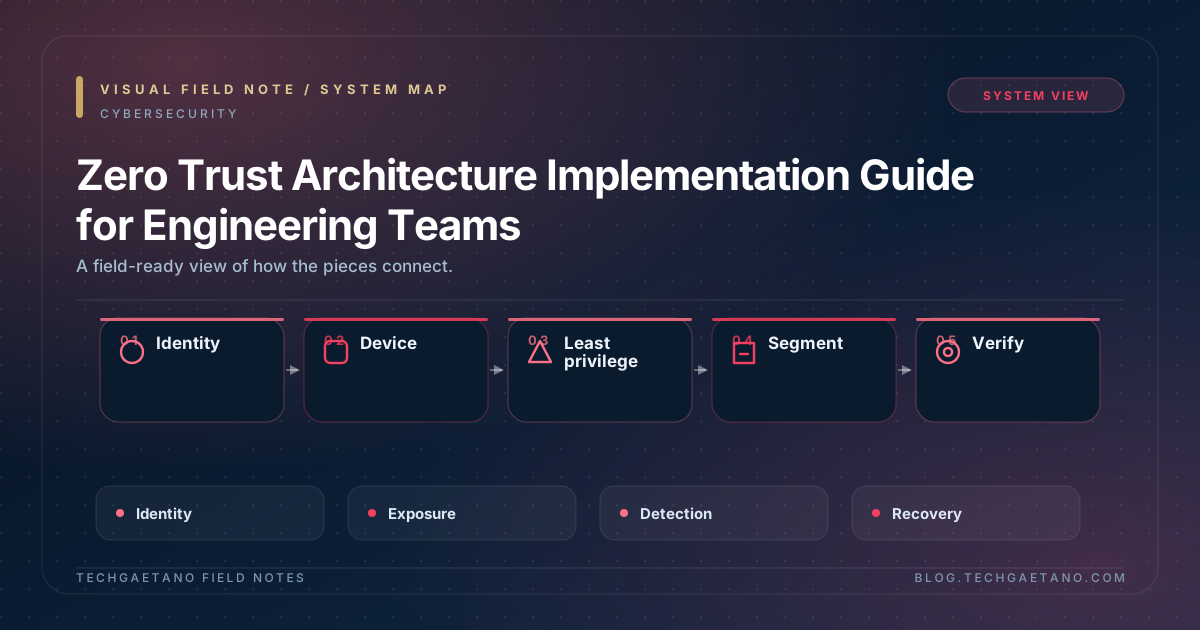
System map
How the moving parts connect, from first input to operating outcome.
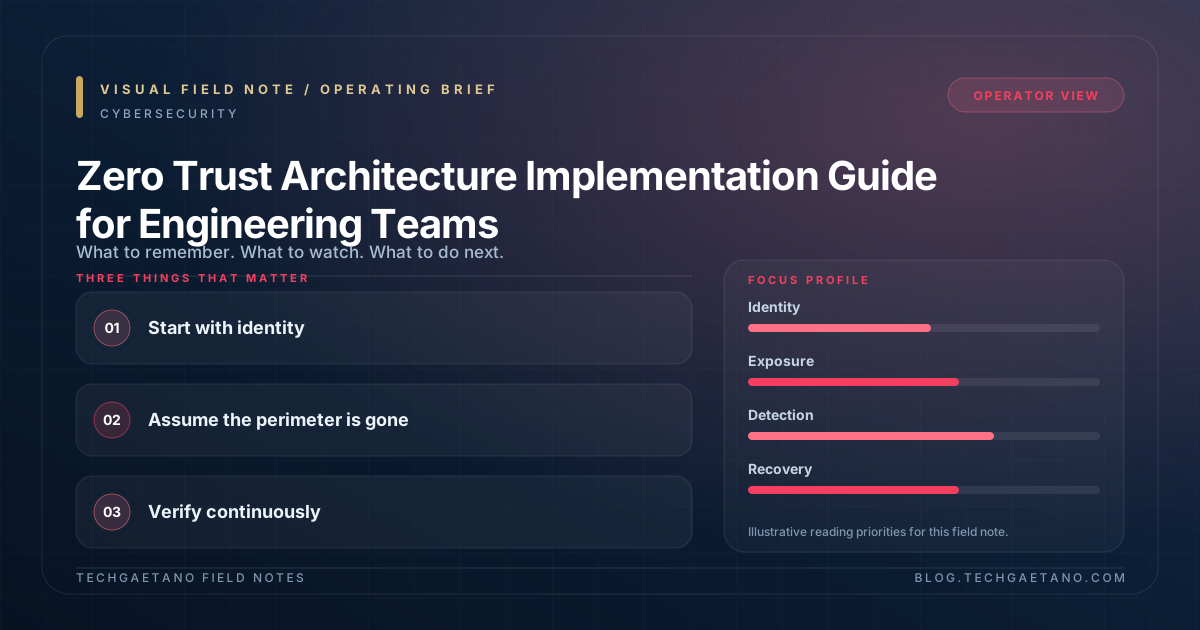
Operating brief
The three decisions that matter and the signals to watch.
Hardening a production environment?
TechGaetano helps teams design zero-trust controls, review identity and network boundaries, and turn security policy into engineering practice.
Talk to a security engineerFrequently asked questions
What is Zero Trust Architecture Implementation Guide for Engineering Teams?
Zero trust has a branding problem. It is simultaneously the most important security architecture of the decade and a phrase that has been attached to every product with a VPN replacement feature. Many teams have "started" zero trust three times without changin.
How should a team get started with Zero Trust Architecture Implementation Guide for Engineering Teams?
Start with asset and identity inventory, define the trust boundaries, and roll out controls in phases: identity, device posture, least-privilege access, segmentation, then continuous verification.
What should teams avoid when working on Zero Trust Architecture Implementation Guide for Engineering Teams?
The main risks are treating zero trust as a product purchase, leaving standing privileges in place, and assuming the model or the network perimeter is a security boundary.
Further reading
Related posts
Platform Engineering: The Business Case for an Internal Developer Platform
Every engineering organization pays a coordination tax. It shows up as onboarding that takes weeks, pipelines that differ from team to team, security…
Read more
Agentic AI and Identity Management: Securing AI Agents as Digital Identities
Autonomous AI agents are no longer a demo. They query databases, execute scripts, call APIs, open pull requests, and move data between systems without…
Read more