Article · Engineering
Agentic AI and Identity Management: Securing AI Agents as Digital Identities
By Caleb · November 2, 2026

Autonomous AI agents are no longer a demo. They query databases, execute scripts, call APIs, open pull requests, and move data between systems without a human in the loop for every step. That shift breaks an assumption underneath most identity and access management: that every principal is a person or a machine you provisioned on purpose.
An agent is neither. It is a long-lived, probabilistic actor that can be spawned in seconds, given a broad goal, and granted a token that outlives the session that created it. If you treat it like a service account, you get static credentials and no accountability. If you treat it like a user, you get MFA prompts nobody can answer and session semantics that do not fit.
The work ahead is giving agents a real identity: a credential, a scope, an owner, an audit trail, and a lifetime that matches the task rather than the calendar.
Why conventional IAM falls short
Traditional IAM was designed around two stable principal types. Users authenticate interactively and inherit group membership. Services authenticate with keys or certificates that a platform team rotates on a schedule. Both models assume the principal's behaviour is relatively predictable and that the blast radius of a stolen credential is bounded by what that principal was always allowed to do.
Agents violate all three assumptions.
- They are ephemeral and numerous. A single workflow can spawn hundreds of short-lived agents. Provisioning each one through a ticketing process does not scale, and doing nothing means they share one over-privileged identity.
- Their intent is not their permission. An agent told to "clean up stale records" will explore. Goal-driven behaviour produces access patterns that no static role anticipated.
- Their credentials leak through context. Agents hold tokens, tool schemas, database URLs, and retrieved documents in working memory. Prompt injection turns that memory into an exfiltration channel.
The failure mode is not theoretical. An agent with a broadly scoped API key and a helpful disposition will happily use it. Least privilege written for humans rarely survives contact with an agent that can call the permission-generating API itself.
What an agent identity actually is
Treat an agent as a first-class principal with five properties.
- A verifiable identity. Cryptographic, unique to the agent run, and resolvable to an owner. Not a shared key in an environment file.
- A delegated scope. The agent receives the intersection of what the user is allowed to do and what the task requires, expressed as concrete permissions rather than an inherited role.
- A short lifetime. Credentials expire with the task, not in thirty days. Re-authentication happens at boundaries, not on a timer.
- An audit trail. Every tool call is attributable to the agent, the run, the initiating user, and the policy that allowed it.
- A revocation path. Killing a run invalidates its credentials immediately, without rotating a shared secret that other workloads depend on.
This is the same shape as workload identity for services, with two additions: delegation from a human principal, and fine-grained scoping per tool call rather than per workload.
The control plane you need
Authentication
Give each agent run its own identity. Short-lived tokens issued by an identity provider, workload identity federation, or a dedicated agent identity broker. Avoid long-lived API keys entirely; they cannot be scoped to a run and they cannot be revoked without collateral damage.
For service-to-service calls inside your perimeter, use mutual TLS or a service mesh with SPIFFE-style identities. For calls to external model providers and SaaS tools, use OAuth client credentials with narrowly defined scopes and automatic rotation.
Authorization
Separate the decision from the enforcement. A policy engine evaluates identity, task context, data classification, and risk, then returns an explicit allow or deny. Enforcement points at the database, the API gateway, and the tool runtime apply it.
Two patterns matter more than the product choice:
- Per-tool authorization. Do not grant an agent "API access." Grant it for order identifiers in a specific range. The unit of permission is the tool invocation.text
orders.read - Just-in-time elevation. When a task genuinely needs more, the agent requests elevation with a reason, a duration, and an approving principal. The grant is recorded and expires on its own.
Delegation
An agent acting on a user's behalf must carry that delegation visibly. Use a token exchange that narrows scope on the way down, so the agent can never exceed the delegating user's authority. This is the same principle as impersonation in classic IAM, applied to machine actors.
Tool and MCP security
Model Context Protocol and similar tool layers are the new attack surface. Every tool is an authenticated API call wearing a friendly name.
- Validate tool arguments server-side. Never trust a model-generated payload because it came from the model.
- Scope tool access per agent run, not per application.
- Treat tool descriptions and retrieved content as untrusted input. Prompt injection delivered through a document can redirect an agent's next call.
- Log tool calls with the same fidelity as user actions, including arguments and results.
A practical rollout
Phase 1: inventory and stop the bleeding
Find every credential an agent can use today. Environment variables, hard-coded keys, shared service accounts, over-scoped tokens. Rotate anything shared between agents and humans. Assign an owner to every agent workload you can identify.
Phase 2: issue per-run identities
Move agent authentication to short-lived tokens issued per run. Start with the highest-risk workflows: anything touching production data or able to execute code. Measure how many credentials you retired.
Phase 3: scope the tools
Replace blanket API access with per-tool permissions. Define the minimum set each workflow needs, then test by removing permissions until something breaks. What breaks tells you what the agent was actually doing.
Phase 4: enforce and observe
Put policy enforcement in front of databases and mutating APIs. Ship identity-aware logs to your SIEM with the agent run ID on every event. Build detections for anomalous agent behaviour: unusual tool sequences, first-time data access, elevation requests outside working patterns.
Phase 5: constrain the blast radius
Segment agent access from production by default. Require human approval for irreversible actions: deletions, external communications, permission changes, financial transactions. Keep a kill switch that revokes an active run's credentials in one action.
Common pitfalls
- Renaming the service account. Calling an over-scoped key "agent-identity" changes nothing. Scope and lifetime are the controls.
- Trusting the prompt. The model is an attacker-influenced component. Any decision that matters belongs in deterministic policy code.
- Unbounded tool access. A tool that reads a database and a tool that runs shell commands should never share a scope.
- No owner. If nobody is accountable for an agent's permissions, the permissions will grow.
- Skipping the audit trail. When an agent does something surprising and you cannot reconstruct why, you will disable the whole program instead of fixing the policy.
- Treating it as a one-time migration. Agents change weekly. Identity has to be part of the deployment pipeline, not a project with an end date.
Metrics that matter
- Percentage of agent runs using short-lived, per-run credentials.
- Number of shared or long-lived credentials available to agents.
- Median and95th-percentile scope of tool permissions per run.
- Time to revoke an active agent run after a decision to stop it.
- Count of elevation requests, their approvals, and their outcomes.
- Share of agent tool calls attributed to a specific run, user, and policy.
- Mean time to detect an agent acting outside its expected pattern.
- Number of production-touching actions requiring human approval, and how often approval was the wrong call.
If tool access grows while revocation time stays flat, you are accumulating risk faster than you can shed it.
Bottom line
AI agents need identity the way humans and services already have it: a verifiable principal, a delegated and minimal scope, a lifetime tied to the task, complete attribution, and immediate revocation.
Build it the same way you would build workload identity, then add delegation from a human and per-tool authorization. Authenticate the run, authorize the call, log the decision, and keep a hand on the kill switch.
The teams that get this right will be able to let agents act with real authority. The teams that do not will either block the technology or hand it a key that opens everything.
Visual field notes
The system at a glance
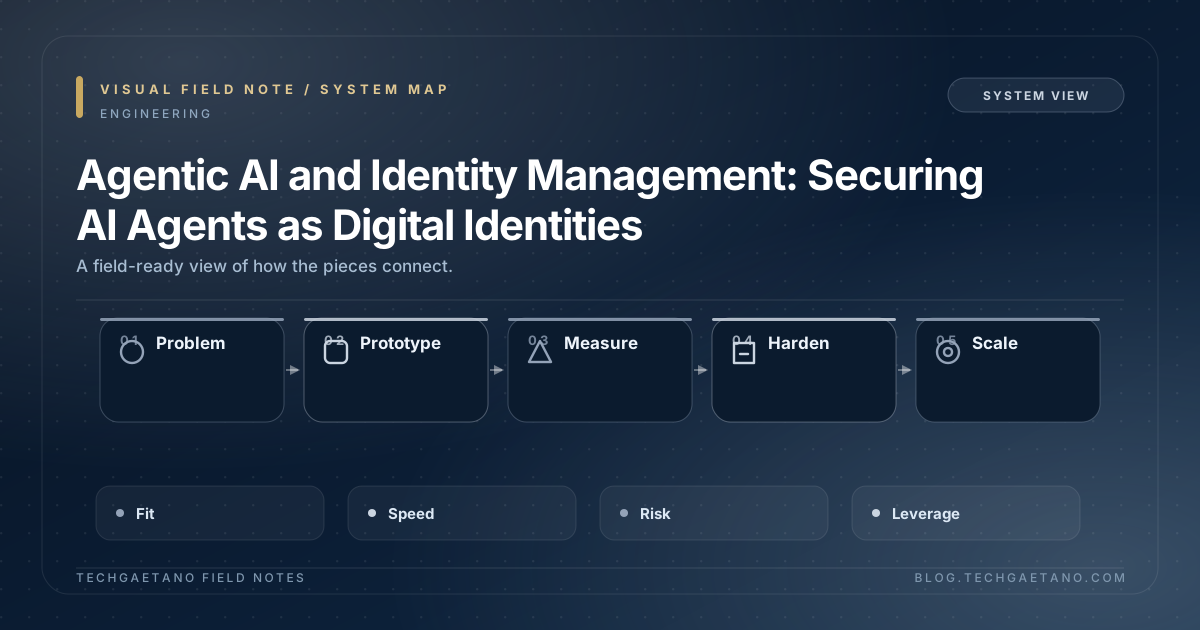
System map
How the moving parts connect, from first input to operating outcome.
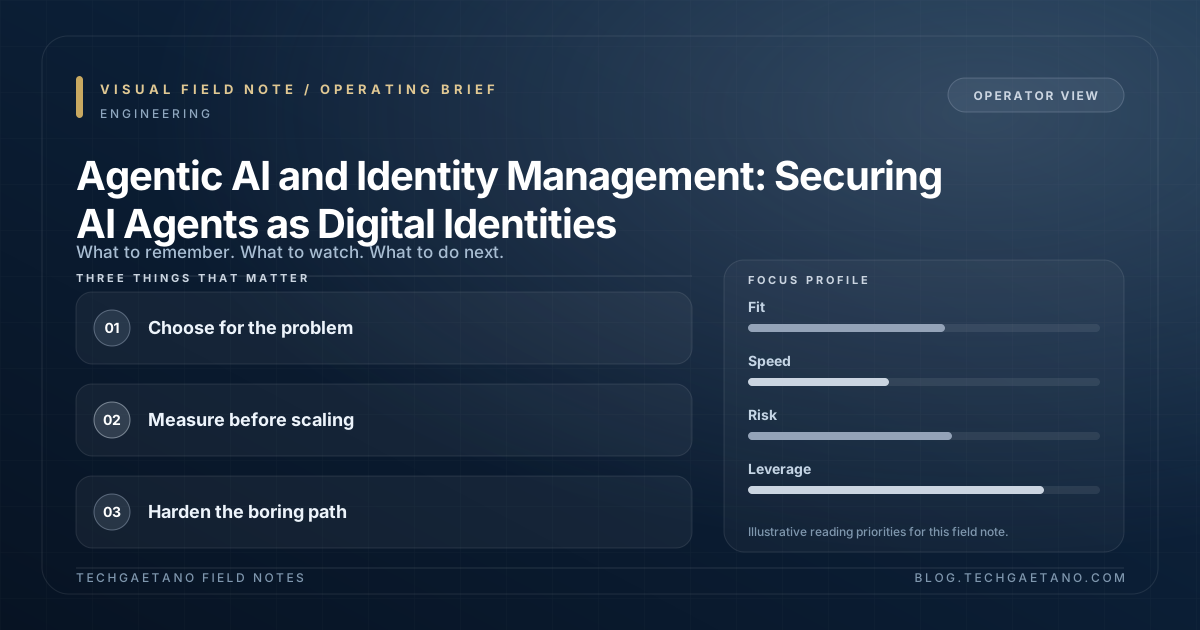
Operating brief
The three decisions that matter and the signals to watch.
Need senior engineering firepower?
TechGaetano partners with teams on architecture, delivery, and the hard technical decisions that shape the next stage of a product.
Talk to TechGaetanoFrequently asked questions
What is Agentic AI and Identity Management?
Autonomous AI agents are no longer a demo. They query databases, execute scripts, call APIs, open pull requests, and move data between systems without a human in the loop for every step. That shift breaks an assumption underneath most identity and access manag.
How should a team get started with Agentic AI and Identity Management?
Start with the problem and its constraints, then choose the smallest tool that solves it. Build a small proof, measure the result, and expand only when the evidence supports it.
What should teams avoid when working on Agentic AI and Identity Management?
The main risks are choosing tools by fashion, optimizing for the demo instead of production, and skipping measurement before expanding a technical bet.
Further reading
Related posts
Zero Trust Architecture Implementation Guide for Engineering Teams
Zero trust has a branding problem. It is simultaneously the most important security architecture of the decade and a phrase that has been attached to…
Read more
The Future AI Hub: Architecture for a Multi-Model Enterprise
Most companies now have an AI story. Fewer have an AI architecture. The difference shows up the second time a model changes, the first time an auditor…
Read more