Article · Platform Engineering
Platform Engineering: The Business Case for an Internal Developer Platform
By Caleb · October 27, 2026
Every engineering organization pays a coordination tax. It shows up as onboarding that takes weeks, pipelines that differ from team to team, security reviews that queue behind a single expert, and senior engineers answering the same infrastructure questions for the fifth time. The work is real, but it produces no customer value directly. It is the cost of giving every team the freedom to assemble its own toolchain.
Platform engineering is a response to that tax. It treats the internal developer platform as a product: a set of self-service capabilities, golden paths, and guardrails that let product teams deliver safely without becoming infrastructure specialists. The goal is not to centralize control. It is to reduce cognitive load while preserving autonomy where it matters.
The business case is often made badly. Proponents talk about developer happiness and "DevEx", which are real but hard to fund. Executives hear a request for another team with no clear return. This article frames the case in operational and financial terms, then describes the minimum viable platform, the operating model, and the metrics that show whether it is working.
The symptoms worth funding
A platform investment should start with evidence, not enthusiasm. Look for these patterns:
- Slow onboarding: a new engineer needs more than a week to ship a first change to production, and much of that time is spent obtaining access, learning local conventions, and debugging environment setup.
- Inconsistent delivery: each team has its own pipeline, deployment process, and observability setup. Security and compliance reviews must be repeated for every variation.
- Specialist bottlenecks: a small group of senior engineers reviews every Terraform change, pipeline update, and production access request. Their queue becomes the organization's delivery constraint.
- High change failure rate: deployments fail often, recovery is manual, and teams avoid releasing on Fridays or during business-critical periods.
- Cloud waste and drift: environments are provisioned by hand, abandoned without cleanup, and configured differently from production.
- Audit pain: evidence for access reviews, change approval, and vulnerability remediation is assembled manually from multiple tools.
These symptoms have a measurable cost: engineering hours lost to toil, delayed revenue from slower delivery, incident impact, cloud waste, and audit findings. Quantify them before proposing a platform.
What an internal developer platform is, and is not
An internal developer platform is the layer that sits between infrastructure and product teams. It typically includes:
- service scaffolding that creates a new service with the organization's defaults
- CI/CD templates that build, test, scan, and deploy consistently
- environment provisioning for development, staging, and production
- secrets and identity integrated with the corporate directory
- observability with standard dashboards, alerts, and log pipelines
- a service catalog that records ownership, dependencies, and runbooks
- documentation and discovery that reflect the current golden path
- security and compliance controls embedded in the workflow
It is not a Kubernetes cluster with a wiki, a portal that links to existing tools, or a mandate that every team use the same stack regardless of fit. A portal without self-service is a directory. A platform without guardrails is a new source of risk. A platform that ignores its users is an expensive internal project.
The strongest platforms offer a paved road: the easiest way to do something is also the compliant, observable, and supportable way. Teams can leave the road when they have a reason, but they pay the cost of maintaining the alternative.
Example: a minimal Backstage catalog entry
A service catalog is the first paved road for many internal developer platforms. Start with one accurate entry per service, owned by a real team and linked to its repository and runbook.
apiVersion: backstage.io/v1alpha1
kind: Component
metadata:
  name: payments-api
  description: Payment capture and refund service
  annotations:
    github.com/project-slug: your-org/payments-api
    backstage.io/techdocs-ref: dir:.
spec:
  type: service
  lifecycle: production
  owner: payments-team
  system: payments
The value is not the YAML. It is the agreement that every production service has an owner, a lifecycle, and a place to find the operational documentation.
Building the business case
Use conservative, organization-specific numbers. The following model is illustrative, not a benchmark.
Assume 120 engineers. Surveys and time tracking suggest each engineer loses five hours per week to environment setup, pipeline maintenance, access requests, and repeated infrastructure work. That is 600 hours per week. If a platform recovers 30 percent of that time, the organization gains 180 hours per week, or roughly 9,000 hours per year.
At a fully loaded cost of $60 per hour, the recovered capacity is worth about $540,000 per year. Add the value of faster onboarding: if 40 new engineers join annually and onboarding drops from 15 days to 5, that is 400 days of productive capacity recovered. Add avoided cloud waste from standardized environments, reduced incident cost from better observability and safer deployments, and lower audit effort from automated evidence.
Now compare that to the platform's total cost: engineering salaries for the platform team, tooling licenses, cloud overhead, and the migration cost for early adopters. A team of six to eight platform engineers is a substantial investment. The case only works if the platform is adopted and the recovered time is real. That is why adoption metrics and a product operating model matter as much as the technology.
Present the case as a range, with assumptions visible. Show the payback period under conservative, base, and optimistic adoption scenarios. Executives are more likely to fund a credible model than a promise of transformation.
Build versus buy
Most organizations should buy or adopt more than they build. The market includes managed developer portals, CI/CD platforms, environment management, and cloud-native service catalogs. Building every component from scratch is rarely justified.
A practical split:
- Buy or adopt commodity capabilities: source control, CI runners, artifact registries, secret stores, observability backends, and identity.
- Configure an existing portal such as Backstage if it fits the organization's scale and skills, rather than building a portal from zero.
- Build the integration layer and golden paths that encode your specific standards, compliance requirements, and operating model.
Calculate total cost of ownership, not license cost. A free portal that requires two full-time maintainers, custom plugins, and an upgrade project every quarter is not free. A managed service that costs more per seat but removes operational burden may be cheaper overall.
The decision should also consider exit cost. Avoid coupling the entire developer experience to a single vendor with no migration path. Keep service metadata and pipeline definitions in formats you can export.
Start with a minimum viable platform
A platform that tries to solve everything at once will disappoint everyone. Start with the capabilities that remove the most friction for the widest set of teams.
A reasonable first release includes:
A service template. One command creates a repository with the standard structure, build files, health endpoints, logging, metrics, tracing, and a pipeline. It should produce a deployable service, not a skeleton that requires a week of wiring.
A golden CI/CD pipeline. Build, test, dependency and container scanning, artifact signing, and deployment to a development environment. Production deployment can follow once the pattern is proven.
Environment self-service. A request or pull request creates a namespaced environment with quotas, network policy, and observability. Cleanup is automatic.
Secrets and identity. Workload identity instead of long-lived credentials. Access is granted through groups, logged, and reviewed.
A service catalog. Every service has an owner, tier, repository, dashboard, runbook, and dependency list. The catalog is generated from metadata where possible, not maintained by hand.
Observability by default. Standard dashboards and alerts are provisioned with the service. Teams can add custom signals without rebuilding the basics.
Security and compliance guardrails. Policy as code for image provenance, network exposure, encryption, and required tags. Violations are blocked or surfaced with a clear remediation path.
Choose two or three pilot teams with real delivery pressure and a willingness to collaborate. Instrument their experience before and after. Do not roll out to the whole organization until the golden path works for the pilots and the migration path is documented.
Operate the platform as a product
The most common failure mode is a platform team that builds what it finds interesting rather than what product teams need. Treat the platform as a product with users, a roadmap, and support obligations.
Appoint a product owner. Someone must own prioritization, user research, adoption, and communication. A pure engineering manager with no product mandate will optimize for technical elegance.
Run discovery continuously. Interview teams, observe onboarding, review support tickets, and measure where time is lost. The backlog should be driven by user problems, not vendor features.
Publish a support model. Define office hours, response targets, escalation paths, and ownership. An unstaffed Slack channel is not support.
Version and deprecate. Golden paths will change. Give teams notice, migration tooling, and a support window. Silent breaking changes destroy trust.
Measure adoption and outcomes. Track the percentage of services on the golden path, time to first deployment, lead time for changes, change failure rate, and mean time to restore. Segment by team and service tier.
Make exceptions cheap to request and expensive to ignore. Teams sometimes have legitimate reasons to deviate. Provide a review path, document the exception, and revisit it. Do not let exceptions become permanent shadow platforms.
Security and compliance as a paved road
Platform engineering is one of the most effective ways to improve security at scale, because it changes defaults rather than issuing policies.
Embed controls in the templates and pipelines:
- short-lived credentials and workload identity by default
- dependency and container scanning with clear failure thresholds
- signed artifacts and provenance attestations
- infrastructure as code with policy checks
- network policies and private-by-default services
- encryption and key management configured automatically
- audit logs shipped to a central, tamper-resistant location
- SBOM generation and retention
- automated evidence for access reviews and change records
When the compliant path is faster than the workaround, compliance improves without a enforcement campaign. When it is slower, teams route around it and the organization gets both shadow IT and audit findings.
A six-month roadmap
Month 1: discovery and baseline. Interview teams, measure onboarding and delivery metrics, inventory existing tooling, and define the first three use cases. Secure an executive sponsor and a product owner.
Month 2: foundation. Stand up the portal or catalog, identity integration, and the first service template. Choose pilot teams and agree on success criteria.
Months 3–4: golden path. Deliver CI/CD, environment self-service, secrets, observability, and policy guardrails for the pilots. Measure time to first deployment and support load. Fix the biggest friction points before expanding.
Month 5: migration and documentation. Migrate two or three additional services. Publish the migration guide, support model, and exception process. Train teams and establish office hours.
Month 6: scale and review. Expand to more teams, publish adoption and outcome metrics, and decide the next investment based on evidence. Fund the platform through a visible operating budget, not a series of project requests.
Metrics that matter
Avoid vanity metrics such as number of portal page views or plugins installed. Track outcomes:
- Adoption: percentage of services using the golden path, active teams, and migration rate
- Delivery: lead time for changes, deployment frequency, change failure rate, mean time to restore
- Onboarding: time from hire to first production change, and time to first deployment for a new service
- Toil: hours spent on environment and pipeline maintenance, measured through surveys and tickets
- Reliability: incident volume and recovery time for platform-supported services
- Compliance: percentage of services meeting required controls, audit findings, and exception count
- Cost: platform run cost per service and cloud waste avoided
- Satisfaction: developer experience score and support responsiveness
Review these monthly with the product owner and quarterly with the executive sponsor. If adoption is low, the problem is usually the product, not the marketing. If outcomes are flat despite adoption, the golden path may be automating the wrong work.
Traps to avoid
Building for the platform team's preferences. The platform exists to serve product teams. Their constraints, not the platform team's interests, should drive the roadmap.
Boiling the ocean. A portal with twenty integrations and no working golden path is worse than a narrow platform that ships.
Mandating adoption before proving value. Mandates without a usable product create resentment and workarounds. Prove the path, then make it the default.
Ignoring the migration. Existing services need a realistic path to the platform. If migration is manual and undocumented, adoption stalls.
Underfunding operations. A platform is a product with on-call, upgrades, and support. Fund it like one, or it will decay.
Measuring activity instead of outcomes. Pipelines created and plugins installed are not business results. Measure delivery, reliability, and cost.
Platform engineering is not a shortcut to fewer engineers. It is a way to make the engineers you have more effective by removing avoidable friction and embedding good defaults. The organizations that get it right treat the platform as a product, start narrow, prove the economics, and let adoption pull the roadmap. The result is not just faster delivery. It is a clearer operating model in which product teams own outcomes and the platform team owns the path to production.
Visual field notes
The system at a glance
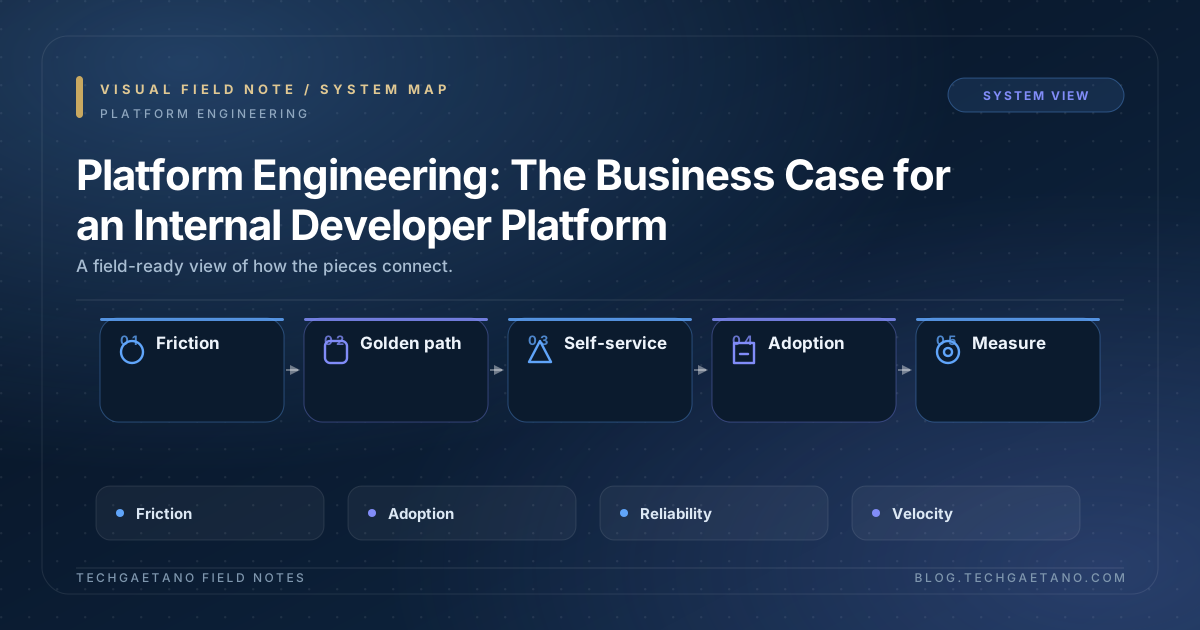
System map
How the moving parts connect, from first input to operating outcome.
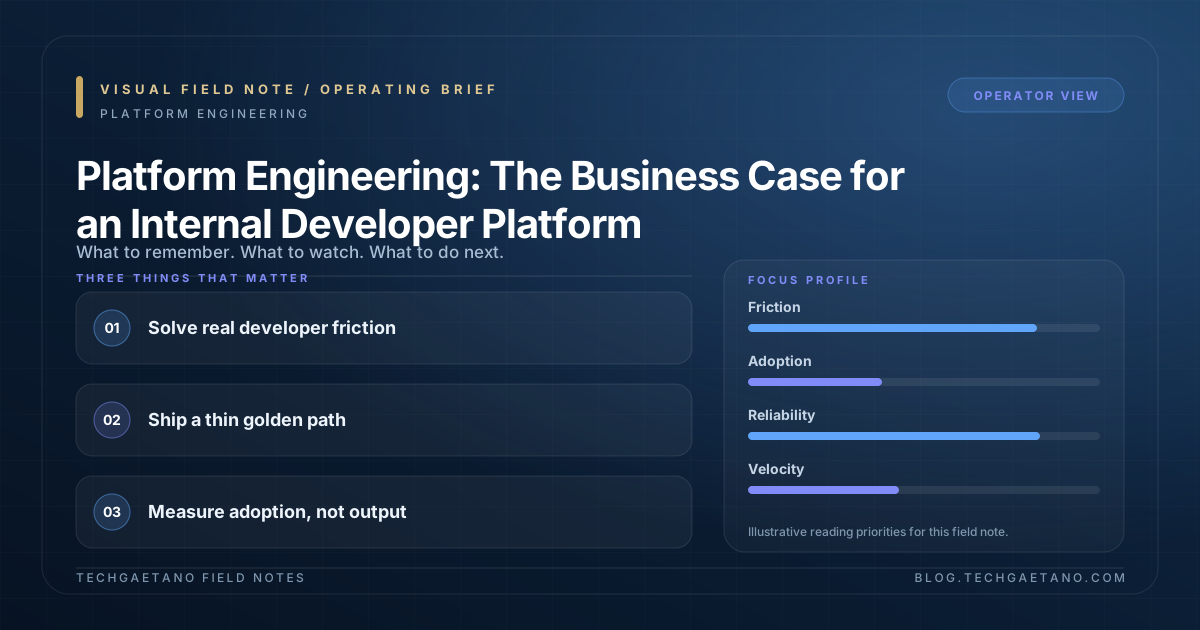
Operating brief
The three decisions that matter and the signals to watch.
Building an internal developer platform?
TechGaetano helps teams find the right first golden path, prove adoption, and operate a platform that developers choose to use.
Shape your platform strategyFrequently asked questions
What is Platform Engineering?
Every engineering organization pays a coordination tax. It shows up as onboarding that takes weeks, pipelines that differ from team to team, security reviews that queue behind a single expert, and senior engineers answering the same infrastructure questions fo.
How should a team get started with Platform Engineering?
Start with the friction developers feel most, such as environment provisioning, CI, or service scaffolding. Ship a thin golden path, measure adoption, and run the platform as a product with real users.
What should teams avoid when working on Platform Engineering?
The main risks are building a platform nobody asked for, forcing adoption, measuring output instead of developer outcomes, and creating a second layer of tickets and approvals.
Further reading
Related posts
Legacy Modernization Without the Big Bang: A Strangler Fig Playbook
Every legacy modernization program starts with the same sentence: "We should just rewrite it." It is an appealing sentence. The current system is slow…
Read more
AI Governance for the Enterprise: From Principles to Operating Model
Most enterprises now have an AI principles document. It says the organization will be transparent, fair, accountable, and secure. It may reference hum…
Read more