Article · AI & Agents
AI Governance for the Enterprise: From Principles to Operating Model
By Caleb · October 27, 2026
Most enterprises now have an AI principles document. It says the organization will be transparent, fair, accountable, and secure. It may reference human oversight, privacy, and the responsible use of data. It is usually signed by an executive and published on the intranet.
Then nothing changes. Teams continue buying AI tools, connecting models to internal data, and shipping features without a shared inventory, a risk classification, or a clear approval path. When something goes wrong, nobody knows who owned the system, which vendor processed the data, or what testing was performed.
The gap is not a shortage of principles. It is the absence of an operating model: the roles, decision rights, controls, and evidence that turn principles into daily practice. This article describes how to build that operating model without creating a governance bureaucracy that slows every experiment to a halt.
Why principles alone fail
Values statements fail for predictable reasons.
There is no inventory. You cannot govern what you cannot see. Most organizations do not have a reliable list of AI use cases, models, vendors, and data flows. Shadow AI thrives in this vacuum.
Risk is treated as binary. Every AI use case is either "approved" or "not approved", so low-risk experiments wait in the same queue as credit decisions and safety-critical systems. Teams learn to avoid the process.
Decision rights are unclear. Legal, security, data privacy, procurement, and engineering all believe someone else owns the final call. Or all of them believe they do, which produces a permanent stalemate.
Controls are not testable. "Ensure fairness" is not a control. "Evaluate the model against defined subgroups before launch and monitor outcome drift monthly" is.
Evidence is not retained. When an auditor or regulator asks how a system was assessed, the answer is a slide deck in someone's inbox. There is no repeatable evidence trail.
The operating model fixes these gaps by making AI use visible, tiering risk, assigning ownership, and defining the minimum evidence required at each tier.
Build the AI inventory first
Start with a register of AI systems. It does not need to be elaborate, but it must be accurate and maintained.
For each use case, record:
- Business owner: the person accountable for the outcome, not the model
- Technical owner: the team responsible for operation and change
- Purpose and users: what decision or task the system supports, and who is affected
- Model and provider: first-party, open source, or third-party API; hosted or on-premises
- Data inputs: categories, sensitivity, provenance, and whether customer or employee data is involved
- Autonomy level: advisory, human-in-the-loop, or fully automated
- External exposure: internal only, customer-facing, or embedded in a regulated process
- Status: experiment, pilot, production, retired
- Risk tier and review date
Populate the register through a short survey, procurement records, cloud invoices, and engineering discovery. Expect the first version to be incomplete. Set a target of full coverage for production systems within 90 days, and make registration a prerequisite for production access to approved model providers.
The inventory is also a portfolio tool. It shows duplication, low-value experiments, vendor sprawl, and use cases that should be consolidated. Many organizations discover they are paying for three tools that do the same job.
Tier risk, not technology
Risk should be based on the use case and its impact on people, not on whether the system uses a large language model or a classical model. A four-tier scheme is usually enough.
Tier 1: Low risk. Internal productivity tools with no material impact on customers, employees, or regulated decisions. Examples include meeting summaries, draft content, code completion on non-sensitive repositories, and internal knowledge search over public documents.
Tier 2: Moderate risk. Systems that influence decisions or handle internal confidential data, but retain meaningful human review. Examples include sales prioritization, support response suggestions, contract drafting assistance, and internal anomaly detection.
Tier 3: High risk. Systems that make or materially shape decisions about individuals, access, money, health, employment, or safety, or that process sensitive personal data at scale. Examples include credit scoring, claims triage, candidate screening, fraud detection, and customer-facing advice.
Tier 4: Critical or prohibited. Systems where failure could cause severe harm, or uses the organization has decided not to permit. Examples include autonomous safety controls, covert manipulation, social scoring, and fully automated decisions with no appeal path.
Use external frameworks as inputs, not as substitutes for judgment. The NIST AI Risk Management Framework, ISO/IEC 42001, and the EU AI Act's risk categories are useful reference points. So are sector regulators and local data protection law. The tiering decision should be documented and reviewable, with a clear path to escalate a use case when its scope changes.
Define controls by tier
The point of tiering is proportionality. Low-risk systems should move quickly; high-risk systems should face real scrutiny. A workable baseline looks like this.
Tier 1 requires registration, a named owner, acceptable-use confirmation, and a basic vendor check. Approval can be automated or delegated to a line manager. Target turnaround: same day.
Tier 2 adds a data classification review, a documented evaluation of quality and failure modes, human review requirements, and logging of inputs and outputs where lawful. Security and privacy review can be lightweight and templated. Target turnaround: five business days.
Tier 3 requires a cross-functional review involving security, privacy, legal, and the business owner. It should include a data protection impact assessment where personal data is involved, a model or system card, evaluation against defined subgroups and edge cases, a human oversight design, an incident response plan, vendor due diligence, and ongoing monitoring with defined thresholds. Target turnaround: two to four weeks, with a fast lane for urgent cases that meet pre-agreed criteria.
Tier 4 is either prohibited or requires executive risk acceptance and board-level visibility. Controls should include independent review, fail-safe design, extensive testing, and a credible path to disable the system.
For every tier, define what "done" means in evidence. A control that cannot be demonstrated is not a control.
Assign decision rights
Governance stalls when nobody knows who decides. Write down the decision rights explicitly.
A typical model has three layers.
The AI review board sets policy, owns the risk taxonomy, approves Tier 3 and Tier 4 use cases, and resolves escalations. It should include the CIO or CTO, the chief risk or compliance officer, the data protection officer, the head of security, and a business representative. It meets weekly or biweekly and publishes decisions.
The AI governance function maintains the inventory, runs the intake and triage process, coordinates reviews, tracks evidence, and reports metrics. It should be small and empowered, not a committee.
Business and engineering teams own their systems. They classify use cases, complete assessments, implement controls, monitor performance, and report incidents. The first line owns the risk; governance provides the framework and challenge.
The second line, typically risk and compliance, provides independent oversight. Internal audit, the third line, periodically tests whether the process works. This three-lines-of-defense structure is familiar to regulated organizations and scales better than centralizing every decision in one team.
Publish service-level targets for each tier. If reviews take six weeks with no communication, teams will route around the process. Measure turnaround time and make it visible.
Build the evidence pack
Every production AI system should have a small, consistent evidence pack that can be produced on request. Keep it in a system of record, not in shared drives.
The pack typically includes:
- System card: purpose, users, model, data, limitations, and known failure modes
- Risk assessment: tier, rationale, and residual risk
- Evaluation report: test sets, metrics, subgroup performance, red-team findings, and acceptance thresholds
- Data protection assessment: lawful basis, minimization, retention, and cross-border transfer where applicable
- Vendor assessment: security posture, data use terms, model change notice, and exit plan
- Human oversight design: who reviews what, with what authority, and how override is logged
- Monitoring plan: metrics, thresholds, alert owners, and review cadence
- Incident runbook: how to contain, disable, notify, and learn from failures
- Change log: model, prompt, data, or vendor changes that could alter behavior
This pack is not paperwork for its own sake. It is the difference between a system you can defend and a system you hope nobody asks about.
Generative AI and agent-specific risks
Generative AI introduces failure modes that traditional model governance does not cover.
Prompt injection can cause a model to ignore instructions, leak data, or take unintended actions. Treat retrieved content and tool outputs as untrusted input. Constrain tools with least privilege and require confirmation for consequential actions.
Data leakage can occur through prompts, logs, retrieval indexes, or vendor retention. Classify data before it reaches a model, redact where possible, and contract for no training on your data.
Hallucination is a quality issue with safety implications. Ground responses in approved sources, require citations for factual claims, and design interfaces that make uncertainty visible.
Shadow AI spreads through personal accounts and unapproved plugins. Make an approved path easy, publish clear rules, and monitor network and procurement signals.
Agentic systems add autonomy and tool use. Require explicit action boundaries, human approval for irreversible steps, full audit logs, and a kill switch. Test failure modes such as loops, tool misuse, and privilege escalation.
Model drift and vendor changes can alter behavior without your code changing. Require notice of material model updates, pin versions where possible, and re-run evaluations after changes.
A 90-day launch plan
Days 1–15: establish the baseline. Appoint an accountable executive and a governance lead. Issue the inventory survey. Collect procurement and cloud records. Draft the risk tiering criteria and a one-page policy.
Days 16–30: publish the process. Stand up the intake form, the review board, and the evidence templates. Define turnaround targets. Run two pilot reviews, one Tier 1 and one Tier 3, and fix the friction they expose.
Days 31–60: close the gaps. Complete the inventory for production systems. Review the highest-risk use cases first. Negotiate vendor terms for data use and model change notice. Publish an approved-tools list and a clear path for exceptions.
Days 61–90: make it routine. Integrate registration into procurement and production access. Train teams on their responsibilities. Publish the first metrics report. Test the incident runbook with a tabletop exercise. Set the review cadence for the next quarter.
Metrics that show the model works
Track a small set of indicators:
- Inventory coverage: percentage of production AI systems registered
- Review turnaround: median and 90th percentile by tier
- Control completion: percentage of required evidence present at launch
- Evaluation quality: pass rate against acceptance thresholds, including subgroup results
- Monitoring coverage: percentage of production systems with active drift and quality monitoring
- Incidents: count, severity, time to detect, and time to disable
- Shadow AI: unapproved tools discovered and remediated
- Vendor concentration: share of use cases dependent on a single provider
Report these to the review board and, in summary form, to the board of directors. The goal is not zero risk. It is known, owned, and managed risk.
Traps to avoid
Governance as a gate at the end. If review happens after build, teams experience it as a blocker. Move intake earlier and provide templates that speed delivery.
One process for every use case. Proportionality is the whole point. A Tier 1 tool should not wait for a Tier 3 review.
Unfunded governance. A part-time coordinator cannot maintain an inventory, run reviews, and monitor production systems. Fund the function and give it authority.
Paper controls. If nobody tests the monitoring or the kill switch, you have documentation, not assurance.
Ignoring vendors. Most enterprise AI risk sits in third-party contracts and model updates. Treat vendor diligence and change notice as core controls.
Chasing the perfect taxonomy. A workable four-tier model in use beats a sophisticated framework that is still in draft.
AI governance is not a brake on innovation. It is the operating system that lets an organization adopt AI at scale without accumulating unmanaged risk. The organizations that do it well make the approved path the fastest path, and they can show their work when it matters.
Visual field notes
The system at a glance
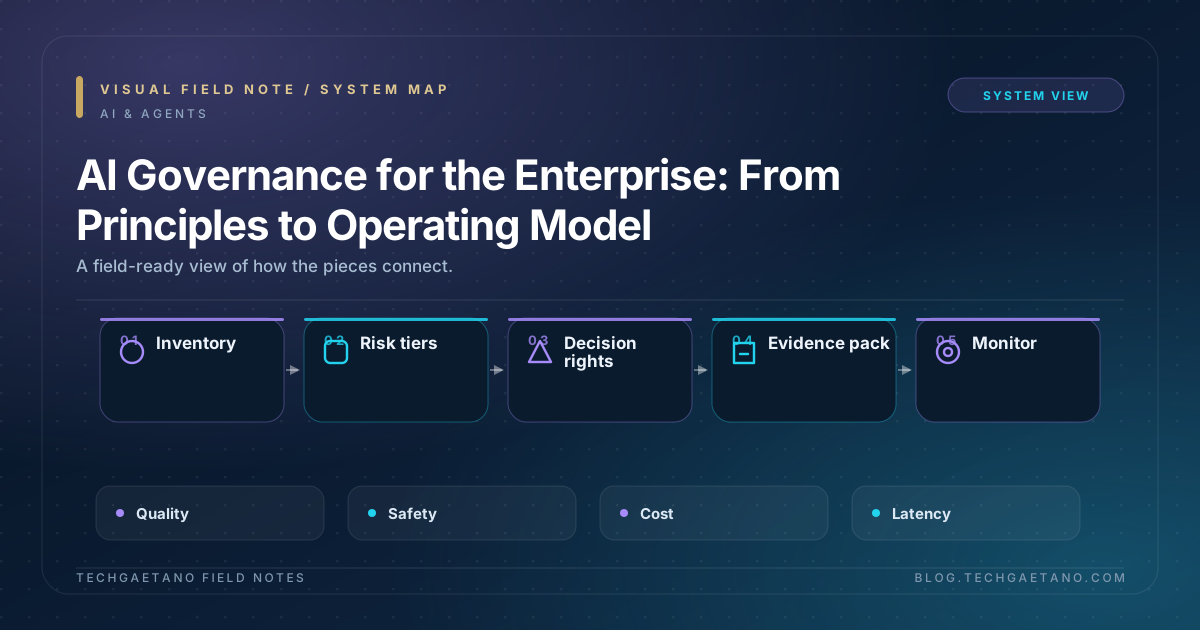
System map
How the moving parts connect, from first input to operating outcome.
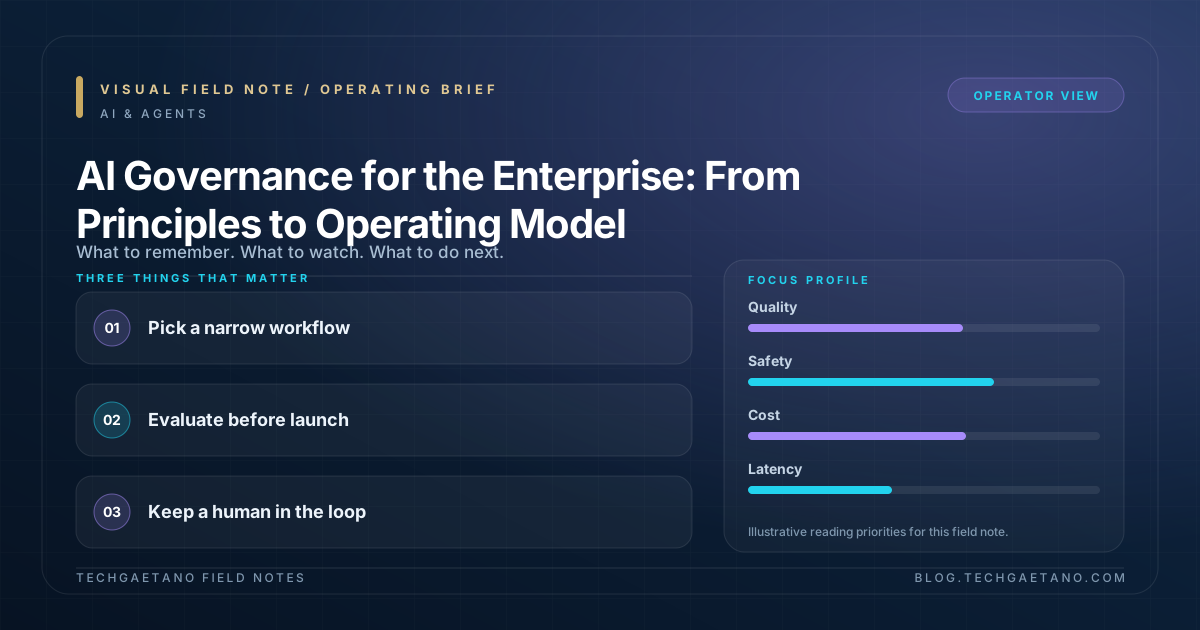
Operating brief
The three decisions that matter and the signals to watch.
Moving AI from prototype to production?
TechGaetano helps teams design agent architectures, secure tool access, and build evaluation and governance into the delivery lifecycle.
Discuss your AI platformFrequently asked questions
What is AI Governance for the Enterprise?
Most enterprises now have an AI principles document. It says the organization will be transparent, fair, accountable, and secure. It may reference human oversight, privacy, and the responsible use of data. It is usually signed by an executive and published on .
How should a team get started with AI Governance for the Enterprise?
Start with a narrow workflow, define an evaluation set and success metrics, and keep a human in the loop for high-impact actions. Version prompts, tools, and model choices like any other production dependency.
What should teams avoid when working on AI Governance for the Enterprise?
The main risks are prompt injection through untrusted tool results, over-broad tool permissions, missing evaluations, and exposing production systems without audit trails or human approval.
Further reading
Related posts
Kenya's Data Protection Act: A Practical Compliance Guide for Engineering Teams
Kenya's Data Protection Act, 2019 changed the conversation about personal data from a legal formality to an engineering requirement. The Office of the…
Read more
Platform Engineering: The Business Case for an Internal Developer Platform
Every engineering organization pays a coordination tax. It shows up as onboarding that takes weeks, pipelines that differ from team to team, security…
Read more