Article · Data & Compliance
Kenya's Data Protection Act: A Practical Compliance Guide for Engineering Teams
By Caleb · October 27, 2026
Kenya's Data Protection Act, 2019 changed the conversation about personal data from a legal formality to an engineering requirement. The Office of the Data Protection Commissioner (ODPC) has been issuing guidance, registering controllers and processors, and enforcing the law. Organizations that treat compliance as a policy document in a shared drive are increasingly exposed.
The practical challenge is that most of the Act lands on engineering. Lawful basis is a legal decision, but consent capture is a product requirement. Data minimization is a principle, but it is implemented in schemas, APIs, and retention jobs. Breach notification has a 72-hour clock, and the evidence that starts that clock usually lives in logs, monitoring, and access controls.
This guide translates the Act into the work engineering teams actually do. It is not legal advice, and it does not replace counsel or a data protection officer. It is a practical operating model for building systems that can demonstrate compliance.
Know your role and your obligations
The Act distinguishes between data controllers, who determine the purpose and means of processing, and data processors, who process personal data on behalf of a controller. Many organizations are both: a controller for customer and employee data, and a processor for data belonging to enterprise clients.
That distinction matters. Controllers carry the primary accountability for lawful processing, notices, data subject rights, and breach notification. Processors must act on documented instructions, implement security, assist the controller, and notify the controller of breaches without undue delay.
Most organizations processing personal data at scale must register with the ODPC. Registration is not a one-time formality: the information must stay accurate as processing activities change. Before launching a new product or data-intensive feature, confirm whether it changes your registration, your notices, or your risk assessments.
Turn the principles into system requirements
The Act's principles are a useful design checklist. Each one implies concrete engineering work.
Lawful, fair, and transparent processing. Every dataset needs a documented lawful basis: consent, contract, legal obligation, vital interests, public interest, or legitimate interests. Engineering should be able to trace each collection point to a basis and a notice. If a product team cannot answer "why are we allowed to process this?", the feature is not ready.
Purpose limitation. Data collected for one purpose should not be silently reused for another. Record the purpose at the field or dataset level, and require review when a new use case appears. Analytics, model training, and marketing are common places where scope quietly expands.
Data minimization. Collect only what the purpose requires. This is where engineers have the most leverage. Challenge optional fields, avoid copying entire records into logs, and design APIs that return the minimum necessary data. Minimization reduces breach impact, storage cost, and the burden of data subject requests.
Accuracy. Provide mechanisms to correct data, and propagate corrections to downstream systems, analytics, and vendors. Stale or duplicated customer records are both a quality problem and a compliance one.
Storage limitation. Define retention periods by data category and purpose. Automate deletion and archival. "Keep everything forever" is not a retention policy, and backups are not an excuse for indefinite retention.
Integrity and confidentiality. Apply appropriate technical and organizational measures: encryption, access control, logging, segregation of duties, secure development, and vendor oversight. The Act does not prescribe a specific standard; it expects measures proportionate to risk.
Accountability. Keep records of processing, assessments, decisions, and evidence. Compliance is judged not only by what you do but by what you can demonstrate.
Build notices and consent that hold up
Notices should be layered. A short, plain-language summary at the point of collection, with a link to the full notice, works better than a wall of legal text nobody reads. At minimum, explain what is collected, why, who it is shared with, how long it is kept, and how to exercise rights.
Consent must be freely given, specific, informed, and unambiguous. That has product implications:
- Do not pre-tick consent boxes or bundle unrelated purposes into one toggle.
- Separate marketing consent from service delivery.
- Make withdrawal as easy as giving consent.
- Record what the user saw, when, and which version of the notice applied.
- For sensitive data, obtain explicit consent where consent is the basis.
Consent is not always the right basis. Employment, contractual necessity, and legal obligations often provide a more appropriate foundation. Using consent when it is not genuinely free can create a false sense of compliance. Document the reasoning.
Treat data subject rights as product features
The Act gives individuals rights over their personal data, including information, access, correction, deletion, objection, and, depending on the context, portability. These are not back-office exceptions. They are workflows that need product design, authorization, logging, and service levels.
Build a data subject access request process that can:
- verify identity without collecting more data than necessary
- locate data across primary systems, backups, analytics, and vendors
- assemble a response in a usable format
- record the request, decision, and response
- meet an internal service level, commonly 30 days, unless counsel advises otherwise
Deletion is harder than access. Data lives in caches, search indexes, data warehouses, logs, backups, and third-party systems. Maintain a data map that shows where each category of personal data resides, and define how deletion propagates. For backups, document the retention window and the process for suppression on restore. For analytics and machine learning, decide whether records must be removed from training sets or whether the model can be retrained without them.
Correction and objection require similar plumbing. A correction that updates the CRM but not the billing system is not a correction. An objection that is recorded but never honored in marketing automation is a complaint waiting to happen.
Security controls that map to the Act
The Act requires appropriate technical and organizational measures. A defensible baseline for most enterprises includes:
- encryption in transit and at rest, with key management separated from data access
- role-based access control, least privilege, and periodic access reviews
- multi-factor authentication for administrative and remote access
- centralized logging and alerting for access to sensitive data
- secrets management and secure configuration baselines
- vulnerability management, patching, and secure code review
- backup, restore testing, and disaster recovery
- vendor due diligence and written data processing agreements
- employee confidentiality commitments and regular training
- incident response playbooks and tabletop exercises
Two controls deserve extra attention. First, access logging: when a breach is suspected, you need to know who accessed what, when, and from where. Second, vendor management: many breaches originate with a supplier, and the controller remains accountable to regulators and data subjects.
Cross-border transfers
The Act restricts transfers of personal data outside Kenya unless there is proof of appropriate safeguards. Depending on the circumstances, those safeguards may include an adequacy determination, explicit consent, a contract that protects the data, or necessity for a legal claim or vital interest.
Engineering must know where data goes. Map cloud regions, support access, analytics tools, backups, and AI providers. A model API that processes prompts in another country is a transfer. A support engineer logging in from abroad may be a transfer. Document the mechanism, the data categories, and the vendor obligations. Do not assume that choosing a local region solves the problem if support, backups, or subprocessors sit elsewhere.
Prepare for the 72-hour breach clock
The Act requires notification to the ODPC within 72 hours of becoming aware of a breach, and notification to affected data subjects without undue delay where the breach is likely to result in high risk to their rights and freedoms.
Seventy-two hours is short. The work that matters happens before the incident:
- define what counts as a personal data breach, including availability and integrity incidents, not just theft
- establish a single intake channel and an on-call escalation path
- maintain a breach log with timestamps, facts, decisions, and notifications
- prepare templates for the ODPC, affected individuals, and internal executives
- define who decides whether notification is required, with legal counsel involved
- test the process with realistic scenarios, including a lost laptop, a misconfigured bucket, and a compromised vendor account
During an incident, contain first, then assess. Preserve evidence. Record the timeline. Do not wait for complete certainty before escalating internally; the clock does not pause while you investigate. If notification is required, state what happened, what data was involved, the likely consequences, the measures taken, and the contact point for affected individuals.
Assess high-risk processing
A data protection impact assessment is expected where processing is likely to result in high risk. Common triggers include large-scale processing of sensitive data, systematic monitoring, profiling, automated decision-making, new technologies, and combining datasets in ways individuals would not expect.
A useful assessment covers:
- the nature, scope, context, and purpose of the processing
- the necessity and proportionality of the approach
- the risks to individuals and their likelihood and severity
- the safeguards that reduce those risks
- the residual risk and who accepts it
- the review date and the conditions that trigger a new assessment
Run the assessment before launch, not after. Integrate it into the architecture review so it influences design rather than documenting decisions already made.
An engineering checklist
Use this as a starting point for any system that handles personal data:
- data map and system inventory updated
- lawful basis identified and documented
- notice published and linked at collection
- consent captured, versioned, and withdrawable where applicable
- fields minimized and optional data challenged
- retention period defined and automated
- access controls, encryption, and logging in place
- vendor agreements and transfer mechanisms confirmed
- data subject request workflow tested
- breach runbook and escalation path current
- DPIA completed where required
- records of processing and evidence retained
- training completed for the team
Common mistakes
Treating compliance as a legal project. Legal can define the obligations, but engineering implements them. Without engineering ownership, controls remain theoretical.
Collecting data "just in case". Extra fields increase breach impact and request complexity. If there is no defined purpose, do not collect it.
Ignoring backups and analytics. Deletion and access requests must cover derived and archived data, not just the production database.
Assuming vendors are compliant because they say so. Require evidence, contract terms, and a clear notification path. Review subprocessors.
Forgetting AI and logs. Prompts, embeddings, support transcripts, and application logs can all contain personal data. Apply the same classification and retention rules.
Waiting for a breach to test the process. A runbook that has never been exercised is a hypothesis, not a capability.
Data protection compliance is not a destination. It is a set of habits embedded in how systems are designed, operated, and retired. The organizations that do it well make the right thing the easy thing: privacy-preserving defaults, clear ownership, automated retention, and evidence that is produced as a by-product of normal engineering work.
Visual field notes
The system at a glance
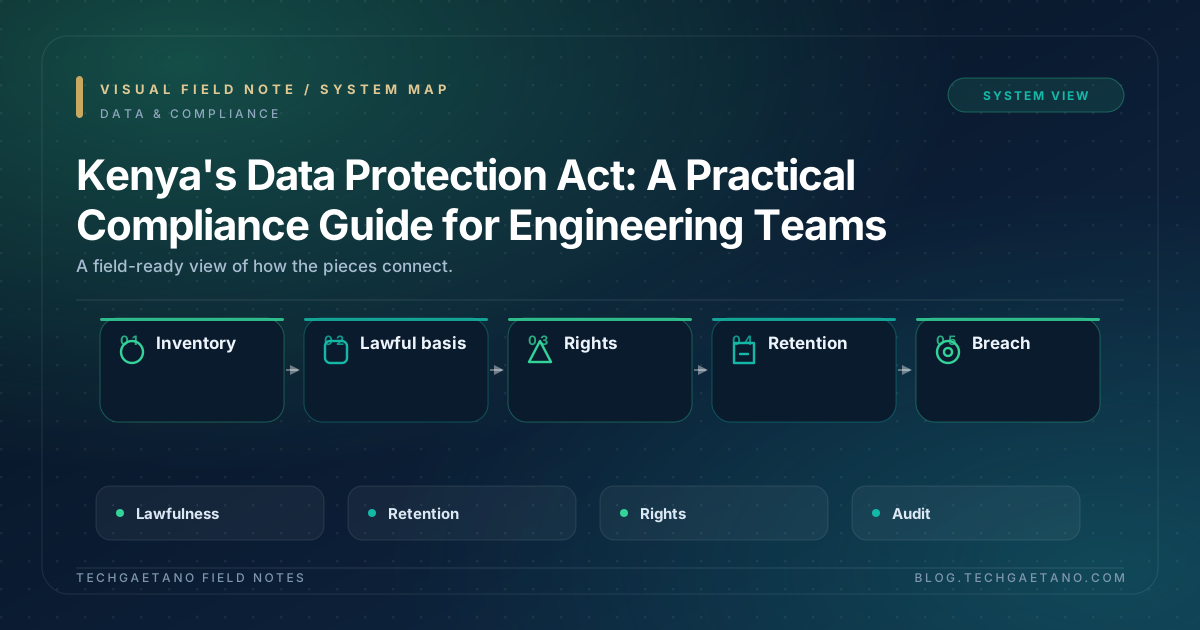
System map
How the moving parts connect, from first input to operating outcome.
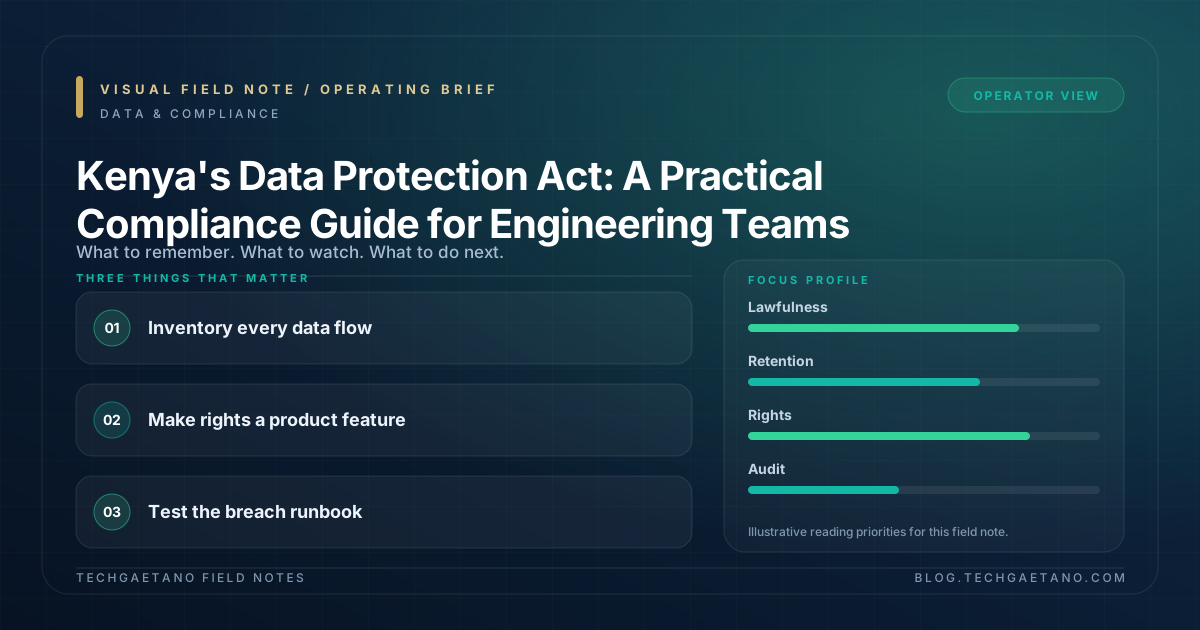
Operating brief
The three decisions that matter and the signals to watch.
Turning compliance into product requirements?
TechGaetano helps teams translate data protection obligations into system requirements, controls, and practical engineering roadmaps.
Review your data programFrequently asked questions
What is Kenya's Data Protection Act?
Kenya's Data Protection Act, 2019 changed the conversation about personal data from a legal formality to an engineering requirement. The Office of the Data Protection Commissioner (ODPC) has been issuing guidance, registering controllers and processors, and en.
How should a team get started with Kenya's Data Protection Act?
Start with a data inventory and a lawful basis for each processing activity. Turn data-subject rights into product features, and build retention, access control, and breach response into the platform.
What should teams avoid when working on Kenya's Data Protection Act?
The main risks are unclear controller and processor roles, consent that does not match actual processing, weak retention controls, and breach-response plans that exist only on paper.
Further reading
Related posts
AI Governance for the Enterprise: From Principles to Operating Model
Most enterprises now have an AI principles document. It says the organization will be transparent, fair, accountable, and secure. It may reference hum…
Read more
Platform Engineering: The Business Case for an Internal Developer Platform
Every engineering organization pays a coordination tax. It shows up as onboarding that takes weeks, pipelines that differ from team to team, security…
Read more