Article · Legacy Modernization
Legacy Modernization Without the Big Bang: A Strangler Fig Playbook
By Caleb · October 27, 2026
Every legacy modernization program starts with the same sentence: "We should just rewrite it." It is an appealing sentence. The current system is slow to change, expensive to run, and understood by a shrinking group of people. A clean rebuild promises a fresh start, a modern architecture, and an end to the workarounds.
It rarely works that way. Big-bang rewrites take longer than planned, accumulate requirements that were never written down, and reach a cutover date with less functionality than the system they replace. Meanwhile, the business cannot pause. The old system keeps changing, the new one drifts, and the organization ends up maintaining both for longer than either team expected.
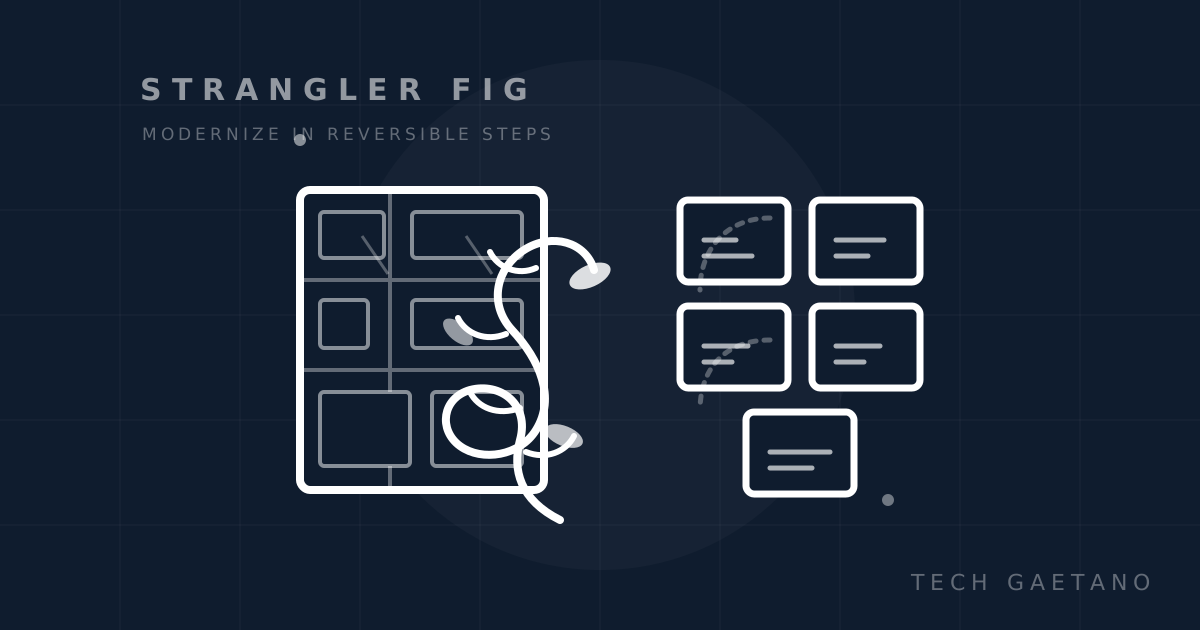
The strangler fig pattern offers a different path. Instead of replacing the legacy system in one move, you grow the new system around it. Requests are gradually routed to new capabilities. The old system keeps serving what it still does well until each piece can be safely removed. The migration becomes a series of reversible steps rather than a single irreversible bet.
Legacy system transformation is rarely a single decision. It is a portfolio of incremental migrations, each one moving a business capability from a monolith to microservices without stopping the organization. Application modernization succeeds when the strangler pattern is treated as a delivery model, not a diagram: route traffic through a seam, prove the new service, then decommission the old path. A credible microservices migration strategy makes the monolith-to-microservices transition reversible at every step, which is why the sequencing matters more than the target architecture.
This playbook describes how to run that migration as a funded program rather than a science project.
Decide why you are modernizing
"Old" is not a business case. Before choosing a pattern, write down the specific outcome the organization needs. Common drivers include:
- Change velocity: routine changes take weeks because of manual testing, coupled releases, or vendor constraints.
- Operating cost: the platform requires expensive hardware, licenses, or specialist contractors to keep running.
- Risk: the system runs on unsupported software, has known security gaps, or depends on a handful of people.
- Capability: the business cannot offer real-time pricing, self-service, open APIs, or new channels without disproportionate work.
- Compliance: audit findings, data residency, or retention requirements cannot be met on the current architecture.
Each driver implies a different first move. A risk-driven program may start with isolation and containment. A capability-driven program may start with a new edge or API layer. A cost-driven program may start with decommissioning the least valuable modules. Without a clear driver, teams optimize for technical elegance and lose executive support before the first release.
Map the estate before you touch it
You cannot strangle a system you do not understand. Build a capability map and a dependency map, then keep both current.
The capability map describes what the business does, not how the software is organized. "Quote to cash", "claims intake", "customer onboarding", and "settlement" are capabilities. The legacy application is one implementation of them, often mixed together. Capabilities give you seams that make business sense; application modules often do not.
The dependency map records how data and control flow between systems, including batch jobs, file drops, message queues, direct database reads, and undocumented integrations. Include the human dependencies too: which reports are produced manually, which teams export spreadsheets, and which partners rely on a specific file format.
For each capability, record:
- business criticality and volume
- current pain and cost
- data ownership and quality
- integration surface
- regulatory constraints
- candidate seam and migration approach
This is also the moment to build a risk register. Include data loss, duplicated processing, customer-visible downtime, regulatory breach, and key-person loss. The register will shape sequencing later.
Choose the first seam carefully
The first migration should be small enough to learn from and important enough to matter. Good candidates share three traits: bounded scope, measurable value, and a clear rollback path.
Good first seams often include:
- Edge and experience layers: a new web or mobile front end backed by APIs that call the legacy system through an anti-corruption layer.
- Read-only capabilities: reporting, statements, product catalog, or status lookups where a new service can run in parallel without owning writes.
- Asynchronous side effects: notifications, document generation, or analytics that can be moved without blocking the core transaction.
- Low-volume, high-friction workflows: a manual approval or onboarding step where a new service can reduce effort and prove the pattern.
Avoid starting with the most complex write path, the oldest data, or the capability with the most regulatory scrutiny. Those become second or third waves, after the team has built tooling, confidence, and organizational support.
Patterns that make the transition safe
The strangler fig is a family of patterns, not a single technique. Most programs combine several.
Facade or gateway. Put a routing layer in front of the legacy system. New capabilities are served by new services; everything else is proxied to the old system. The facade becomes the control point for traffic shifting, authentication, and observability.
Anti-corruption layer. Translate between the legacy data model and the new domain model. This protects new services from old schema quirks and makes it possible to change the legacy system's representation without rewriting consumers.
Branch by abstraction. Introduce an interface that both the old and new implementations satisfy. Switch implementations behind a feature flag, then remove the old path once the new one is proven.
Parallel run and shadow traffic. Send a copy of production traffic to the new service without using its response. Compare outputs, latency, and error rates. This is especially valuable for calculations, pricing, and eligibility decisions where subtle differences matter.
Canary and progressive delivery. Route a small percentage of real traffic to the new capability, expand gradually, and keep an automated rollback trigger. Define the rollback criteria before the release, not during an incident.
Event interception. Publish events from the legacy system at key state changes, then let new services react. This avoids invasive changes to the old codebase and creates a path to eventual decoupling.
The common thread is reversibility. Every step should have a way back that does not require restoring a backup or asking customers to tolerate a outage.
Example: a strangler facade in NGINX
Put a routing layer in front of the legacy application and move one path at a time. The legacy route stays as the default; only the migrated capability points at the new service.
upstream legacy_app {
  server 10.0.1.10:8080;
}

upstream pricing_service {
  server 10.0.2.20:8080;
}

server {
  listen 80;
  server_name api.example.com;

  # New capability: route only this path to the new service.
  location /pricing/ {
    proxy_set_header Host $host;
    proxy_set_header X-Request-Id $request_id;
    proxy_pass http://pricing_service;
  }

  # Everything else still goes to the legacy system.
  location / {
    proxy_set_header Host $host;
    proxy_set_header X-Request-Id $request_id;
    proxy_pass http://legacy_app;
  }
}
Start with a canary weight or a feature flag, compare error rates and latency against the legacy path, then increase traffic only after reconciliation passes. When the new path is stable, delete the legacy route rather than leaving it as a permanent fallback.
Data is the hard part
Most modernization timelines slip because of data, not application code. The new service can be written quickly; agreeing on ownership, reconciling history, and cutting over writes takes longer.
Treat data migration as a product with its own backlog. Key decisions include:
- System of record: which system owns each entity during each phase, and when ownership transfers
- Write strategy: dual write, change data capture, or a single writer behind an API
- Identity and keys: how records are matched across old and new systems
- Reconciliation: how often totals are compared, who investigates differences, and what tolerance is acceptable
- History: what must be migrated, what can be archived, and what can be left behind
- Deletion and retention: how legal holds, erasure requests, and retention rules apply across both systems
- Cutover and rollback: the exact sequence, the freeze window, and the point of no return
Change data capture is often the least invasive way to keep systems in sync, but it exposes every schema quirk to the new pipeline. Dual writes are simpler to reason about but create consistency problems when one side fails. Whichever approach you choose, build reconciliation from day one. A migration without reconciliation is a hope, not a plan.
Fund outcomes, not phases
Legacy programs fail when funding is tied to a multi-year plan that assumes a stable scope. Fund tranches tied to decommissioning outcomes instead.
Each tranche should have a business sponsor, a capability in scope, a measurable outcome, and an explicit exit criterion. For example: "Move customer statements to the new service, reduce statement generation cost by 40 percent, and decommission the legacy statement job." When the outcome is achieved, the next tranche is funded.
This approach does three things. It forces the team to finish and remove old components rather than leaving them running indefinitely. It gives executives regular evidence of progress. And it creates natural stopping points if priorities change, without wasting the entire investment.
A twelve-month shape
The exact sequence depends on the estate, but a typical program follows four phases.
Months 1–2: discover and establish. Complete the capability and dependency maps, choose the first seam, stand up the facade, and define the migration architecture. Establish the metrics baseline: lead time, change failure rate, mean time to restore, cost per transaction, and incident volume.
Months 3–5: first migration. Deliver one bounded capability end to end, including data, observability, security review, and rollback. Decommission the corresponding legacy path if possible. Publish what was learned and adjust the pattern.
Months 6–9: expand. Migrate two or three additional capabilities, prioritizing those that unlock the business case. Invest in shared platform capabilities: identity, secrets, environment provisioning, and observability. Start retiring integrations that only existed to support the old path.
Months 10–12: consolidate and decommission. Move the remaining high-value capabilities, reduce the legacy footprint, and negotiate the end of vendor contracts where possible. Set the next year's tranche based on measured unit costs and risk reduction.
Metrics that prove progress
Modernization is not measured by lines of code or services deployed. Measure the outcomes the program exists to change:
- Lead time for changes in migrated capabilities versus legacy
- Change failure rate and mean time to restore
- Cost per transaction or per active user
- Percentage of traffic served by new services
- Number of legacy components decommissioned, not just replaced
- Incident volume and severity during and after cutover
- Onboarding time for engineers working in the new stack
- Audit findings closed or avoided
Track the baseline before migration and report the trend monthly. If the new system is not better on these measures, the program is rebuilding complexity rather than reducing it.
Traps to avoid
Rewriting in secret. A parallel team that disappears for a year loses organizational knowledge and political support. Ship incrementally and keep the business involved.
Strangling without decommissioning. Running both systems forever doubles cost and risk. Every tranche should include a removal plan.
Ignoring the operating model. New services need owners, on-call, patching, and lifecycle management. If the platform team is not funded, the new estate becomes the next legacy estate.
Over-engineering the target state. A perfect domain model designed before the first migration is usually wrong. Let the seams teach you where the boundaries belong.
Skipping reconciliation. Silent data drift is worse than a visible failure. Compare totals continuously and make differences visible.
Treating the legacy team as the enemy. The people who understand the old system are essential to migrating it safely. Give them a role in the new architecture and protect the time they need to document and transfer knowledge.
Legacy modernization is not a technology project with a business side effect. It is a business change delivered through technology, one reversible step at a time. The strangler fig works because it respects that reality: keep the old system serving value while the new one earns trust, then remove the old one deliberately. The goal is not a heroic cutover. It is a steady reduction in risk and cost that the organization can see and fund with confidence.
Visual field notes
The system at a glance
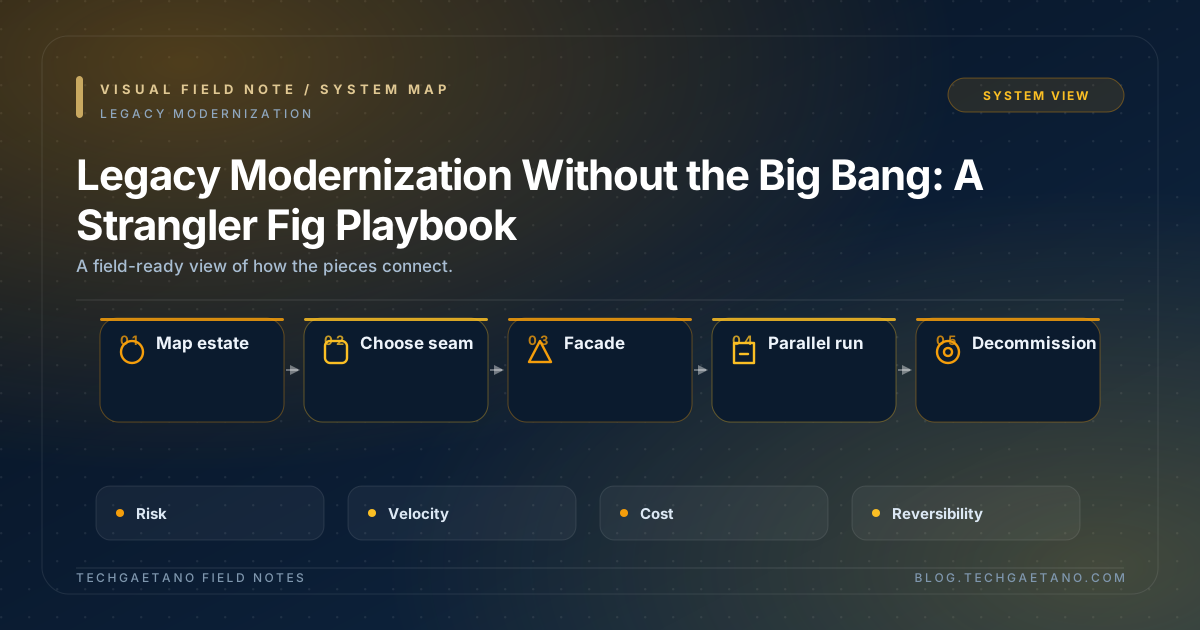
System map
How the moving parts connect, from first input to operating outcome.
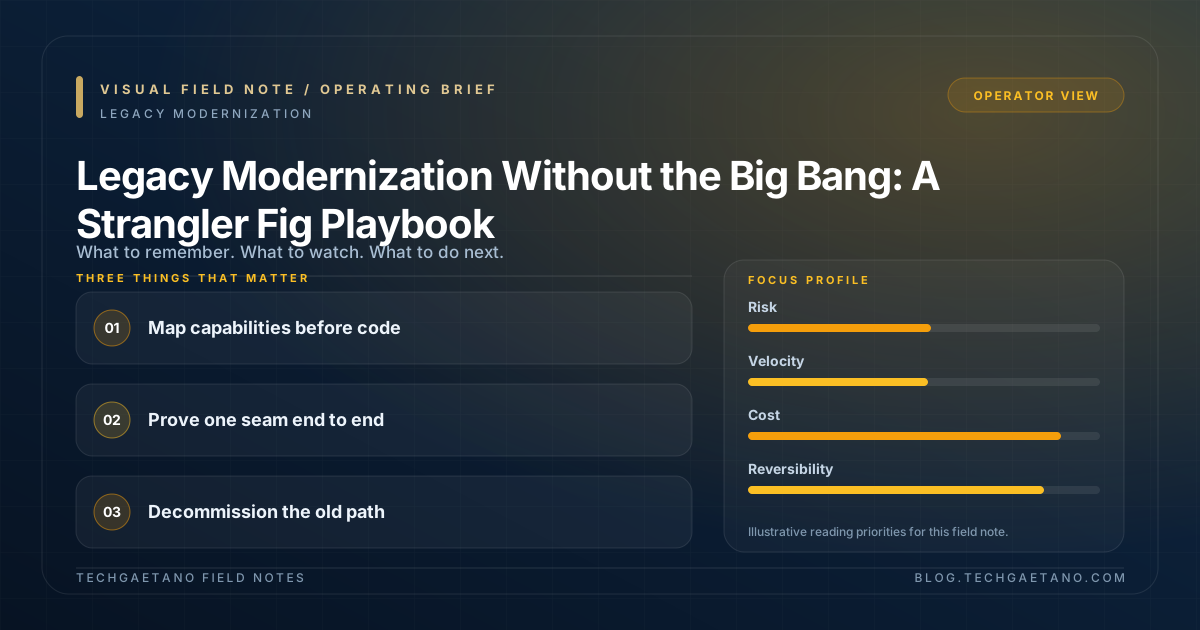
Operating brief
The three decisions that matter and the signals to watch.
Modernizing a legacy estate?
TechGaetano helps teams plan incremental migration, strangler patterns, and monolith-to-microservices transitions without a big-bang rewrite.
Plan your modernizationFrequently asked questions
What is Legacy Modernization Without the Big Bang?
Every legacy modernization program starts with the same sentence: "We should just rewrite it." It is an appealing sentence. The current system is slow to change, expensive to run, and understood by a shrinking group of people. A clean rebuild promises a fresh .
How should a team get started with Legacy Modernization Without the Big Bang?
Start with a capability and dependency map, choose one bounded seam, and put a facade in front of the legacy system. Migrate one capability end to end, including data reconciliation and rollback, before expanding the scope.
What should teams avoid when working on Legacy Modernization Without the Big Bang?
The common traps are rewriting in secret, strangling without decommissioning, skipping reconciliation, and over-engineering a target architecture before the first migration proves the boundaries.
Further reading
Related posts
Platform Engineering: The Business Case for an Internal Developer Platform
Every engineering organization pays a coordination tax. It shows up as onboarding that takes weeks, pipelines that differ from team to team, security…
Read more
AI Governance for the Enterprise: From Principles to Operating Model
Most enterprises now have an AI principles document. It says the organization will be transparent, fair, accountable, and secure. It may reference hum…
Read more