Article · AI & Agents
The Silent Exfiltration: Taming Shadow AI Without Killing Velocity
By Caleb · November 3, 2026

By every operational metric, modern development teams are moving faster than ever. Codebases appear in hours instead of days, documentation writes itself, and complex refactoring takes minutes. Beneath this surge in productivity lies an uncomfortable reality: Shadow AI has quietly become one of the largest unmanaged attack surfaces in the modern enterprise.
Every day, well-intentioned engineers, analysts, and product managers paste proprietary source code, internal architectures, customer data, and sensitive business metrics into unvetted, consumer-facing LLM interfaces. They are not trying to cause a breach—they are trying to meet deadlines. Yet when a developer pastes a confidential API key or a fragment of proprietary payment-routing logic into a public model to fix a syntax error, that data leaves the corporate boundary. It may be retained in vendor logs, processed by third-party browser extensions, or incorporated into model training pipelines.
Strict bans do not solve the problem; they drive usage underground. Enterprises need a pragmatic strategy that protects intellectual property while preserving the speed engineers require.
The Shift from Shadow IT to Shadow AI
Traditional Shadow IT was relatively visible. An employee signed up for an unsanctioned SaaS tool with a corporate email or card, eventually triggering alerts in SSO audits, expense reports, or CASB systems.
Shadow AI is different:
- Zero footprint, infinite access. It requires no credit card, complex installation, or corporate integration. It lives as a browser tab, lightweight extension, or auto-updating IDE plugin.
- Contextual leakage. Classic DLP tools were built to stop file transfers. Shadow AI leaks data through context: a block of obfuscated code, a SQL query containing production schema, or a snippet of unreleased strategy.
- The agentic risk surface. Local AI CLI tools and developer agents do not merely ingest data—they act with the user's permissions. An unauthorized agent can gain broad read/write access to repositories and local secrets.
Industry data underscores the scale: a majority of enterprise knowledge workers report using unauthorized AI tools at work, and a substantial share of those interactions include internal business data, source code, or customer information.
Three Pillars of a Modern Anti-Leakage Defense
Blocking every generative AI endpoint is a losing game of cat-and-mouse. Effective defense combines architectural guardrails, intelligent observability, and a culture of enablement.
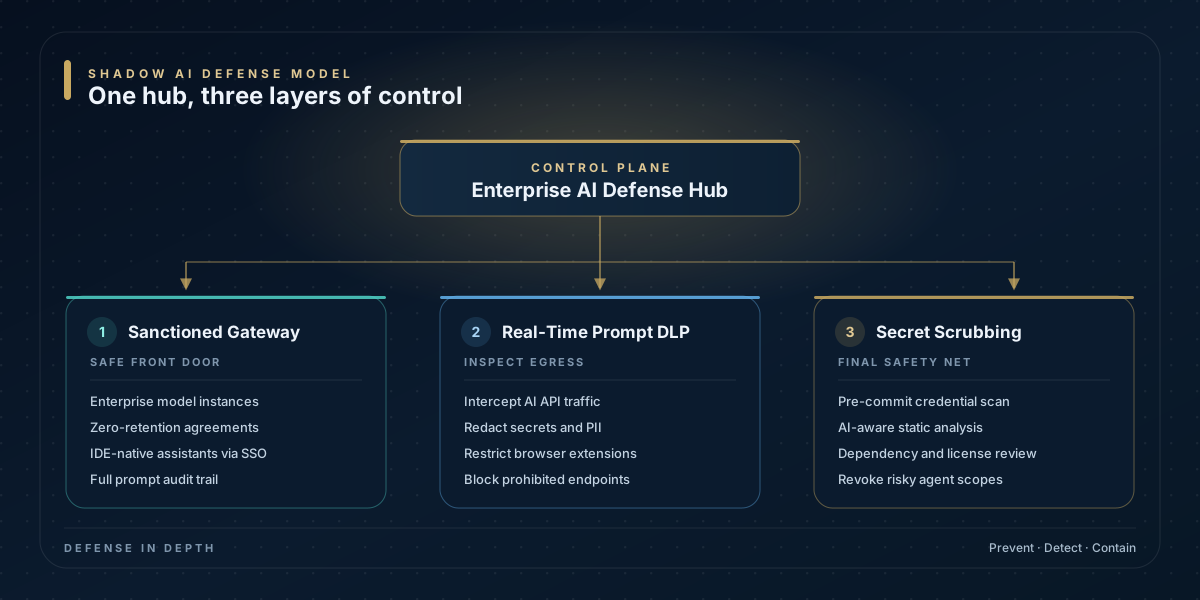
1. Build a sanctioned "front door"
The most effective way to reduce unsanctioned tools is to offer a superior alternative.
Deploy an internal AI gateway (or enterprise instances of major providers) under explicit zero-data-retention agreements. When developers know prompts are not stored, audited by third parties, or used for training, the incentive to use personal accounts drops sharply.
Provide enterprise licenses for IDE-native tools (GitHub Copilot Enterprise, Cursor Enterprise, or internal extensions) that route through the secure gateway. When secure assistance is embedded in the daily workflow, pasting code into personal browser tabs becomes unnecessary.
2. Implement real-time prompt DLP and egress inspection
Standard firewalls do not understand the semantics of an AI prompt. Security architecture must inspect outbound traffic to known AI endpoints.
- Intercept HTTP and WebSocket requests to AI APIs and automatically redact secrets (API keys, JWTs, cloud credentials) and PII before the payload leaves the network.
- Enforce enterprise browser policies that restrict unapproved extensions from reading page DOMs, scraping inputs, or transmitting data to unauthorized hosts.
3. Harden the code repository as the final safety net
AI-generated code can introduce hardcoded secrets or license issues. The repository must catch what earlier layers miss.
- Mandate pre-commit hooks that scan for credentials, tokens, and sensitive endpoints.
- Require AI-aware static analysis on every pull request to verify that suggested code meets security baselines and does not introduce unvetted dependencies.
An Acceptable-Use Operating Model
Technical controls are only half the solution. Governance must be simple and actionable. A clear three-tier framework works:
| Tier | Status | Approved Data Types | Action Required |
|---|---|---|---|
| Tier 1: Sanctioned | Fully approved (enterprise) | Internal code, non-sensitive docs, public assets | None – use via corporate SSO |
| Tier 2: Conditional | Under review / limited beta | Public data, anonymized non-prod code | Manager approval + sandbox isolation |
| Tier 3: Prohibited | Unsanctioned public tools | Confidential IP, PII, financials, secrets, prod code | Explicitly blocked at the proxy |
The framework only works if it is enforced consistently. Tier 1 should feel frictionless, so the compliant path is also the fast path. Tier 2 should have a real approval workflow with a turnaround measured in hours, not weeks, or teams will route around it. Tier 3 should be blocked technically, not just prohibited on paper—a policy that exists only in a wiki is a suggestion.
The Path Forward: Enablement Over Restriction
Preventing Shadow AI leakage is not about locking down workstations until productivity stalls. It is about understanding why people reach for unsanctioned tools: they want to do good work, faster.
Replace arbitrary bans with secure internal gateways, real-time prompt protection, and clear usage guidelines. Enterprises can protect intellectual property without sacrificing engineering velocity.
Enablement also changes the detection model. When the sanctioned path is genuinely better, anomalous usage becomes a signal worth investigating rather than the default state. You stop chasing every consumer endpoint and start watching for the specific behaviors that matter: bulk pasting of repository content, credentials appearing in outbound requests, and agents requesting permissions far beyond their task.
Key Takeaways for Security and Engineering Leaders
- Audit the actual footprint. Use SSO, CASB, and DNS logs to surface which unauthorized AI services are already in use.
- Offer a safe alternative. Provide enterprise-grade AI tools under strict zero-data-retention agreements.
- Protect your secrets. Treat AI prompt inputs with the same rigor applied to public Git repositories—scan, redact, and govern them accordingly.
Conclusion
Shadow AI is not a discipline problem; it is a design problem. People reach for consumer tools because those tools are faster than the sanctioned path, and no amount of policy will change that arithmetic. The organizations that contain the risk are the ones that make the secure route the shortest one.
That means treating AI access as an engineering capability rather than a compliance checkbox. Build the gateway, instrument the egress, harden the repository, and publish a usage model simple enough that nobody needs to guess. Then measure what actually changes: how much traffic flows through sanctioned endpoints, how many secrets are caught before they leave, and how quickly risky agent permissions are revoked.
The goal is not zero AI usage. It is zero unmanaged exposure. Teams that get this right keep the velocity that makes them competitive, while the data that matters stays inside the boundary it was always supposed to stay in.
Visual field notes
The system at a glance
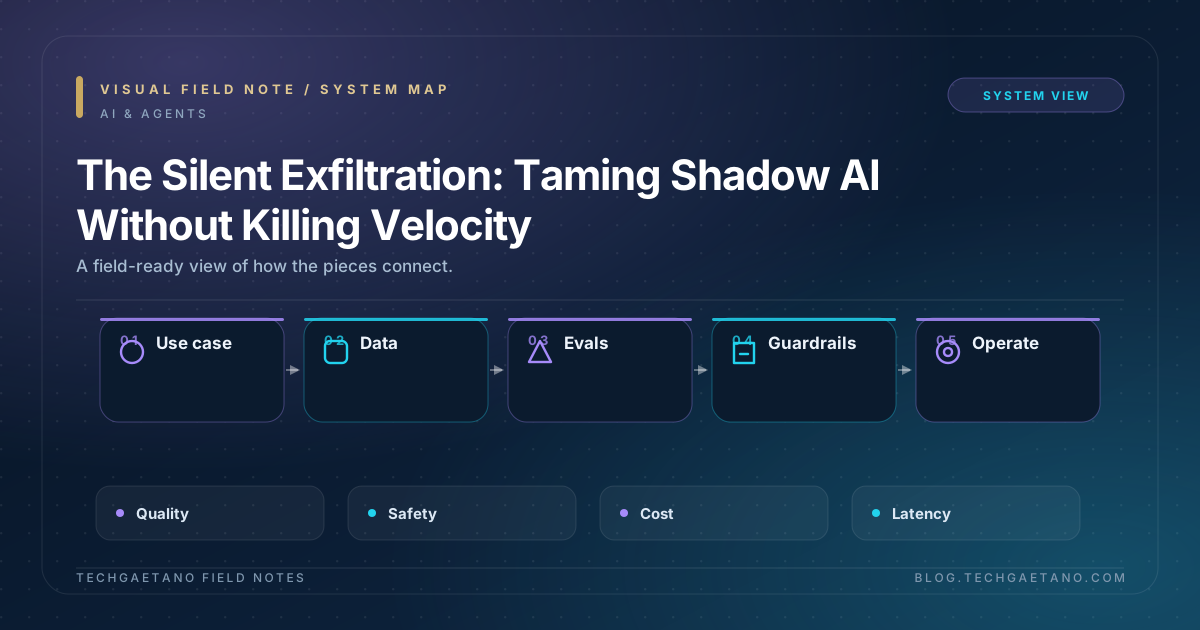
System map
How the moving parts connect, from first input to operating outcome.
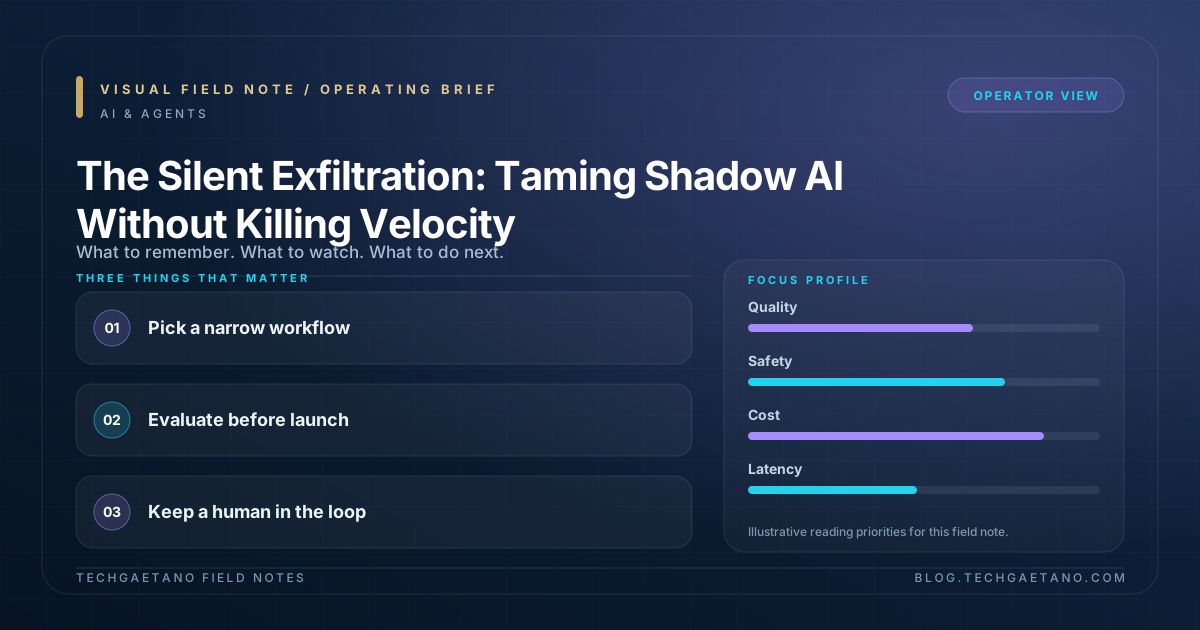
Operating brief
The three decisions that matter and the signals to watch.
Moving AI from prototype to production?
TechGaetano helps teams design agent architectures, secure tool access, and build evaluation and governance into the delivery lifecycle.
Discuss your AI platformFrequently asked questions
What is The Silent Exfiltration?
By every operational metric, modern development teams are moving faster than ever. Codebases appear in hours instead of days, documentation writes itself, and complex refactoring takes minutes. Beneath this surge in productivity lies an uncomfortable reality: .
How should a team get started with The Silent Exfiltration?
Start with a narrow workflow, define an evaluation set and success metrics, and keep a human in the loop for high-impact actions. Version prompts, tools, and model choices like any other production dependency.
What should teams avoid when working on The Silent Exfiltration?
The main risks are prompt injection through untrusted tool results, over-broad tool permissions, missing evaluations, and exposing production systems without audit trails or human approval.
Further reading
Related posts
AI Governance for the Enterprise: From Principles to Operating Model
Most enterprises now have an AI principles document. It says the organization will be transparent, fair, accountable, and secure. It may reference hum…
Read more
Platform Engineering: The Business Case for an Internal Developer Platform
Every engineering organization pays a coordination tax. It shows up as onboarding that takes weeks, pipelines that differ from team to team, security…
Read more