Article · AI & Agents
The Rise of AI
By Caleb · August 3, 2026
Artificial intelligence has moved from the pages of science fiction into the engine rooms of the modern economy. In less than a decade, AI has transformed how we search, how we write, how we diagnose diseases, how we trade stocks, and how we drive. Its rise is not a single event but a compounding chain of breakthroughs in computing power, data, and algorithms.
From symbols to learning
The earliest AI systems were rules-based. Programmers hand-coded logic: if this, then that. These expert systems were brittle and narrow. The real inflection point came with machine learning — software that improves itself by finding patterns in data rather than following hand-written rules.
Three forces converged:
- Compute became dramatically cheaper with GPUs and, later, dedicated AI accelerators.
- Data exploded as the internet digitized human knowledge at planetary scale.
- Algorithms matured, most importantly the deep neural network, which proved astonishingly good at recognizing images, speech, and language.
The deep learning era
In 2012, a neural network called AlexNet crushed the competition in image recognition. In 2016, AlphaGo defeated the world champion at Go, a game long considered beyond the reach of machines. Each milestone reset expectations about what was possible.
The largest leap arrived with the transformer architecture, introduced in 2017. Transformers made it possible to train models on enormous amounts of text while keeping track of long-range context. This underpins the large language models that now answer questions, write code, and summarize documents with near-human fluency.
Generative AI changes the game
What distinguishes today's wave is generation. Previous AI was mostly analytical — classifying, predicting, recommending. Generative models produce entirely new output: essays, images, video, software, even molecules.
ChatGPT's public launch in late 2022 became the fastest consumer product adoption in history. Within weeks, hundreds of millions of people had used a large language model. Businesses followed, embedding AI into customer support, marketing, software development, and research.
Risks and responsibilities
The rise of AI is not without turbulence. Critics point to real concerns:
- Misinformation — generative models can fabricate convincing falsehoods.
- Bias — models learn from historical data and can reproduce its prejudices.
- Displacement — automation threatens jobs across white-collar and blue-collar roles.
- Concentration — the largest models require resources only a few companies possess.
- Alignment — ensuring powerful systems reliably do what humans intend remains an open research problem.
Regulators worldwide are responding with new frameworks, from the EU AI Act to a wave of executive orders and standards bodies. The debate over how to govern a technology this powerful — and this fast-moving — is only beginning.
The road ahead
No one can say with certainty where the rise of AI ends. The most likely future is not a world of sentient machines but one in which AI quietly permeates every layer of the economy, the way electricity and the internet did before it.
The defining question of the next decade is not whether AI will be powerful. It is whether we can steer that power toward broadly shared benefit. That choice — made by researchers, companies, regulators, and users together — will shape the story of the century.
Visual field notes
The system at a glance
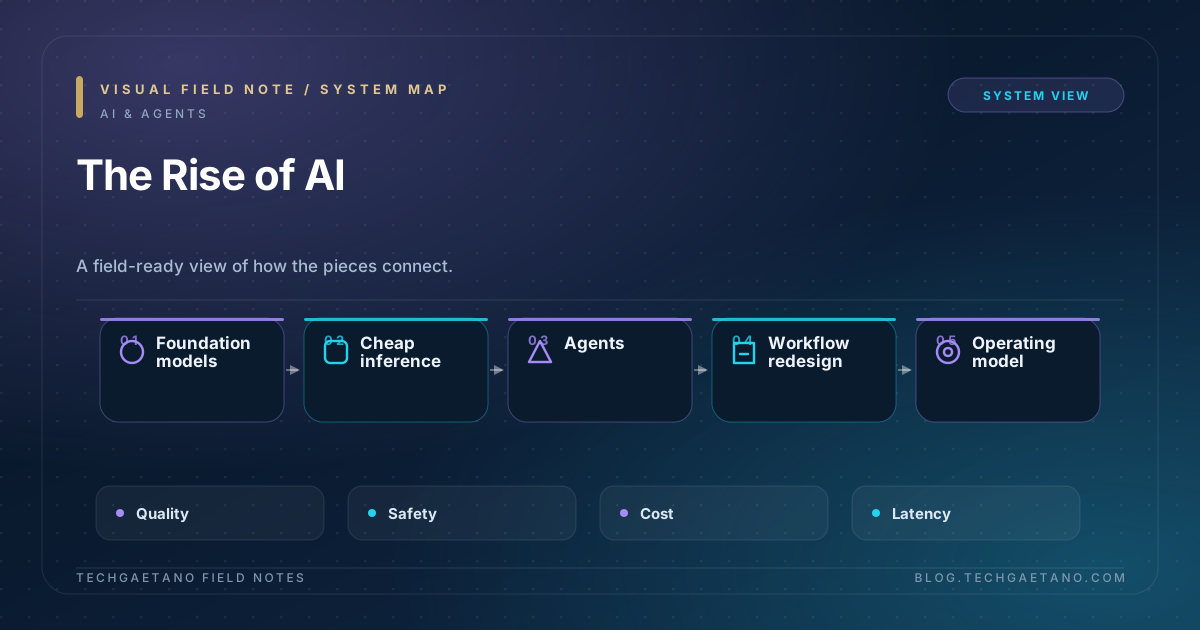
System map
How the moving parts connect, from first input to operating outcome.
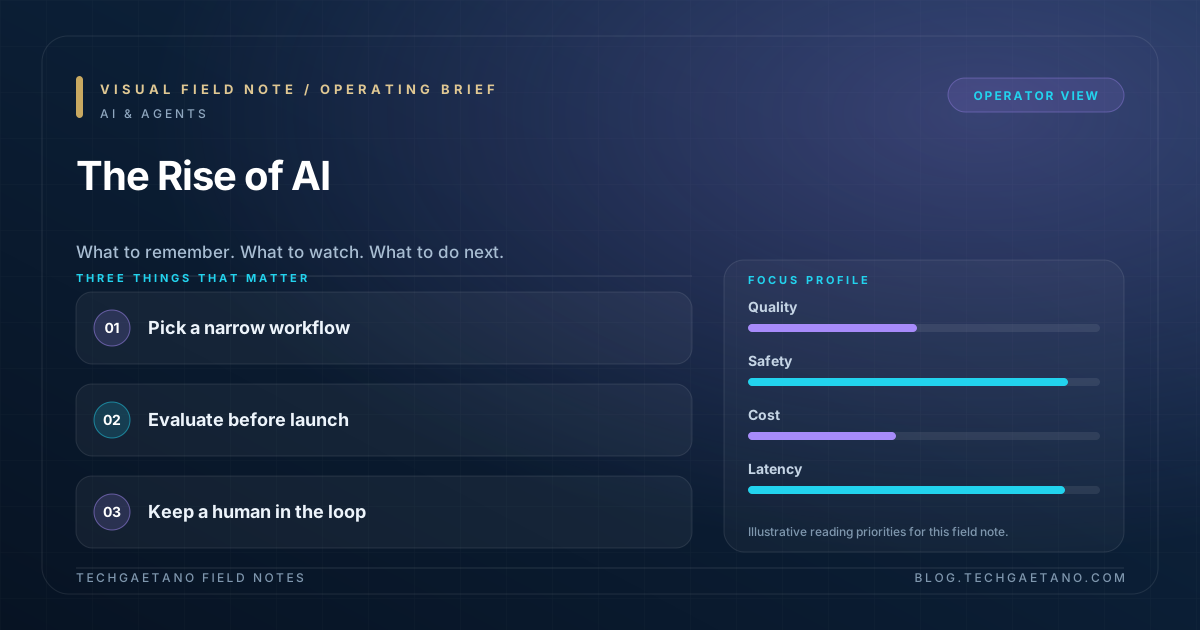
Operating brief
The three decisions that matter and the signals to watch.
Moving AI from prototype to production?
TechGaetano helps teams design agent architectures, secure tool access, and build evaluation and governance into the delivery lifecycle.
Discuss your AI platformFrequently asked questions
What is The Rise of AI?
Artificial intelligence has moved from the pages of science fiction into the engine rooms of the modern economy. In less than a decade, AI has transformed how we search, how we write, how we diagnose diseases, how we trade stocks, and how we drive. Its rise is.
How should a team get started with The Rise of AI?
Start with a narrow workflow, define an evaluation set and success metrics, and keep a human in the loop for high-impact actions. Version prompts, tools, and model choices like any other production dependency.
What should teams avoid when working on The Rise of AI?
The main risks are prompt injection through untrusted tool results, over-broad tool permissions, missing evaluations, and exposing production systems without audit trails or human approval.
Further reading
Related posts

Claude AI, Reviewed: A Practitioner's Verdict
Claude has crossed an important threshold. It is no longer the interesting alternative you try on a side project; for a growing number of engineering…
Read more
AI Governance for the Enterprise: From Principles to Operating Model
Most enterprises now have an AI principles document. It says the organization will be transparent, fair, accountable, and secure. It may reference hum…
Read more