Article · AI & Agents
Claude AI, Reviewed: A Practitioner's Verdict
By Caleb · October 27, 2026

Claude has crossed an important threshold. It is no longer the interesting alternative you try on a side project; for a growing number of engineering and writing teams, it is the model they reach for first. That deserves a proper verdict rather than another breathless launch reaction.
This review is written from the perspective of someone who has to run these systems in production: pay the bills, pass security review, measure quality, and explain to a board why the stack changed again. The question is not whether Claude is good. It is where Claude is the right default, where it is not, and what you should put around it either way.
The short verdict
Claude is an excellent primary model for code-heavy work, long-document reasoning, and prose that needs less editing. It is a weaker choice for teams that need the broadest multimodal platform, the lowest possible cost per token, or hard guarantees about model behaviour across versions.
The practical recommendation: make Claude a first-class provider, not the only provider. Put a model gateway in front of it, keep an evaluation suite, and negotiate the commercial terms before the workload becomes critical.
What Claude gets right
Writing that needs less editing
Most models can produce fluent text. Fewer produce text that survives an edit without being rewritten. Claude is unusually good at holding a brief: tone, audience, length, and the constraints you actually care about. It follows negative instructions well, which matters more than it sounds. Telling a model "do not use bullet points" or "do not mention pricing" is often ignored elsewhere; Claude tends to comply.
For teams producing documentation, proposals, policy summaries, and customer-facing copy, that reliability reduces the hidden cost of AI: the editing labour that eats the time saved.
Code review, refactors, and agentic loops
Claude's reputation in engineering is earned. It is strong at reading a codebase, explaining a failure, and proposing a minimal change rather than a rewrite. In agentic setups, it tends to stay on task, call tools in a sensible order, and recover from a failed command without spiralling.
That matters because the value of coding assistants is moving from autocomplete to delegated work: fix this failing test, migrate this module, investigate this alert. Claude is one of the few models that behaves like a careful junior engineer rather than an enthusiastic intern. It still needs supervision, tests, and review, but the supervision burden is lower than average.
Long context that is actually usable
Claude handles long inputs well, including contracts, design docs, logs, and multi-file codebases. Raw context size is not the point; the useful question is whether the model can find and use the relevant detail without losing the thread. Claude is good at citing the right section, noticing contradictions, and preserving earlier constraints across a long conversation.
For legal, compliance, and technical review workflows, that is a genuine differentiator. It is also why Claude pairs well with retrieval: you can supply a substantial evidence pack and ask for a grounded answer.
Safety and enterprise posture
Anthropic built Claude around Constitutional AI and a safety-first positioning, and that shows up in conservative behaviour. For regulated enterprises, conservatism is often a feature. The model is less likely to produce something that embarrasses you in a customer interaction, and the company's enterprise documentation, data-processing terms, and attestations are mature enough for most procurement processes.
Two caveats. First, verify the current certifications and data-residency options for your jurisdiction rather than assuming. Second, confirm the training-data terms for the specific product you use. Consumer and API terms are not always identical, and they change.
MCP and tool connectivity
Anthropic originated the Model Context Protocol, and Claude clients support it well. That gives Claude a practical advantage in enterprises that are standardising how models reach internal tools and data. Instead of writing bespoke function-calling glue for every assistant, you expose a tool once through an MCP server and let compatible clients use it.
This is strategically important. The model is interchangeable; the integrations are not. A tool layer built on an open protocol reduces lock-in even if you standardise on Claude today.
Where Claude still falls short
Cost at the top end
Claude's best models are priced like premium tools, and agentic workloads consume far more tokens than chat. A coding agent that reads files, runs tests, and iterates can burn through a budget quickly. Consumer plans are affordable; production usage at scale is not.
The fix is not to avoid Claude. It is to route: use a smaller model for classification, extraction, and simple edits; reserve the frontier model for reasoning and code changes; cache aggressively; and set per-team budgets. If you cannot measure cost per request, you cannot control it.
Latency and capacity
Frontier models are not instant. For interactive chat that is acceptable; for voice, real-time control, or high-volume background jobs it can be a constraint. Rate limits and capacity also vary by tier, and a pilot that works at low volume can hit ceilings in production.
Design for this from the start: queues for non-interactive work, streaming for user-facing responses, timeouts, retries with backoff, and a fallback provider for peak load.
Version churn and reproducibility
Claude models are updated, deprecated, and renamed on a cadence that no production team enjoys. A prompt tuned against one version can behave differently on the next. If your product depends on exact output shape, that is a real operational risk.
Mitigate with version pinning where offered, a regression suite, and a policy that no model upgrade reaches production without evaluation. Treat prompts and model versions as deployable artefacts, not configuration trivia.
Ecosystem and modality gaps
Claude is excellent at text, code, and document understanding. It is not the broadest platform. Teams that need image generation, video, voice cloning, real-time speech, or a huge marketplace of prebuilt connectors will find more elsewhere. Claude can call tools that provide some of these capabilities, but that is integration work, not a native feature.
Conservative refusals
Safety is a strength until it becomes friction. Claude can refuse or hedge on legitimate work involving security research, medical content, or sensitive historical material. The refusals are usually reasonable, but they are not always predictable. Teams in edge-case domains should test their actual workload rather than relying on demos.
Opaque limits
Context windows, rate limits, and feature availability differ by model, plan, and API tier. Documentation is decent but sprawls. Budget time for a proper technical evaluation instead of assuming the marketing page applies to your account.
How it compares
OpenAI remains the broader platform. If you need one vendor for text, images, voice, real-time APIs, and a large ecosystem, OpenAI is hard to beat. Claude's advantage is concentrated in writing quality, coding, and long-document work.
Google wins on integration with Workspace and Google Cloud, strong multimodal models, and enormous context windows. Teams already standardised on Google infrastructure get a smoother path. Claude is often the better pure writer and code reviewer.
Open models have closed much of the quality gap for narrow tasks. They offer control, cost advantages at high volume, and data residency that hosted APIs cannot always match. The trade-off is operational burden: serving, scaling, evaluating, and securing the inference stack becomes your problem.
The honest conclusion is that the top three hosted models are close enough that procurement, data terms, latency, and integration quality now matter as much as benchmark scores. Anyone quoting a single benchmark as a decisive verdict is selling something.
The operational verdict
Use Claude as the primary model when:
- Your workload is code-centric, especially multi-step agent workflows.
- You process long documents and need grounded, well-cited answers.
- Customer-facing prose quality is a competitive advantage.
- You are building internal tools through MCP and want a model that supports the protocol well.
- Your security team values conservative behaviour and mature enterprise terms.
Do not make Claude your only provider when:
- You need native image, video, or real-time voice generation.
- Your unit economics depend on the cheapest possible token.
- You have a hard latency budget under a few hundred milliseconds.
- Data residency requirements rule out the available regions.
- You cannot tolerate periodic model behaviour changes without warning.
The architecture that works is boring and effective: a model gateway with routing and fallback, a prompt and version registry, an evaluation suite that runs before every change, and cost caps per application. That setup lets you use Claude where it is strongest without betting the company on a single vendor.
What would change the verdict
Three developments would strengthen Claude's position materially: more predictable versioning and deprecation windows, broader regional deployment for data-residency-sensitive customers, and better price-performance at the mid-tier for high-volume agent work. None of these are unreasonable, and all are plausible.
A serious regression in coding quality or a sharp price increase would weaken the case. So would a competitor offering clearly better agent reliability at half the cost. Watch the evaluations, not the launch posts.
Bottom line
Claude is the best general-purpose model I would choose today for engineering teams that write a lot of code and a lot of prose. It is not the cheapest, not the fastest, and not the broadest. It is the most dependable at the work that compounds: understanding context, making a careful change, and explaining itself.
Verdict: strongly recommended as a primary provider, with a second provider behind a gateway and an evaluation suite you actually run. Treat it like a senior hire, not a magic wand. That framing will keep you out of most of the trouble.
Visual field notes
The system at a glance
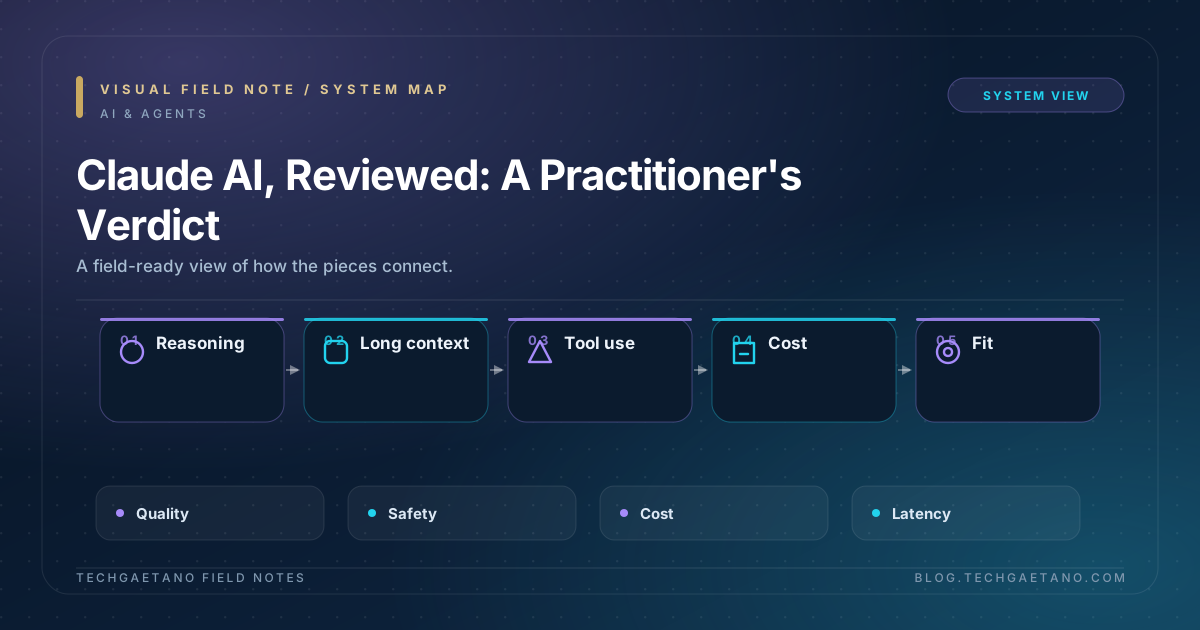
System map
How the moving parts connect, from first input to operating outcome.
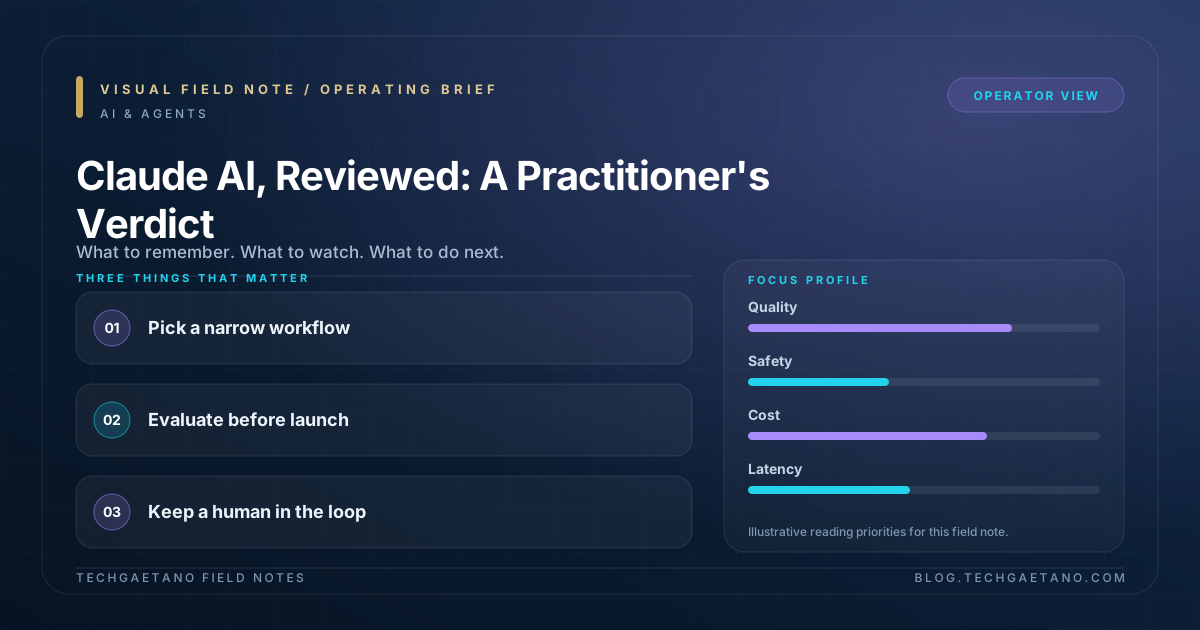
Operating brief
The three decisions that matter and the signals to watch.
Moving AI from prototype to production?
TechGaetano helps teams design agent architectures, secure tool access, and build evaluation and governance into the delivery lifecycle.
Discuss your AI platformFrequently asked questions
What is Claude AI?
Claude has crossed an important threshold. It is no longer the interesting alternative you try on a side project; for a growing number of engineering and writing teams, it is the model they reach for first. That deserves a proper verdict rather than another br.
How should a team get started with Claude AI?
Start with a narrow workflow, define an evaluation set and success metrics, and keep a human in the loop for high-impact actions. Version prompts, tools, and model choices like any other production dependency.
What should teams avoid when working on Claude AI?
The main risks are prompt injection through untrusted tool results, over-broad tool permissions, missing evaluations, and exposing production systems without audit trails or human approval.
Further reading
Related posts
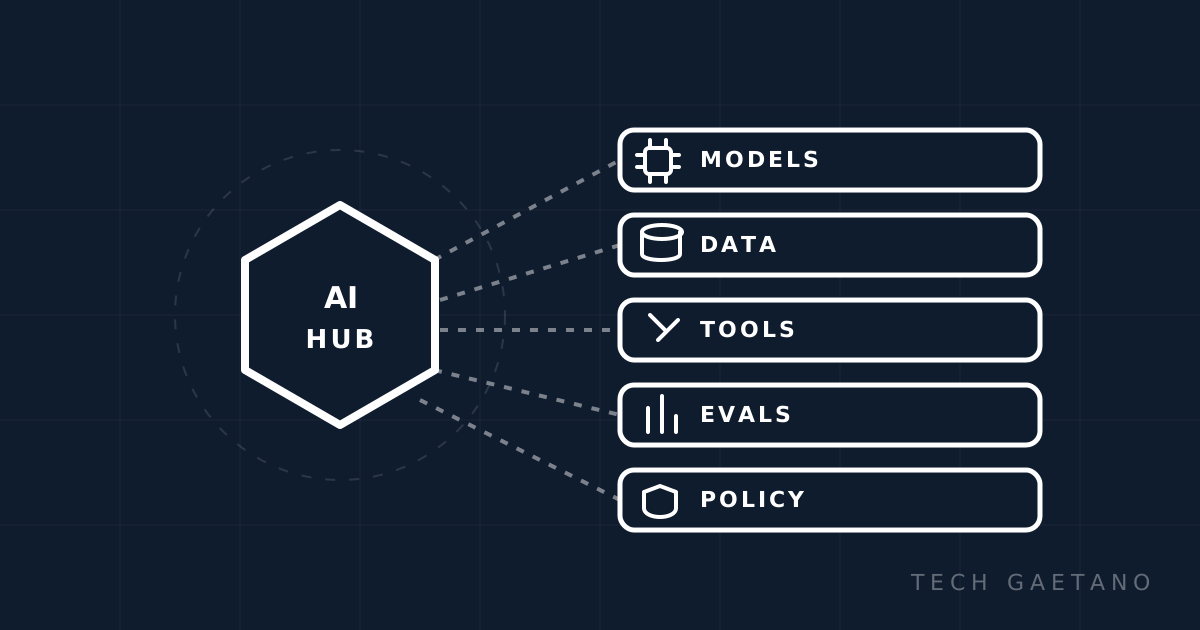
The Future AI Hub: Architecture for a Multi-Model Enterprise
Most companies now have an AI story. Fewer have an AI architecture. The difference shows up the second time a model changes, the first time an auditor…
Read more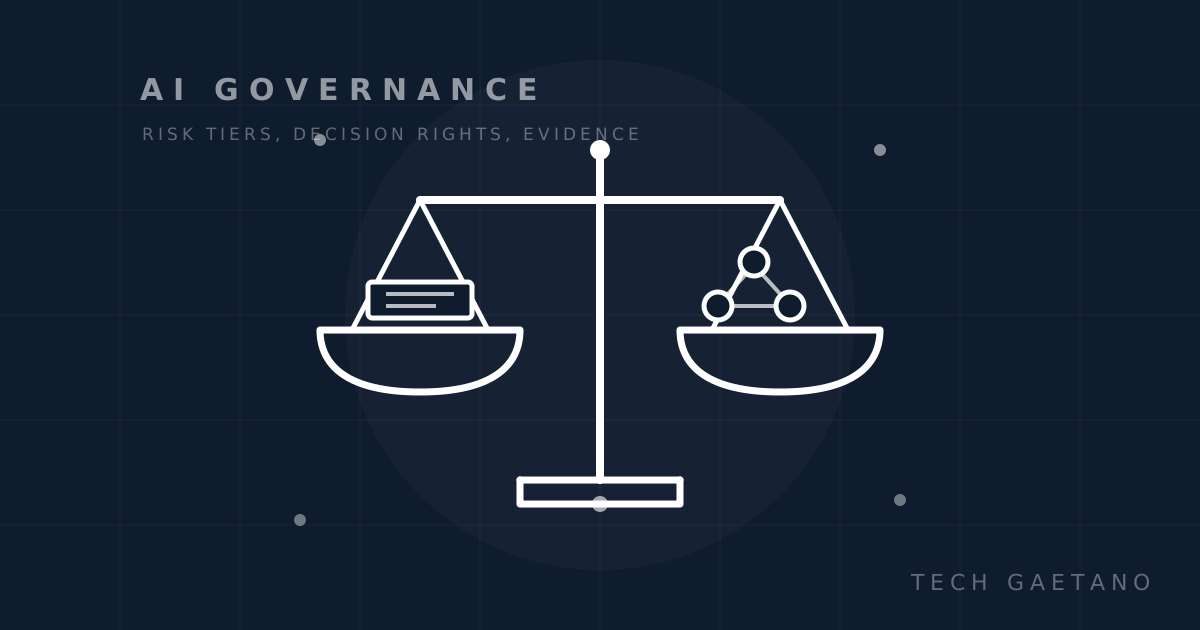
AI Governance for the Enterprise: From Principles to Operating Model
Most enterprises now have an AI principles document. It says the organization will be transparent, fair, accountable, and secure. It may reference hum…
Read more