Article · AI & Agents
MCP vs REST vs gRPC: When Should You Use Model Context Protocol?
By Caleb · October 27, 2026
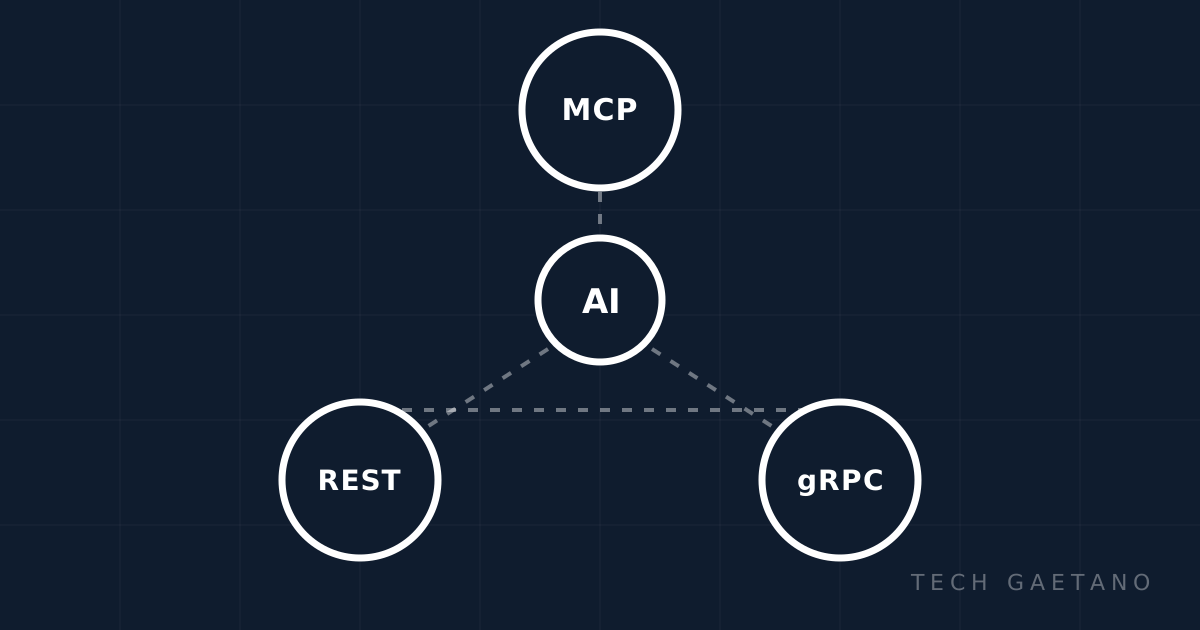
The question sounds like a showdown, and that is the first problem. REST, gRPC, and the Model Context Protocol are not three competitors in the same category. REST and gRPC are ways for software services to talk to each other. MCP is a way for an AI host to discover and use tools and context. Asking which one wins is like asking whether you should use HTTP or a database driver.
That does not mean the question is useless. Teams genuinely need to decide where each protocol belongs, and getting it wrong produces either unnecessary complexity or a security mess. Here is a practical framework for choosing.
The category error
REST and gRPC answer the question: how does one service call another reliably and efficiently? MCP answers a different question: how does a model-driven application expose tools, resources, and prompts to an AI client in a standard way?
In a real system, they stack. A Claude or ChatGPT client talks to an MCP server. That MCP server calls your internal REST or gRPC services. Those services talk to databases and queues. You are not replacing REST with MCP; you are inserting a model-facing layer in front of the APIs you already have.
REST, briefly
REST is the default for public APIs because it uses ordinary HTTP semantics: resources have URLs, verbs describe intent, responses are cacheable, and everything can be debugged with curl. OpenAPI gives you a contract and a healthy ecosystem of gateways, clients, and documentation tools.
Use REST when you need broad client compatibility, cacheable reads, public or partner APIs, and straightforward operations. Its weaknesses are chattiness, verbose payloads, and weak built-in streaming. You can add server-sent events or WebSockets, but then you are layering features onto a model that was not designed for them.
gRPC, briefly
gRPC is contract-first: you define messages and methods in Protocol Buffers, generate clients, and get strongly typed calls over HTTP/2. It supports multiplexing, bidirectional streaming, deadlines, and efficient binary payloads. It is the natural choice for service-to-service traffic inside a platform, especially in polyglot environments and service meshes.
The costs are real. Browser support requires gRPC-Web or a proxy. Debugging binary frames is less pleasant than reading JSON. Schema evolution needs discipline, and the tooling is heavier than a REST endpoint. For low-volume internal APIs, gRPC can be overkill.
MCP, briefly
MCP is an open protocol introduced by Anthropic in late 2024 and since adopted across the industry. It uses JSON-RPC 2.0 and defines three roles: a host (the AI application), a client (the connector inside the host), and a server (the thing exposing capabilities).
MCP servers expose three primitives:
- Tools: functions the model can call, with schemas and descriptions.
- Resources: contextual data the host can read, such as files or records.
- Prompts: reusable prompt templates the server makes available.
Transport is typically stdio for local servers or Streamable HTTP for remote ones. The newer specification revisions added a proper authorization model based on OAuth 2.1 patterns, including resource indicators and audience-bound tokens. That matters: earlier implementations often passed user tokens straight through to downstream APIs, which is exactly the kind of confused-deputy problem security teams lose sleep over.
MCP's purpose is standardisation. Before it, every AI vendor had its own function-calling format, and every integration was written N times for M clients. MCP turns that into N plus M: expose a tool once, and any compatible host can use it.
The decision matrix
Choose REST when
- You are building a public or partner-facing API.
- The workload is CRUD, search, or resource retrieval.
- Responses benefit from HTTP caching, CDNs, or conditional requests.
- You want the widest possible client support and the simplest debugging story.
- The API will be consumed by browsers, mobile apps, and third parties.
Choose gRPC when
- Traffic is internal, service-to-service, and high volume.
- You need low latency, streaming, or strict typed contracts.
- Multiple languages must share a generated client.
- You already run a service mesh with mTLS and observability.
- Deadlines, retries, and backpressure need first-class support.
Choose MCP when
- You are exposing tools or context to one or more AI hosts.
- You want a connector that works across Claude, IDE agents, and other MCP-compatible clients.
- The integration needs dynamic discovery of tools and schemas.
- You want human-in-the-loop approval, tool-level permissions, and auditability at the AI boundary.
- You are building an internal AI platform and want to avoid bespoke function-calling glue.
Use more than one when
Almost always. A typical enterprise stack uses gRPC between internal services, REST for public and browser-facing APIs, and MCP servers as thin adapters for AI access. The MCP server should call the existing REST or gRPC service rather than reimplementing business logic.
Where the latency actually goes
Protocol debates often ignore the dominant cost. A model turn takes hundreds of milliseconds to several seconds. A REST or gRPC call inside your network takes single-digit milliseconds. MCP adds a JSON-RPC hop and some schema overhead, which is noise next to inference.
What does matter:
- Tool fan-out. Ten sequential tool calls at 200 ms each is two seconds before the model even responds.
- Payload size. Pulling a megabyte of JSON into the context window costs tokens and time.
- Cold starts. Serverless MCP servers and edge functions add latency on the first request.
- Streaming. Users perceive latency differently when tokens stream immediately.
- Retries and timeouts. A slow downstream API with no deadline turns into a stuck agent.
Optimise those before arguing about protocol framing.
Security: three different threat models
REST security is familiar: OAuth or OIDC, scopes, rate limits, input validation, and careful authorization on every resource. The main risks are broken object-level authorization and over-broad tokens.
gRPC security leans on transport: mTLS, workload identity, authorization interceptors, and short-lived certificates. The main risks are misconfigured mesh policies and services that trust anything inside the cluster.
MCP introduces a new and less mature threat surface. Tool descriptions and tool results are untrusted input that goes into a model's context. A malicious document can contain instructions that cause the model to call a destructive tool. Tool poisoning, prompt injection, and confused-deputy attacks are real.
Practical controls:
- Keep MCP servers thin and enforce authorization inside them, not in the model prompt.
- Never pass a user's token through to a downstream API without audience restriction. Use token exchange or server-held credentials with explicit scopes.
- Require human approval for destructive or high-value actions.
- Log every tool call with the identity, arguments, and result summary.
- Treat tool descriptions as versioned API contracts and review changes.
- Sandbox tools that execute code or touch production data.
MCP is not a security boundary by itself. It is an integration boundary that must be secured like any other.
Example: a thin MCP adapter
Keep the business logic in the existing REST or gRPC service. The MCP server should authenticate the caller, enforce authorization, and return a compact result.
// mcp-adapter.ts
import { McpServer } from "@modelcontextprotocol/sdk/server/mcp.js";
import { z } from "zod";

const server = new McpServer({ name: "orders", version: "1.0.0" });

server.tool(
  "get_order",
  { orderId: z.string().uuid() },
  async ({ orderId }, extra) => {
    const res = await fetch(`${process.env.API_BASE_URL}/orders/${orderId}`, {
      headers: { Authorization: `Bearer ${process.env.API_TOKEN}` },
    });

    if (!res.ok) {
      return {
        isError: true,
        content: [{ type: "text", text: `Order API returned ${res.status}` }],
      };
    }

    return {
      content: [{ type: "text", text: await res.text() }],
    };
  }
);
Use a server-held credential with the narrowest scope that works, or exchange the user's token for an audience-bound token. Do not forward a general user token to downstream APIs. For a deeper introduction to the protocol itself, read MCP, Explained.
The architecture that works
Keep systems of record behind REST or gRPC. Put a small MCP server in front of them for AI access. Route all model traffic through a gateway that handles authentication, quotas, logging, and provider fallback.
A clean flow looks like this:
- The AI host authenticates the user and obtains a scoped token.
- The host calls an MCP server over Streamable HTTP.
- The MCP server validates the token, checks the user's permissions, and calls the internal REST or gRPC service.
- The internal service enforces its own authorization and returns data.
- The MCP server returns a compact, structured result to the model.
- The gateway logs the call, cost, latency, and outcome.
That design keeps business logic in one place, gives security a single enforcement point, and lets you swap models without rewriting integrations.
Common mistakes
- Replacing REST with MCP internally. Wrong layer. You will build a slower, less observable service API.
- Using gRPC for browser clients without a proxy. You will spend a week on gRPC-Web and still fight intermediaries.
- Building one MCP server per vendor. Defeats the standard. Build one server per system, not per client.
- Exposing raw database access as a tool. Convenient in a demo, catastrophic in production.
- Ignoring tool result size. A tool that returns the entire table will blow your context budget and your latency target.
- Trusting the model to enforce permissions. Authorization belongs in code, not in a prompt.
Bottom line
MCP does not replace REST or gRPC, and it is not trying to. It standardises the boundary between AI hosts and the tools they use. REST remains the right choice for public resources, gRPC for high-performance internal services, and MCP for exposing those capabilities to models in a portable way.
Choose by layer, not by fashion. If you are exposing a tool to an AI client, use MCP. If you are building the service behind it, use the protocol your platform already supports. The teams that get this right treat MCP as a thin, well-audited adapter, not as a new monolith.
Visual field notes
The system at a glance
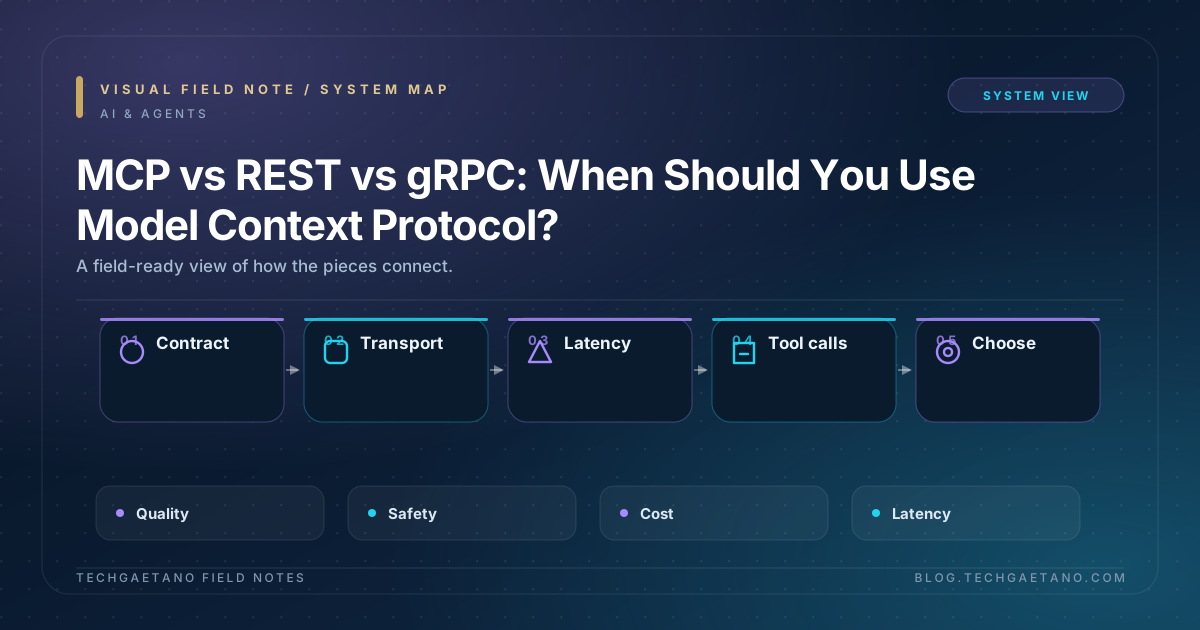
System map
How the moving parts connect, from first input to operating outcome.
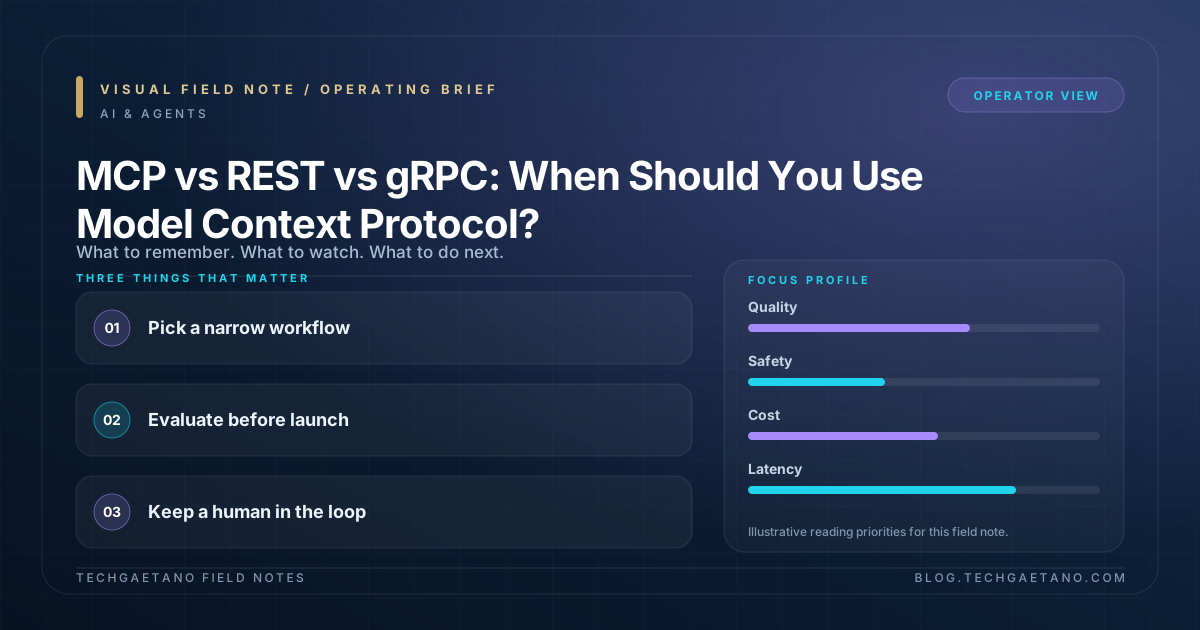
Operating brief
The three decisions that matter and the signals to watch.
Moving AI from prototype to production?
TechGaetano helps teams design agent architectures, secure tool access, and build evaluation and governance into the delivery lifecycle.
Discuss your AI platformFrequently asked questions
What is MCP vs REST vs gRPC?
The question sounds like a showdown, and that is the first problem. REST, gRPC, and the Model Context Protocol are not three competitors in the same category. REST and gRPC are ways for software services to talk to each other. MCP is a way for an AI host to di.
How should a team get started with MCP vs REST vs gRPC?
Start with a narrow workflow, define an evaluation set and success metrics, and keep a human in the loop for high-impact actions. Version prompts, tools, and model choices like any other production dependency.
What should teams avoid when working on MCP vs REST vs gRPC?
The main risks are prompt injection through untrusted tool results, over-broad tool permissions, missing evaluations, and exposing production systems without audit trails or human approval.
Further reading
Related posts
The Future AI Hub: Architecture for a Multi-Model Enterprise
Most companies now have an AI story. Fewer have an AI architecture. The difference shows up the second time a model changes, the first time an auditor…
Read more
Claude AI, Reviewed: A Practitioner's Verdict
Claude has crossed an important threshold. It is no longer the interesting alternative you try on a side project; for a growing number of engineering…
Read more