Article · Cybersecurity
Malicious AI Hacking Tools: A Defense Guide to WormGPT, ARTEX, and 10 More Threats

By Caleb Ngeno · November 17, 2026

Abstract. Malicious AI tools are no longer a single chatbot with an unsafe name. Public reporting in 2025 and 2026 shows a market of paid dark LLMs, fraud copilots, agentic penetration-test frameworks, patch-to-exploit research agents, credential abuse services, AI phishing platforms, synthetic identity kits, and self-modifying malware. This article is educational. It explains the tools at a threat-model level and proposes practical ways to stop each one. It also contrasts them with good AI, including reported OpenAI Codex Security findings in Apple devices. It gives no commands, prompts, exploit steps, or setup instructions. The main lesson is that most named tools are wrappers around models, stolen access, public code, or exposed infrastructure. That makes identity control, exposure management, tool governance, payment tracing, and behavior-based detection more useful than chasing brand names.
Keywords: malicious AI tools, WormGPT, FraudGPT, GhostGPT, ARTEX, CAIRN, CyberStrikeAI, PentAGI, LLMjacking, AI phishing, dark LLM, AI malware, defensive security
The phrase "malicious AI tool" is used loosely. Some names refer to a real product. Some are clone brands. Some are marketing labels for a private Telegram or Discord service. Some are research projects that attackers reuse. This article groups them by what they do and how a defender can interrupt them.
This is for study and defense only. It describes public findings from security vendors and government agencies. It does not explain how to buy, configure, prompt, or operate any of these tools.
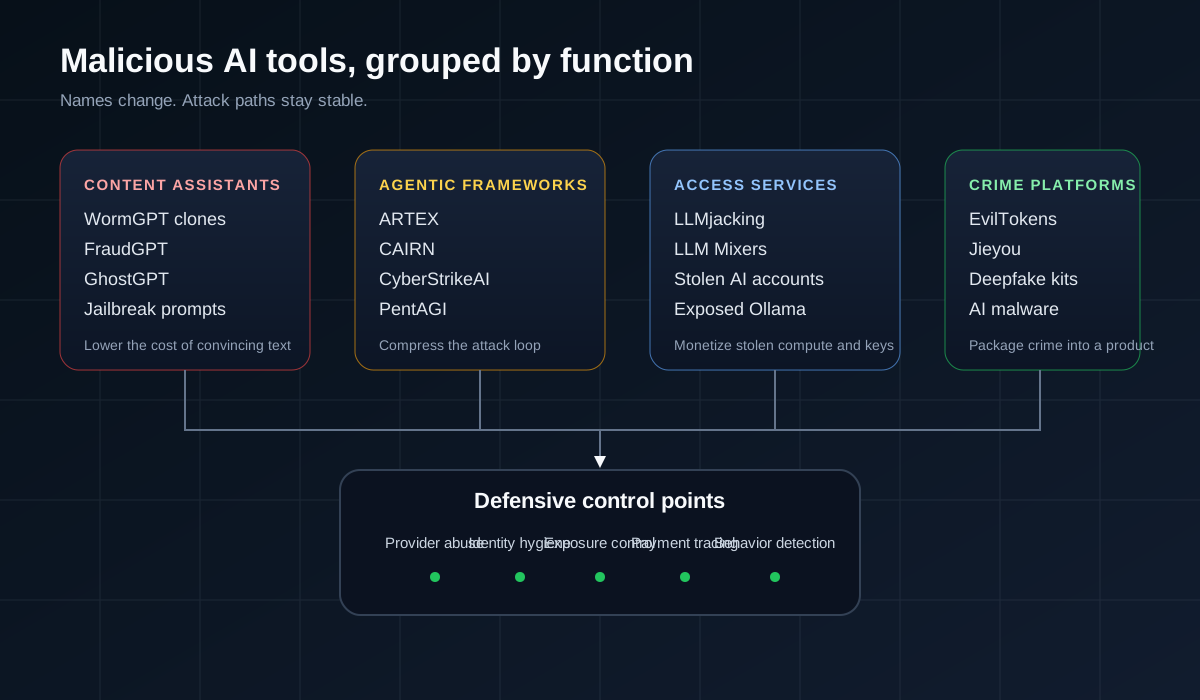
The short version
Most malicious AI tools do not invent a new kind of attack. They reduce time and skill. A dark LLM removes the need to write convincing text. An agentic framework removes much of the manual work in reconnaissance and exploitation. A phishing platform gives non-technical criminals a clean dashboard. An LLMjacking service turns stolen cloud keys into resale income.
That matters because the defensive path is familiar. Stop the tool by breaking one or more links in the chain:
- Stop access to the model, key, console, or infrastructure.
- Stop the payment and account infrastructure that funds the service.
- Stop the email, domain, app, or cloud identity used for delivery.
- Stop the exposed service or vulnerable asset the tool needs.
- Stop the behavior after access, through logging, least privilege, and response.
Tool names change quickly. These control points do not.
The good side: AI that finds flaws first
Malicious AI tools are only one half of the story. The same reasoning and tool use can help defenders find bugs before criminals do. OpenAI launched Codex Security in March 2026 as an application security agent. OpenAI says it builds a repository-specific threat model, investigates potential vulnerabilities, validates findings in an isolated environment, and proposes patches for human review. In April 2026, OpenAI said Codex Security had contributed to more than 3,000 critical and high severity fixed vulnerabilities.
Apple's 2026 security notes show the effect. Computer Weekly reported that nine of close to 20 WebKit issues in one update were attributed to a researcher using OpenAI tools. MacObserver counted at least 13 WebKit CVEs across two August documents that credited OpenAI Codex Security. Apple also told Reuters that it was accelerating patch cadence because AI can compress the time between discovery and exploit code.
On November 17, 2026, a breaking social media report said a new OpenAI model found 35 vulnerabilities in Apple devices, including flaws that could let attackers take control of iPhones and Macs. That report is a signal of capability, but the number should be treated as a claim until OpenAI or Apple publishes detail. The verified record already shows AI-assisted WebKit findings in Apple advisories, and it shows why fast patching matters.
The defensive lesson is not to ban AI security research. It is to run it with rules. Use isolated validation, coordinated disclosure, human review, clear scope, and a fast patch process. Apple also capped some bug bounty submissions after a surge in AI-generated reports, according to the Financial Times and 9to5Mac. That is the other half of good AI discipline: more findings create more triage work, and low-quality reports can bury real bugs.
Good AI does not remove the need for judgment. It changes the workload. Teams that can validate and patch quickly gain an advantage. Teams that cannot will face both attackers and a backlog of reports.
1. WormGPT and dark LLM subscriptions
WormGPT was reported in 2023 as an uncensored language model marketed for phishing and malware writing. Outpost24 described it as one of the first commercial dark AI tools, with access sold through private channels. Later reporting found many clones using the WormGPT name. The brand outlived the original service.
Group-IB reported that at least three dark LLM vendors were active in 2025, with subscriptions priced from about $30 to $200 per month. The value proposition is simple: a user pays for fewer refusals, prewritten criminal prompts, and a helper that sounds confident.
How to stop it: Providers can detect coordinated abusive signups, block leaked payment instruments, and share indicators with platforms and payment processors. Buyers can be disrupted through subscription seizures and account bans. Enterprises should assume that convincing text is cheap. Use DMARC, SPF, and DKIM, domain lookalike monitoring, out-of-band verification for payments, and phishing-resistant MFA. Teach staff that good grammar is no longer a trust signal.
2. FraudGPT, Evil-GPT, and GhostGPT fraud copilots
These tools focus on fraud work rather than generic hacking. Public reports describe phishing copy, business email compromise drafting, scam site content, and support for malware or exploit questions. Some are private subscriptions. Some are one-time access services. Some are just renamed wrappers around a hosted model.
The important defensive point is that the model output is only the front end. The attack still needs delivery infrastructure: domains, mailboxes, phone numbers, wallet addresses, web hosting, and stolen credentials. That gives defenders several places to act.
How to stop it: Monitor newly registered lookalike domains, enforce email authentication, and flag unusual payment instruction changes. Use vendor and bank verification through a known channel, not the channel in the message. Apply conditional access, impossible-travel checks, and session revocation. Payment providers and platforms can disrupt these services through merchant abuse monitoring, wallet freezing, and referral to law enforcement.
3. Jailbreak-as-a-service and stolen AI accounts
Not every malicious AI tool is a separate model. Some services sell jailbreak prompts, leaked system instructions, or access to compromised AI accounts. Rapid7 and other vendors have documented a market around stolen accounts and custom prompts that try to remove safety controls.
This category is important because it lets attackers use legitimate providers. Traffic may look like a normal enterprise account until usage spikes appear. The abuse can include phishing content, vulnerability research assistance, malware refactoring, and bulk translation of scams.
How to stop it: Treat AI accounts as high-value identities. Require MFA, short-lived tokens, device checks, and separate service accounts. Alert on new API keys, unusual regions, abnormal token volume, and sudden model changes. Scan code repositories and logs for leaked keys. Revoke sessions quickly when a device is lost or an employee leaves. Providers can detect prompt patterns at scale, but enterprises should not depend on provider filters alone.
4. ARTEX and agentic penetration-test frameworks
Google Threat Intelligence Group reported in November 2026 that multiple threat actors were using open-source agentic penetration-test frameworks during intrusions. It named ARTEX, CAIRN, CyberStrikeAI, and PentAGI. Google described a shift from chatbot help to systems that can coordinate tasks and move faster than manual operators.
Check Point reported ARTEX campaigns against gray-market iOS signing certificate shops. That reporting showed certificate theft and credential theft at scale, but it did not show a breach of Apple internal systems. The lesson is about supply-chain targets and speed, not only famous brand names.
How to stop it: Remove exposed consoles and weak administrative interfaces from the internet. Put identity in front of every management plane. Patch edge devices on a short clock. Use EDR and cloud logs to detect rapid sequences of discovery, privilege changes, and lateral movement. Segment critical systems so one stolen account cannot open a path to many others. Keep tested offline backups, because fast intrusions often move toward data theft and extortion.
5. CyberStrikeAI, HexStrike AI, and tool-connector frameworks
Some frameworks act as orchestration layers. They connect a model to scanners, cloud tools, browsers, and other services. Google named CyberStrikeAI in its 2026 threat update. Halcyon described HexStrike AI as an agentic offensive framework with more than 150 integrations. The exact feature count matters less than the pattern: a model can call many tools in sequence and keep results in one workflow.
This is where AI assistance becomes operationally useful. A person still sets goals and makes decisions, but the tool reduces the time between finding a weakness and acting on it.
How to stop it: Govern every tool interface as a privileged API. Use allowlists, separate service accounts, scoped tokens, and audit logs. Block direct outbound access from build systems and developer laptops to unknown automation endpoints. Sandbox security tooling that can reach production. Watch for machine-speed calls, such as hundreds of discovery actions in minutes, and throttle or isolate the source. Treat "agent" accounts as non-human identities with owners and expiry dates.
6. CAIRN and PentAGI as multi-agent workers
CAIRN and PentAGI were named in Google's Q4 2026 update as examples of multi-agent frameworks seen in threat activity. Multi-agent systems split work across roles. One part may gather public data, another may summarize findings, and another may track tasks. For defenders, the precise split is less important than the operational result: more work happens between human decisions.
This speeds up the "scan, decide, act, learn" loop. It also creates more telemetry. Each agent call, tool call, and data access can leave a trace if logging is enabled.
How to stop it: Centralize logs from identity providers, endpoints, cloud control planes, and security tools. Correlate by user, device, token, and time. Alert on compressed attack chains, such as reconnaissance followed quickly by account changes or bulk downloads. Use canary accounts and canary files to catch automated discovery. Give incident responders playbooks that assume the first alert is part of a chain, not an isolated event.
7. exploit_agent and patch-to-exploit research agents
PT Security's 2026 report described exploit_agent as a system that can analyze security patches and infer exploit paths. This is a different kind of risk. It does not need a stolen model or an underground forum. Public patches and advisory notes are enough input for a research assistant that helps a skilled attacker move faster.
This does not mean every patch will be exploited. It does shorten the window between disclosure and active abuse, especially for internet-facing systems with known weaknesses.
How to stop it: Reduce time to patch for exposed assets. Maintain a live inventory of public-facing services and remove what does not need to be public. Use virtual patching or WAF rules while fixes roll out. Subscribe to vendor advisories and prioritize by exposure, not by internal preference. Add canary tokens to files and services that attackers like to enumerate. Monitor patch-diff scanning and unusual traffic to endpoints tied to new advisories.
8. LLMjacking and LLM mixer services
Google's LLMjacking report described attackers who steal cloud credentials and use them to run large volumes of model inference. In some incidents, fraudulent charges exceeded $100,000 in one day. Sysdig later described "LLM Mixers," where stolen access is pooled, resold, and routed through different accounts.
This is malicious AI infrastructure without a malware payload on the victim machine. The asset is the victim's cloud account and API quota. The attacker sells access or uses the compute for other criminal work.
How to stop it: Scan for leaked keys in repositories, CI logs, and developer machines. Use separate projects or subscriptions for AI workloads, with hard budgets and anomaly alerts. Apply least privilege to service accounts and rotate keys on a schedule. Disable unused regions, models, and APIs. Watch for new keys, unusual model choices, strange user agents, and sudden token volume. Add spend controls that fail closed instead of only sending email alerts.
9. EvilTokens and Jieyou-style AI phishing platforms
Recorded Future described EvilTokens as an AI-powered phishing-as-a-service platform. It reported more than 65,000 credential theft attempts across over 200 Microsoft accounts since July 2025. Check Point also described Jieyou, a Chinese-language PhaaS platform sold to a large criminal user base, with AI-assisted landing pages and anti-detection features.
These platforms matter because they package phishing into a product. A customer does not need to write code, host pages, or send mail. The platform provides templates, dashboards, and infrastructure.
How to stop it: Use phishing-resistant MFA for critical accounts. Block legacy authentication. Review OAuth app consent grants and mailbox rules. Alert on sign-ins from new devices and impossible locations. Register and monitor lookalike domains. Send reported messages to a mailbox analysis pipeline that checks URLs, sender alignment, and page behavior. Domain registrars, hosting providers, and email providers can disrupt these services through abuse reports, infrastructure seizure, and repeated account bans.
10. Deepfake and synthetic identity kits
AhnLab's 2026 report described AI-powered impersonation tools used in voice phishing, fake recruitment, and investment fraud. These kits combine voice cloning, face generation, script writing, and social engineering templates. The aim is to make a fake person sound familiar and a fake company look real.
The tool is only one part of the crime. The attack needs a channel, a pretext, and a money mule or payment route. That gives defenders ways to intervene before a transfer happens.
How to stop it: Never approve high-value payments from a single voice call or video call. Use a written callback to a known number and a second approver. Train finance and HR teams on voice cloning and fake interview scenarios. Use liveness checks for identity verification, and add device and document checks where regulation allows. Banks can add behavioral signals around new payees, unusual transfer timing, and mule account patterns. Platforms can label synthetic media and remove impersonation assets quickly.
11. Promptflux, Promptsteal, Honestcue, and AI-augmented malware
Check Point reported samples named Promptflux and Promptsteal in 2026. It also described Honestcue, an information stealer that sends gathered data to an LLM for analysis. Promptspy was reported as Android malware that uses generative AI at runtime to adapt its behavior. These names show different uses of AI inside malware: content generation, data triage, and adaptation.
This does not create magic malware. Endpoint controls and basic hygiene still work. The change is that malware can produce more varied text, adapt screens or prompts, and help an operator sort stolen data faster.
How to stop it: Keep operating systems and apps patched. Use application control and reputable endpoint protection. Restrict script execution and macro use. On mobile, use MDM, play protect style checks, app allowlists, and monthly patch compliance. Monitor outbound traffic from unexpected processes and large uploads from new binaries. Treat LLM API calls from endpoints as suspicious unless an approved application needs them.
12. Exposed local inference and VAPT toolchains
Sysdig's 2025 reporting described a VAPT tool that scanned the internet for exposed Ollama servers and then used them for offensive tasks. This is not a malicious model in the usual sense. The attacker uses a legitimate local model server that someone left reachable on the public internet.
This category will grow as teams deploy local AI infrastructure. An unauthenticated inference endpoint can consume compute, expose model metadata, and support further activity. It may also sit near internal data or tools, which makes it more valuable.
How to stop it: Bind local inference services to localhost or a private interface. Put authentication and TLS in front of any shared deployment. Apply firewall rules and network policies. Include model servers in asset inventory and vulnerability scans. Never place an inference endpoint beside production data without a clear trust boundary. Alert on public exposures, unusual API volume, and new services opened by container deployments.
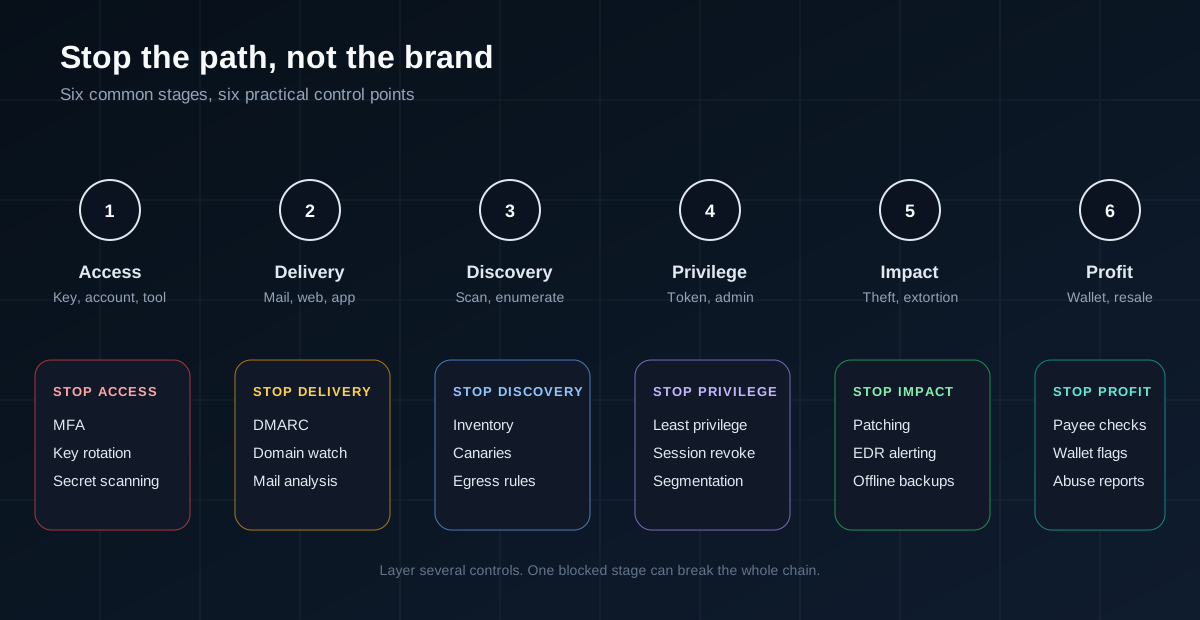
A defense program that outlasts the tool names
A single tool can be blocked. A market cannot. The durable response is to make the attack path expensive at several points.
Identity first. Use phishing-resistant MFA, short-lived tokens, conditional access, and non-human identity governance. Most tool categories need a credential at some stage.
Exposure management. Keep an inventory of every public service, admin console, model endpoint, VPN, remote desktop service, and CI system. Remove what is not needed. Patch what remains.
Payment and platform abuse. Dark LLM vendors and PhaaS platforms need accounts, hosting, domains, and payment rails. Report abuse quickly and preserve evidence. Takedowns work best when several providers act together.
Behavior detection. Look for compressed attack chains, unusual API volume, bulk downloads, new forwarding rules, OAuth grants, and admin actions from new devices. AI tools are fast, and speed creates signals.
Email and web controls. Enforce DMARC, SPF, and DKIM. Flag lookalike domains. Scan reported messages. Use safe browsing and DNS filtering. Train staff to verify payments through a second channel.
Endpoint and mobile hygiene. Patch systems, control scripts, manage apps, and monitor outbound traffic. Self-modifying malware still needs a place to run.
Cloud cost controls. Set budgets, quotas, and alerts for AI services. Separate workloads by project. Review keys and permissions on a schedule. LLMjacking is visible in bills when billing is not buried.
Incident readiness. Write playbooks for stolen API keys, OAuth abuse, exposed model servers, and fast lateral movement. Rehearse them. The value of a playbook is measured during the first ten minutes, not during an annual review.
What the evidence does and does not show
Public reporting supports several conclusions. Criminals sell AI tools. Agentic frameworks have appeared in real intrusions. AI-generated phishing is more convincing. Stolen model access can cause large bills. Synthetic media supports fraud at scale.
The evidence does not support the idea that one tool can break a well-run enterprise at will. Most reports describe tools that help with a task. They do not remove the need for access, infrastructure, money movement, or a defensive mistake.
It is also wrong to treat every open-source security tool as malicious. Many are used by defenders and researchers. The problem appears when a tool is used without authorization, paired with stolen access, or operated as a service for crime.
Final assessment
The fastest way to understand malicious AI tools is to separate the model from the attack path. The model writes text, summarizes data, or coordinates actions. The attack path still needs a target, an identity, a channel, a vulnerable system, and a way to profit.
Stop the tool by attacking that path. Protect identities. Shrink exposure. Govern API access. Monitor behavior. Verify payments out of band. Patch quickly. Report abuse to providers. Those controls work whether the tool is called WormGPT, ARTEX, GhostGPT, or something that does not exist yet.
Sources
- Outpost24, "The Dark AI Tools Landscape"
- Group-IB, "Weaponised AI Is Powering the Fifth Wave of Cybercrime"
- Google Cloud, "Agentic threat activity crosses a significant threshold"
- Google Cloud, "LLMjacking: Monetizing compromised cloud models"
- Sysdig, "LLMjacking Just Got Easier: LLM Mixers and the AI Supply Chain"
- Check Point, "The AI Threat Landscape: How Attackers Are Leveraging AI"
- Recorded Future, "AI Is Both a Target and a Tool"
- PT Security, "AI in 2026: how attackers use artificial intelligence"
- Halcyon, "Underground AI-as-a-Service"
- OpenAI, "Codex Security: now in research preview"
- OpenAI, "Trusted access for the next era of cyber defense"
- Computer Weekly, "Apple addresses multiple WebKit vulnerabilities"
- MacObserver, "Apple's Bug Credits Now Name OpenAI Codex, Claude and Two More AI Tools"
- 9to5Mac, "Apple caps security bug reports amid surge in AI-generated findings"
- Watcher Guru, November 17 breaking report on 35 Apple flaws
- Bermix Studio, cover photo on Unsplash

About the author
Caleb Ngeno
Lead Developer
Founder and lead developer with expertise in full-stack development and cloud solutions.
Hardening a production environment?
TechGaetano helps teams design zero-trust controls, review identity and network boundaries, and turn security policy into engineering practice.
Talk to a security engineerFrequently asked questions
What is Malicious AI Hacking Tools?
Abstract. Malicious AI tools are no longer a single chatbot with an unsafe name. Public reporting in 2025 and 2026 shows a market of paid dark LLMs, fraud copilots, agentic penetration test frameworks, patch to exploit research agents, credential abuse service.
How should a team get started with Malicious AI Hacking Tools?
Start with asset and identity inventory, define the trust boundaries, and roll out controls in phases: identity, device posture, least-privilege access, segmentation, then continuous verification.
What should teams avoid when working on Malicious AI Hacking Tools?
The main risks are treating zero trust as a product purchase, leaving standing privileges in place, and assuming the model or the network perimeter is a security boundary.
Further reading
Related posts
AI-Automated Hacking: Google, FBI Warnings, ARTEX, and the Risk to Large Enterprises
Abstract. Automated hacking has moved from chatbot assistance to agent workflows that can scan, decide, act, and learn with little human input. Google…

Cloud Security and Multicloud Environments: Six Research Opportunities for Resilient Enterprise Architecture
Abstract. Multicloud is no longer an exception in enterprise architecture. It is the normal operating condition: public clouds, private clouds, SaaS,…