Article · Cybersecurity
Cloud Security and Multicloud Environments: Six Research Opportunities for Resilient Enterprise Architecture

By Caleb Ngeno · November 16, 2026
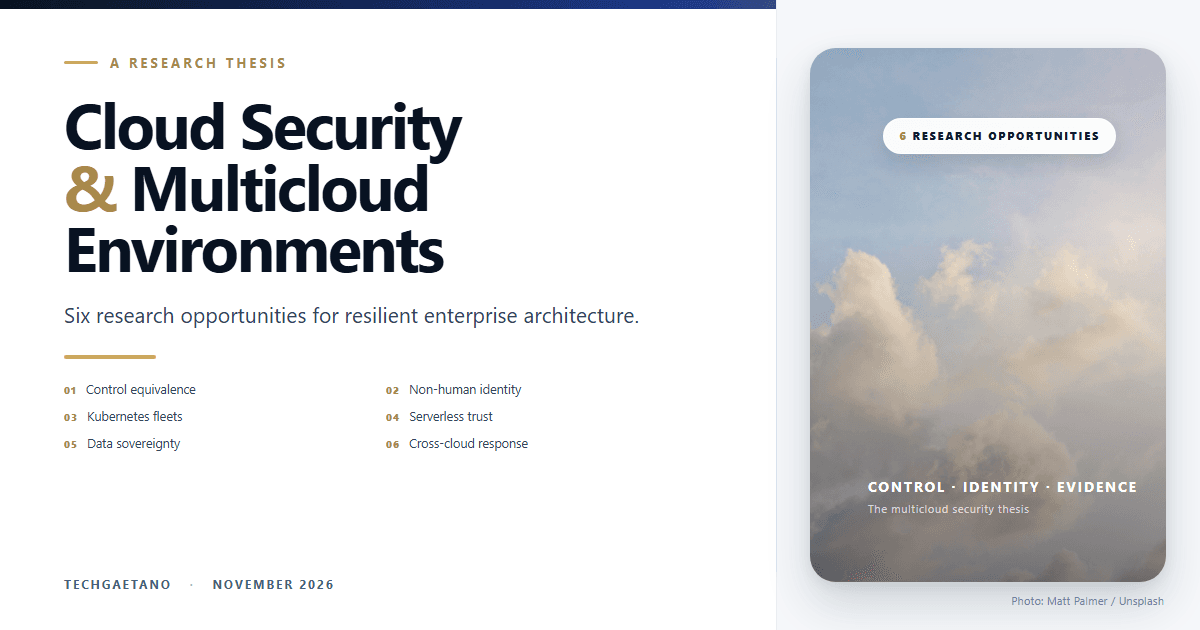
Abstract. Multicloud is no longer an exception in enterprise architecture. It is the normal operating condition: public clouds, private clouds, SaaS, edge locations, and acquired estates coexist, often by accident rather than design. Yet most security models still assume a single provider, a single control plane, and a single evidence trail. This thesis argues that the central problem in multicloud security is not the absence of controls. It is the absence of portable evidence that controls are equivalent, effective, and continuously enforced across providers, jurisdictions, and supply chains. The paper develops a three-plane model — governance, control, and evidence — and identifies six research opportunities: control equivalence and continuous assurance; non-human identity as the multicloud control plane; Kubernetes and container fleet security; serverless and event-driven trust boundaries; data sovereignty and key custody; and cross-cloud detection, response, and resilience. It concludes with a reference architecture, testable propositions, and a 90-day practitioner agenda.
Keywords: cloud security, multicloud, hybrid cloud, zero trust, identity, Kubernetes, serverless, data sovereignty, cloud assurance, incident response.
The thesis in one page
Multicloud security is usually described as a configuration problem. The assumption is that if each provider is configured correctly, the estate is secure. That assumption fails at the seams.
The seams are where the interesting failures live. A workload runs in one cloud, its identity is federated from another, its data is replicated to a third, its logs are collected in a fourth, and its software supply chain crosses all of them. Each provider can be secure in isolation while the composition is insecure. A control that exists in every cloud is not necessarily a control that behaves the same way in every cloud. A policy that is enforced at deploy time is not necessarily enforced at runtime. A log that is collected is not necessarily evidence that anyone can use during an incident.
The central claim of this thesis is therefore:
Multicloud security is not the sum of provider controls. It is the ability to prove, continuously, that identity, workload, data, and response controls remain equivalent and effective across providers, jurisdictions, and supply chains.
The unit of assurance is not the data centre, the cloud account, or the certification badge. It is the control evidence chain: the linked record of what policy was intended, what control was implemented, what was observed at runtime, who approved an exception, and what happened when the control failed.
That reframing matters because it changes what we measure. A programme that reports “99% of resources encrypted” may still be unable to answer a simpler question: which identities can decrypt customer data across all three clouds, and when were those permissions last reviewed? A programme that reports “all clusters are compliant” may still be unable to prove that the same admission policy means the same thing in each provider’s managed Kubernetes service.
The six research opportunities in this paper are the places where that evidence gap is widest. They are not a maturity model. They are a research agenda for the next generation of cloud security architecture.
Why multicloud changes the security problem
The adoption data is unambiguous. Flexera’s 2026 State of the Cloud Report, based on a survey of 753 cloud decision-makers and users, found that 73% of organisations operate hybrid estates, a three-percentage-point increase year over year. Just 14% operate exclusively in a multicloud environment without a private cloud. Security remained a leading challenge for 82% of respondents, second only to cost. The report also notes that many organisations arrive at hybrid or multicloud complexity “by happenstance rather than by design”, often through mergers, acquisitions, and siloed applications.
That is the first important point: multicloud is frequently an emergent property, not an architecture decision. A company acquires a business running on a second cloud. A product team adopts a best-of-breed SaaS platform. A data team uses a third provider for analytics. A subsidiary operates in a regulated market with local-cloud requirements. The estate becomes multicloud before the security model does.
The threat landscape reflects the same complexity. The Cloud Security Alliance’s Top Threats to Cloud Computing 2026 report, based on input from more than 500 industry experts, ranks inadequate identity and access management as the leading cloud security threat. AI-enhanced attacks enter at number two, and AI system compromise enters at number six. The report’s summary is blunt: identity, AI, third-party resources, APIs, and cloud data dominate the risk landscape, while traditional concerns about the underlying infrastructure and cloud service providers have been displaced. The organisations most exposed are not necessarily those with weak perimeter controls; they are those whose governance, visibility, and change management have not kept pace with complexity.
This is the second important point: the threat has moved from the infrastructure layer to the control and identity layers. In a single cloud, a security team can build a reasonably complete picture of identities, roles, resources, and logs. In a multicloud estate, that picture is fragmented across providers, each with its own vocabulary, policy language, telemetry format, and assurance programme.
The third point is regulatory. Data protection and sector rules do not stop at a cloud boundary. Kenya’s Data Protection Act, for example, requires controllers to notify the Office of the Data Protection Commissioner within 72 hours of becoming aware of a breach that poses a real risk of harm, while processors must notify controllers without delay and, where reasonably practicable, within 48 hours. The EU Data Act adds obligations around cloud switching and third-country access. Financial-sector regulators increasingly expect operational resilience, third-party risk management, and exit planning. A multicloud estate must satisfy all of these obligations while proving that data has not crossed a boundary it should not have crossed.
The final point is architectural. Cloud providers expose different primitives for the same security intent. “Least privilege” can be implemented with IAM policies, role-based access control, attribute-based access control, service accounts, workload identity federation, or a combination. “Network segmentation” can mean security groups, network policies, service meshes, private endpoints, or shared VPC constructs. “Encryption with customer-controlled keys” can mean different key hierarchies, rotation models, and administrative boundaries. The names are similar. The semantics are not.
That is why a control catalogue alone is insufficient. The enterprise needs a way to translate intent into provider-specific implementations, then prove that the translation preserved the security property. That is the research problem.
Method and scope
This is a conceptual and practitioner-evidence thesis, not a systematic review or a primary empirical study. It synthesises four kinds of evidence:
- Industry survey data from Flexera’s 2026 State of the Cloud Report and the Cloud Security Alliance’s 2026 Top Threats report.
- Standards and guidance from NIST, CISA, OWASP, and the Cloud Security Alliance, including NIST SP 800-207 on zero trust, NIST SP 800-190 on container security, NIST SP 800-204D on software supply-chain security in DevSecOps, and the OWASP Serverless FaaS Security Cheat Sheet.
- Legal and regulatory instruments, including the EU Data Act and Kenya’s Data Protection Act.
- Research literature and venues, including the Information and Computer Security work on cybersecurity capabilities for critical infrastructure resilience and the ACM Cloud Computing Security Workshop (CCSW), which is co-located with ACM CCS and focuses on cloud security, isolation, confidential computing, and cloud-native systems.
The paper’s contribution is a framing and a research agenda. It does not claim to measure how many enterprises have solved these problems. It argues that the problems are under-specified, under-instrumented, and under-measured — and that the security industry’s current vocabulary makes them harder to see.
The scope is enterprise multicloud: two or more public clouds, or a combination of public cloud, private cloud, SaaS, and edge. The paper focuses on security architecture and assurance rather than commercial procurement, though the two are connected. It treats AI as both a workload to be secured and an attacker capability, but it does not attempt a full AI-security taxonomy.
The evidence gap: three planes of multicloud security
A useful way to organise the problem is to separate three planes.
The governance plane
The governance plane answers: who owns the control, what policy applies, and who accepted the residual risk?
In a single cloud, governance can often be implicit. In multicloud, it becomes explicit or it becomes fiction. Each provider has its own account structure, organisational hierarchy, billing model, and audit programme. Each business unit may have its own cloud team. Each acquisition may bring its own identity provider. The result is a matrix of ownership that nobody can draw from memory.
The governance plane needs a control taxonomy that is provider-neutral, a mapping to provider-specific implementations, and an exception process that records risk acceptance. The Cloud Security Alliance’s Cloud Controls Matrix and Consensus Assessment Initiative Questionnaire are useful starting points because they give a common control vocabulary. But a questionnaire is not continuous assurance. It is a snapshot, usually supplied by the vendor, usually at a point in time, usually optimised for procurement.
The Information and Computer Security literature on critical-infrastructure resilience is relevant here. Malatji, Marnewick, and Von Solms frame resilience as a set of cybersecurity capabilities rather than a single technical control. That framing is useful for multicloud because it shifts attention from “do we have the control?” to “do we have the capability to govern, detect, respond, and recover across the estate?” The answer depends on governance as much as technology.
The control plane
The control plane answers: what is enforced, where, and against which identities and workloads?
This is where most security investment goes: identity and access management, network policy, encryption, key management, workload protection, vulnerability management, and logging. The control plane is necessary but not sufficient. It is also where the semantic differences between providers are most dangerous, because the same control name can hide different behaviour.
Consider multi-factor authentication. In one environment it may mean a push notification to a mobile app. In another it may mean a phishing-resistant hardware key. In a third it may be bypassed by a break-glass account that nobody reviews. The control exists in all three. The security property does not.
Consider encryption. A provider-managed key may protect data at rest from a stolen disk, but it may not protect against a compromised identity with decrypt permission. A customer-managed key in a hardware security module may provide stronger separation, but only if key administration is separated from data administration. The control name is the same. The trust boundary is not.
Consider Kubernetes. A network policy that denies traffic by default in one distribution may behave differently in another because of the CNI plugin, the policy engine, or the managed service’s defaults. A pod security standard may be enforced at admission in one cluster and merely audited in another. The manifest is portable. The security outcome is not.
The evidence plane
The evidence plane answers: how do we know, and how would we prove it?
This is the most neglected plane. It includes logs, audit trails, configuration snapshots, policy decisions, vulnerability findings, software bills of materials, build provenance, runtime attestations, access reviews, incident timelines, and the records of who approved what.
In a multicloud estate, evidence is fragmented by design. Each provider emits its own audit logs, identity logs, network flow logs, and service logs. Time synchronisation may differ. Identity identifiers may not map cleanly across providers. A single transaction may traverse a SaaS platform, two public clouds, and an on-premises system, with no common correlation ID. During an incident, the team has to reconstruct the story from fragments.
The evidence plane is also where regulators and auditors increasingly live. A breach notification is not just a statement that something happened. It is a claim about what data was involved, which systems were affected, what controls were in place, and what the organisation did. The 72-hour clock in Kenya’s Data Protection Act, or the 72-hour clock under GDPR, does not pause while the security team builds a timeline across four clouds.
The thesis, then, is that the evidence plane should be designed as a first-class architecture concern, not as a by-product of logging. The enterprise needs an evidence ledger: a protected, queryable record that links policy intent, control implementation, runtime observation, and human decision. The rest of this paper explores six research opportunities that would make that ledger possible.
Six research opportunities
1. Control equivalence and continuous assurance
The first opportunity is the hardest: proving that a control implemented in one cloud is equivalent to a control implemented in another.
Most enterprises solve this with a control matrix. A control is mapped to a provider service, an owner is assigned, and an auditor samples evidence once a year. The matrix is useful for procurement and compliance. It is not a security control. It does not tell you whether the control is still enforced after the last change, whether the provider changed a default, or whether an exception was granted and forgotten.
The research problem is to define control equivalence in a way that is testable. Equivalence is not “the same service name” or “the same certification.” It is the preservation of a security property under a specified threat model. For example, the property might be: no identity outside the production administrative group can decrypt production customer data without a recorded approval. The implementation can differ across providers. The property must not.
That suggests a research programme with three parts:
- A formal control intent model. A provider-neutral language for expressing security properties, assumptions, and evidence requirements.
- Provider-specific translation and conformance testing. A way to map intent to implementations and test whether the implementation preserves the property, including under failure and misconfiguration.
- Continuous evidence collection. Automated collection of configuration, policy, runtime, and audit evidence, with freshness, integrity, and provenance metadata.
The practical test is simple: take a control that auditors accept today, change one provider default, and see whether the enterprise can detect the change and prove the impact within minutes. Most cannot. That is the gap.
Research question 1: How can an enterprise prove control equivalence across providers continuously, with evidence that is portable, verifiable, and meaningful to auditors and regulators?
2. Non-human identity as the multicloud control plane
The Cloud Security Alliance’s 2026 report puts inadequate identity and access management at the top of the threat list. That is not surprising. Identity is how work gets done in the cloud, and non-human identities — service accounts, workload identities, CI/CD runners, bots, agents, and integrations — now outnumber human users in many estates.
In a multicloud environment, identity becomes the control plane. A workload in one cloud assumes a role, exchanges a token with a second cloud, calls a SaaS API, and writes to a data store in a third. Each hop is an identity decision. Each decision depends on trust relationships that may be invisible in the architecture diagram.
The research opportunity is to model and govern the identity graph: a graph of human and non-human identities, roles, permissions, trust relationships, and resource reachability across providers. The graph should answer questions such as:
- Which identities can reach production customer data, directly or through a chain of assumptions?
- Which non-human identities have standing privileges, and who owns them?
- Which cross-cloud trust relationships would allow a compromised workload to pivot?
- Which tokens are long-lived, unrotated, or unmonitored?
- Which AI agents can act on production systems, and under whose authority?
This is more than entitlement review. It is attack-path analysis for identity. The practical metrics are equally important: number of standing administrative roles, age of long-lived credentials, percentage of workloads using short-lived credentials, number of unowned service accounts, and time to revoke access after an employee or vendor leaves.
The research agenda should include:
- Identity graph construction from provider APIs, identity providers, CI/CD systems, and SaaS platforms.
- Blast-radius scoring that accounts for cross-cloud trust and data sensitivity.
- Continuous authorization that evaluates context at request time, not just at provisioning time.
- Agent identity governance for AI agents that act on APIs and tools, including delegation, consent, and audit.
Research question 2: Can an identity graph that spans clouds, SaaS, and CI/CD predict blast radius and privilege creep better than traditional asset- or network-centric models?
3. Kubernetes and container fleet security
Kubernetes has become the common substrate for portable workloads, including in multicloud estates. That portability is real at the application layer. It is less real at the security layer. Managed Kubernetes services differ in their control plane configuration, network plugins, admission controllers, node images, identity integration, and logging.
NIST SP 800-190 provides a useful lifecycle model for container security: image, registry, orchestrator, host, and runtime. In a multicloud fleet, each stage has provider-specific failure modes. An image may be signed in one registry and pulled without verification in another. A cluster may enforce pod security standards at admission in one environment and merely audit them in another. A network policy may be applied by a CNI plugin that interprets it differently. A node pool may run a different kernel or container runtime.
The research opportunity is fleet-level security assurance: proving that a set of clusters across providers enforces the same security properties, even when the underlying services differ.
Key building blocks already exist: signed images, software bills of materials, SLSA provenance, admission control, pod security standards, network policies, secrets management, runtime detection, and CIS benchmarks. The gap is composition. How do you prove that a workload admitted in cloud A would be admitted, denied, or treated differently in cloud B? How do you detect a drift in one cluster out of hundreds? How do you trace a vulnerable image from build to every running pod across every provider?
The research agenda should include:
- Policy equivalence testing for admission, network, and pod security policies across distributions.
- Fleet-level attack-path analysis that combines identity, network, and workload data.
- Provenance-aware admission that verifies signature, SBOM, and build policy at deploy time.
- Runtime attestation that detects drift from the intended workload identity and configuration.
Research question 3: How can an enterprise prove that a Kubernetes security policy has the same effect across heterogeneous clusters, and detect semantic drift before it becomes an incident?
4. Serverless and event-driven trust boundaries
Serverless changes the unit of security from the server to the function and the event. That is a useful abstraction for developers and a difficult one for security teams.
The OWASP Serverless FaaS Security Cheat Sheet highlights a familiar set of risks: over-privileged functions, unvalidated event inputs, insecure secrets, function chaining, temporary storage reuse, and insufficient logging. In a multicloud estate, these risks compound because event sources, identity models, and execution environments differ across providers.
A function is often triggered by an event from another service: an object upload, a queue message, a database change, an HTTP request, or an AI agent action. The event is a trust boundary. If the function trusts the event without validating its source, schema, and authorization context, an attacker can inject data or trigger behaviour the developer did not intend. If the function has a broad role because it is easier than fine-grained permissions, a single compromised event can reach far beyond the intended resource.
The research opportunity is event provenance and least-privilege composition. The goal is to make it possible to answer: which event triggered this function, who or what produced it, what authority did it carry, what did the function do, and what data did it touch?
That requires:
- Event schemas with security metadata, including source identity, integrity, and authorization context.
- Per-function identity with least privilege, short-lived credentials, and no shared secrets.
- Isolation of temporary storage and explicit data lifetime controls.
- Function-level tracing that links events, invocations, data access, and downstream calls.
- Policy for function chaining, so that one function cannot invoke another with more privilege than the original request justified.
Research question 4: Can event provenance be made a first-class security primitive for serverless systems, so that trust is established at the event boundary rather than assumed inside the function?
5. Data sovereignty and key custody
Data sovereignty is often reduced to data residency: store the data in a particular region and the problem is solved. That is a necessary but insufficient condition. Sovereignty is about legal jurisdiction, ownership, control, access, and portability. Data can be replicated by managed services, backups, logs, support access, and AI services. A region setting does not answer the question of who can be compelled to disclose the data, or who can decrypt it.
The EU Data Act is one of the clearest signals that cloud switching and third-country access are now regulatory concerns, not just procurement preferences. It creates obligations around switching between cloud providers and around government access to data held by providers. For enterprises, the practical question is not only “where is the data?” but “can we move it, can we prove who accessed it, and can we control the keys?”
The research opportunity is jurisdiction-aware data flow and cryptographic control. The enterprise needs a data map that includes:
- The legal jurisdiction of the data, the provider, the underlying infrastructure, and any subprocessors.
- The identities and services that can access or decrypt the data, including support and AI services.
- The replication, backup, and log paths that may move data across borders.
- The key custody model, including who can use, rotate, export, or destroy keys.
- The exit path: what would it take to move the data and workloads to another provider, and how would we prove deletion?
Confidential computing is relevant here, but it is not a silver bullet. It can reduce trust in the infrastructure operator for specific workloads, but it introduces new attestation, key management, and operational complexity. The research agenda should compare sovereign cloud, customer-managed keys, confidential computing, and contractual controls against a realistic threat model, rather than treating any one of them as a complete answer.
Research question 5: How can an enterprise model and enforce data sovereignty as a combination of legal jurisdiction, cryptographic key custody, access control, and portability — rather than as a region setting?
6. Cross-cloud detection, response, and resilience
The final opportunity is the one that determines how bad an incident becomes: detection and response across clouds.
IBM’s 2026 Cost of a Data Breach Report puts the global average breach cost at $4.99 million, with financial services at $6.29 million. The mean time to identify and contain a breach is 247 days. AI-enabled attacks add roughly $1 million to the average breach, while extensive use of security AI and automation is associated with $1.93 million in savings. The lesson is not that AI is magic. It is that detection and response capability changes the economics of an incident.
In a multicloud estate, detection is harder for structural reasons. Logs are in different formats and different accounts. Identity identifiers do not always map across providers. Time zones and clock drift complicate correlation. A detection rule written for one provider’s audit log may have no equivalent in another. The security team may have excellent visibility into one cloud and almost none into the SaaS platforms and acquired estates that surround it.
The research opportunity is cross-cloud evidence correlation and response assurance. The goal is to build a detection and response capability that can answer, within the regulatory clock:
- What happened, in what order, across which providers?
- Which identities were involved, and what did they have access to?
- What data was read, changed, or exfiltrated?
- Which controls failed, and which controls worked?
- What is the evidence, and can we prove it has not been altered?
That requires a protected evidence store, common identity mapping, detection-as-code with test coverage, and incident-response playbooks that are exercised across providers. It also requires a realistic assessment of shared responsibility. The provider is responsible for the security of the cloud. The customer is responsible for security in the cloud. During an incident, the handoff between the two can consume hours that the regulator does not grant.
Research question 6: How can enterprises measure and improve detection coverage, evidence integrity, and response time across heterogeneous cloud providers and third parties?
A reference architecture for multicloud security
The six opportunities point to a reference architecture built around the three planes. The architecture is not a product stack. It is a set of design commitments.
| Layer | Core question | Minimum evidence |
|---|---|---|
| Governance | Who owns the control and accepted the risk? | Control taxonomy, RACI, policy versions, exception register |
| Identity | Who can reach what, directly or indirectly? | Identity graph, entitlement reviews, token age, cross-cloud trust map |
| Workload | What is running, and why should we trust it? | SBOM, signature, provenance, admission decisions, runtime attestation |
| Data | Where is it, who can decrypt it, and under whose jurisdiction? | Data map, key custody, access logs, replication and backup paths |
| Operations | Would we know, and could we respond? | Detection coverage, drill results, incident timeline, regulatory notifications |
The architecture has five design commitments:
- Federated governance, not fragmented governance. A central control taxonomy and evidence standard, executed by provider-specific teams. The centre defines the security properties. The edges implement them.
- Identity as the primary graph. Asset inventories are necessary, but identity graphs are more predictive of blast radius in cloud environments. Build the graph across humans, workloads, CI/CD, SaaS, and AI agents.
- Policy as code, evidence as a product. Policy should be versioned, tested, and deployed like software. Evidence should be collected automatically, stored immutably, and exposed through a queryable interface.
- Workload provenance over workload location. In multicloud, location is a weak proxy for trust. What matters is what the workload is, how it was built, what it can reach, and whether it is behaving as intended.
- Data boundaries that survive replication. A data boundary that exists only in the primary store is not a boundary. It must apply to backups, logs, caches, analytics, AI services, and support access.
The architecture also needs an operating model. A central cloud security function should own the taxonomy, the evidence standard, and the cross-cloud risk view. Platform teams should own the golden paths and the policy-as-code libraries. Application teams should own the workload configuration and the data classification. Internal audit should be able to query the evidence ledger directly rather than requesting screenshots.
Testable propositions and a research agenda
The thesis is intended to be falsifiable. The following propositions can be tested through case studies, design-science research, controlled experiments, and threat modelling.
| Proposition | Claim | Possible method |
|---|---|---|
| P1 | Control equivalence cannot be inferred from certification or service names; it must be continuously evidenced. | Multi-case study of control mappings and audit evidence |
| P2 | Identity graph centrality predicts blast radius better than network topology in multicloud estates. | Graph analysis plus red-team exercises |
| P3 | Policy-as-code reduces configuration drift but does not eliminate semantic divergence across providers. | Policy equivalence testing across clusters and clouds |
| P4 | Event provenance is the effective security perimeter for serverless systems. | Threat modelling and event-injection experiments |
| P5 | Data sovereignty is a function of key custody and legal access, not region alone. | Legal-technical mapping and tabletop exercises |
| P6 | Cross-cloud detection coverage is materially lower than single-cloud coverage for equivalent spend. | Detection coverage experiments and incident simulations |
The research agenda should be interdisciplinary. Computer science can contribute formal policy models, graph algorithms, and systems instrumentation. Law and policy research can contribute jurisdiction-aware data models and switching/exit analysis. Organisational research can contribute governance and incentive design. Industry venues such as ACM CCSW are well suited to the systems work, while journals such as Information and Computer Security provide a home for the resilience and governance dimensions.
There is also a measurement agenda. The field needs metrics that are comparable across organisations and meaningful to boards:
- Percentage of production identities using short-lived credentials.
- Number of standing administrative roles and unowned service accounts.
- Mean time to detect and revoke a compromised identity.
- Percentage of workloads with verified provenance and runtime attestation.
- Number of cross-cloud data paths with documented legal and key-custody controls.
- Detection coverage per critical attack path, not per log source.
- Time to produce a regulator-ready incident timeline.
These metrics are imperfect. But they are more useful than “percentage of resources compliant,” because they measure the properties the enterprise actually cares about.
A 90-day practitioner agenda
For teams that need to move before the research agenda matures, the following sequence is a practical starting point.
Days 0–30: establish the evidence baseline
- Inventory every cloud provider, account, subscription, project, and SaaS platform that holds production data.
- Build a first-pass identity graph for humans and non-human identities. Include CI/CD, backup, monitoring, vendor, and AI-agent identities.
- Classify data and map the legal jurisdictions, key custody models, and replication paths.
- Create a provider-neutral control matrix mapped to existing frameworks such as the CSA Cloud Controls Matrix and NIST guidance.
- Identify the top ten cross-cloud attack paths and the evidence needed to prove or disprove them.
Days 31–60: fix the highest-risk seams
- Remove long-lived credentials and standing administrative access where possible.
- Federate workload identity across providers and require short-lived credentials.
- Separate key administration from data administration for regulated data.
- Enforce signed images, SBOMs, and provenance checks in the deployment pipeline.
- Standardise admission, network, and secret policies across Kubernetes fleets, then test for semantic drift.
- Centralise audit, identity, and data-access logs in a protected evidence store.
Days 61–90: prove the capability
- Run a cross-cloud tabletop exercise with legal, communications, and a critical vendor.
- Test the breach-notification workflow against the 72-hour and 48-hour clocks.
- Measure detection coverage for the top ten attack paths, not just log ingestion.
- Execute a restore, failover, or exit test for one critical workload.
- Produce a board-level report on the evidence gaps, the residual risks, and the remediation dates.
The sequence is deliberately biased toward evidence. A team that fixes ten controls but cannot prove them has improved its posture. A team that can prove ten controls has built a capability.
Limitations and conclusion
This thesis has limits. It synthesises survey data, standards, and practitioner evidence rather than presenting new empirical measurements. Industry surveys have sampling and self-report limitations. Provider documentation changes quickly. Legal obligations vary by jurisdiction and sector. The six opportunities are not exhaustive; confidential computing, post-quantum cryptography, API security, and AI-agent security all deserve deeper treatment.
Those limits do not weaken the central argument. They reinforce it. Multicloud security is a moving target, and the organisations that manage it well are the ones that can observe, prove, and adapt faster than the estate changes.
The conclusion is therefore both architectural and organisational. Architecturally, enterprises need a governance plane, a control plane, and an evidence plane that are designed together. Organisationally, they need to stop treating assurance as an annual audit artefact and start treating it as a continuous product. The cloud providers will continue to improve their native controls. The hard problem will remain at the seams: identity across clouds, policy across clusters, events across services, data across jurisdictions, and evidence across incident timelines.
The enterprise that can prove its controls across clouds is more secure than the enterprise that merely deploys them. That is the thesis. The six research opportunities are the work required to make it true.
Sources
- Cloud Security Alliance: Top Threats to Cloud Computing 2026
- Cloud Security Alliance: 2026 Top Threats press release
- Flexera: 2026 State of the Cloud Report
- IBM: Cost of a Data Breach Report 2026
- NIST SP 800-207: Zero Trust Architecture
- NIST SP 800-190: Application Container Security Guide
- NIST SP 800-204D: Software Supply Chain Security in DevSecOps
- NIST SP 800-218: Secure Software Development Framework
- CISA: Zero Trust Maturity Model
- OWASP: Serverless FaaS Security Cheat Sheet
- OWASP: Kubernetes Security Cheat Sheet
- Cloud Security Alliance: Cloud Controls Matrix
- EU: Data Act, Regulation (EU) 2023/2854
- Kenya Law: Data Protection Act, section 43
- Malatji, Marnewick, and Von Solms: Cybersecurity capabilities for critical infrastructure resilience
- ACM Cloud Computing Security Workshop (CCSW)
- SPIFFE: Secure Production Identity Framework for Everyone
- SLSA: Supply-chain Levels for Software Artifacts
- Confidential Computing Consortium
Cover photo: Matt Palmer on Unsplash.

About the author
Caleb Ngeno
Lead Developer
Founder and lead developer with expertise in full-stack development and cloud solutions.
Hardening a production environment?
TechGaetano helps teams design zero-trust controls, review identity and network boundaries, and turn security policy into engineering practice.
Talk to a security engineerFrequently asked questions
What is Cloud Security and Multicloud Environments?
Abstract. Multicloud is no longer an exception in enterprise architecture. It is the normal operating condition: public clouds, private clouds, SaaS, edge locations, and acquired estates coexist, often by accident rather than design. Yet most security models s.
How should a team get started with Cloud Security and Multicloud Environments?
Start with asset and identity inventory, define the trust boundaries, and roll out controls in phases: identity, device posture, least-privilege access, segmentation, then continuous verification.
What should teams avoid when working on Cloud Security and Multicloud Environments?
The main risks are treating zero trust as a product purchase, leaving standing privileges in place, and assuming the model or the network perimeter is a security boundary.
Further reading
Related posts
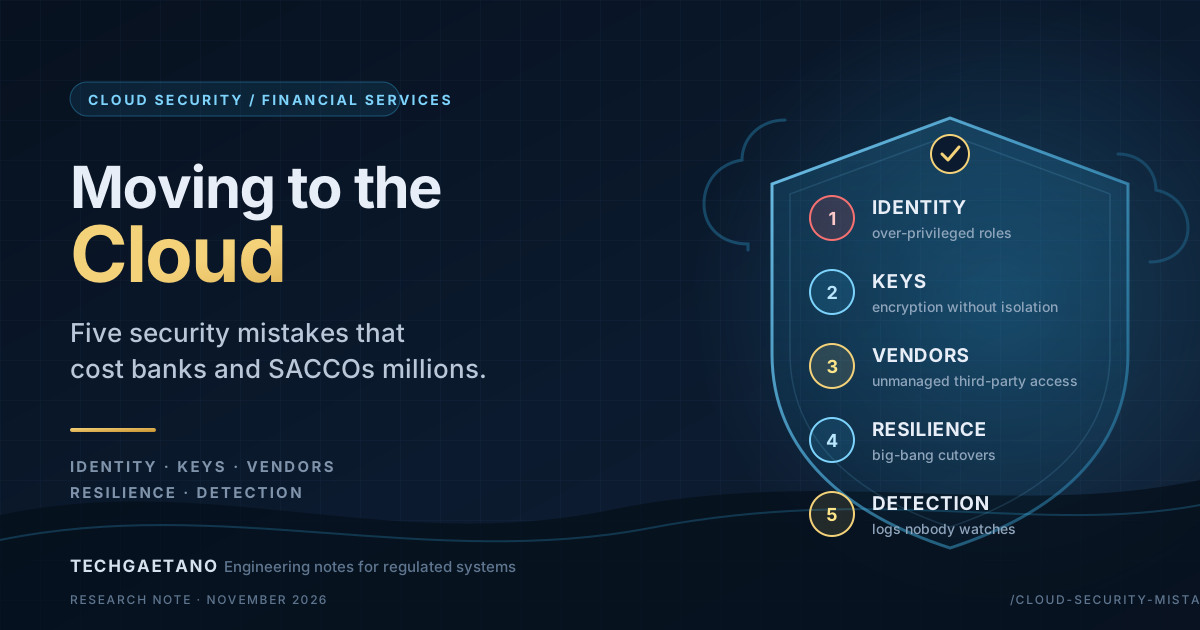
Moving to the Cloud: Five Security Mistakes That Cost Banks and SACCOs Millions
Cloud migration is no longer a strategic experiment for financial institutions. It is the operating model. In Kenya, the Central Bank's 2025 innovatio…


Post-Quantum Cryptography Automation in CI/CD Pipelines: A DevSecOps Framework for Crypto-Agility
Abstract. Cryptographic migration is no longer a distant research topic. NIST finalized ML KEM, ML DSA, and SLH DSA in 2024; migration guidance now po…