Article · Cybersecurity
Moving to the Cloud: Five Security Mistakes That Cost Banks and SACCOs Millions

By Caleb Ngeno · November 16, 2026
Cloud migration is no longer a strategic experiment for financial institutions. It is the operating model. In Kenya, the Central Bank's 2025 innovation survey found that 45% of commercial banks had implemented cloud computing, compared with 21% of microfinance banks, while 83% of institutions had adopted APIs. Cyber risk was the top innovation-related concern for 82% of commercial banks and 93% of MFBs.
The direction is clear. The security model is not.
Most cloud failures in banking are not failures of the cloud provider. They are failures of controls that were designed for a data centre, copied into a cloud account, and never redesigned. The result is a familiar pattern: the institution moves faster, the perimeter disappears, identities multiply, third parties gain more access, and the incident response plan still assumes someone can walk to a server room.
The cost is not theoretical. IBM's 2026 Cost of a Data Breach Report puts the average financial-services breach at $6.29 million, up from $5.56 million a year earlier and 26% above the $4.99 million global average. The mean time to identify and contain a breach rose to 247 days. AI-enabled attacks added roughly $1 million to the average breach, while extensive use of security AI and automation was associated with $1.93 million in savings.
For a bank, the number is larger than the breach itself. It includes regulatory penalties, customer redress, fraud losses, migration remediation, churn, and the slower cost of lost trust. For a SACCO, the number can be existential.
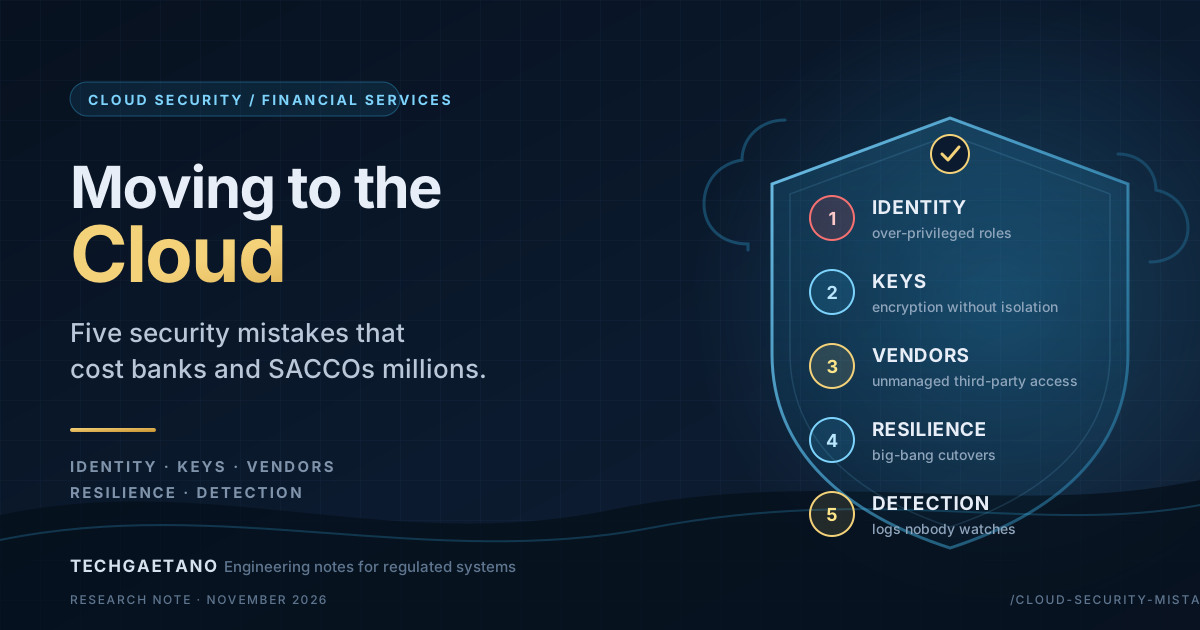
These are the five mistakes that repeatedly turn a cloud programme into a million-dollar lesson.
The five mistakes at a glance
| Mistake | What it looks like | What it costs |
|---|---|---|
| Lifting and shifting identities | Broad IAM roles and long-lived keys moved into the cloud unchanged | Cloud takeover, data theft, regulatory penalties |
| Encrypting data without isolating keys | The same workload can read data and decrypt it | Encryption that fails at the moment it is needed |
| Trusting third parties more than your own controls | Vendor and integrator access is unmanaged or unaudited | Fraud, supply-chain breaches, contract disputes |
| Treating migration as a cutover, not a resilience test | Big-bang go-live without rollback or reconciliation | Outage, customer harm, fines, churn |
| Measuring uptime instead of detection and response | Logs exist, but nobody is watching them | Long dwell time, late notification, bigger losses |
Mistake 1: Lifting and shifting identities
The first cloud migration mistake is usually invisible in the architecture diagram. The application moves. The database moves. The identity model moves with it, unchanged.
On-premises, access was often constrained by network position. A service account might have broad database rights because it ran on a trusted subnet. In the cloud, that same account can be reached from anywhere if its credentials leak. Network location is no longer a reliable proxy for trust.
Capital One is the canonical example. In 2019, an attacker exploited a misconfigured web application firewall to reach the EC2 instance metadata service, obtained temporary credentials for an IAM role, and used those credentials to access S3 buckets containing credit-card application data. The role had far more access than the workload needed.
The breach affected approximately 106 million people in the United States and Canada. The OCC fined Capital One $80 million, explicitly citing the bank's failure to establish effective risk-assessment processes before migrating significant IT operations to the public cloud, and its failure to correct deficiencies in a timely manner. A consumer class action settled for $190 million. The penalty and settlement alone reached $270 million, and total disclosed costs have been reported above $300 million.
The uncomfortable detail is that Capital One had encryption, a WAF, and IAM. Each component worked as designed. The system still failed because the identity attached to the workload could reach data it had no business reaching, and the resulting access was not monitored closely enough to stop exfiltration.
What to do instead
- Inventory every human and machine identity that can reach production data, including CI/CD runners, backup jobs, monitoring agents, and vendor integrations.
- Remove long-lived access keys. Use workload identity federation, instance roles, and short-lived credentials.
- Enforce least privilege with permission boundaries, resource policies, and regular access reviews. A role should not be able to list and read every bucket in the account.
- Require IMDSv2 and restrict access to instance metadata. Treat metadata credentials as a high-value attack path.
- Use cloud infrastructure entitlement management to find unused and excessive permissions, then remove them.
- Test the blast radius: assume a workload credential is stolen and ask what it can reach. If the answer is "the customer database," the design is not finished.
The cloud makes identity the new perimeter. If the identity model is lifted and shifted, the perimeter is now wherever a stolen token can travel.
Mistake 2: Encrypting data without isolating the keys
Encryption is necessary. It is also one of the most commonly misunderstood controls in cloud security.
Capital One encrypted its data. The attacker could still decrypt it because the compromised role had access to both the data and the means to decrypt it. The encryption protected against a stolen disk. It did not protect against a stolen identity with the right permissions.
This is the key-isolation problem. If the same workload, administrator, or CI/CD pipeline can read the ciphertext and use the decryption key, encryption is not a boundary. It is a formatting decision.
Banks and SACCOs often get the first half right: enable encryption at rest, enable TLS, turn on provider-managed keys. The second half is harder. Key custody, separation of duties, rotation, and auditability determine whether encryption actually contains a breach.
What to do instead
- Use a dedicated key management service or HSM. Do not store keys alongside the data or in application configuration.
- Separate key administrators from data administrators. The person who can delete a key should not be the person who can export a customer table.
- Prefer customer-managed keys for regulated data, with documented rotation and recovery procedures.
- Use envelope encryption and field-level encryption for high-risk attributes such as national ID numbers, account numbers, and mobile numbers.
- Log and alert on key usage, especially decrypt operations from unusual identities, regions, or times.
- Test key-loss and key-compromise scenarios. A backup that cannot be decrypted is not a backup.
- Tokenise data where the business does not need the original value. Tokenisation reduces the number of systems that need access to the key entirely.
Encryption is not a checkbox. It is a trust boundary. If the key sits inside the same blast radius as the data, the boundary is decorative.
Mistake 3: Trusting third parties more than your own controls
Financial institutions rarely build their entire stack. They buy core banking systems, mobile money integrations, payment gateways, identity checks, and cloud services. That dependency is necessary. It is also an attack surface.
SASRA's 2023 supervision report is blunt: 99% of cyber-attacks and breaches on regulated SACCO systems were occasioned through third-party systems vendors and integrators. The regulator responded with Circular SASRA/GG/1/2023, dated 6 June 2023, setting minimum requirements for engaging third-party system integrators and vendors, particularly for mobile money services.
The losses are documented. SACCOs lost Sh106 million in the 17 months to March 2021, an average of about Sh6.23 million per month or Sh208,000 per day, according to the Financial Sector Stability Report. The attacks targeted weak controls in SACCO systems, including minimal verification of member identity when services were requested. The sector holds more than Sh800 billion in member deposits.
That combination is dangerous: a trusted vendor connection, weak identity verification, and a pool of depositors' money.
The cloud version of this mistake is assuming that a vendor's security posture is your security posture. It is not. The vendor may secure its platform while your configuration, your access paths, and your member data remain your responsibility. A shared-responsibility model is not a shared-accountability model.
What to do instead
- Build a vendor inventory that includes every integration, API, service account, and data-sharing channel. If a vendor can move money or read member data, it belongs in the register.
- Tier vendors by access and criticality. Apply the strongest controls to payment integrators, core banking providers, cloud providers, and anyone with production credentials.
- Put security obligations in the contract: 48-hour breach notification to the institution, audit rights, penetration-test evidence, incident cooperation, data-return and deletion terms, and indemnity or bank guarantees where required.
- Require vendors to report attacks to the regulator within the timelines SASRA has set. The 2023 circular requires vendors to report attack trends and incidents to the Authority within 12 hours, among other controls.
- Use private connectivity, IP allow-listing, and short-lived credentials for vendor access. Do not give a vendor a permanent shared password because it is convenient.
- Audit vendor activity. Review logs, not just reports. A vendor's assurance letter is not a substitute for evidence.
- Limit concentration. If one integrator serves every SACCO in a region, an attacker who compromises the integrator inherits a trusted position across the entire network.
- Map the processor's 48-hour notification duty under Kenya's Data Protection Act to your own 72-hour controller duty. The clock starts at awareness, not at the end of the investigation.
Outsourcing the system does not outsource the obligation. The member's deposit is still yours to protect.
Mistake 4: Treating migration as a cutover, not a resilience test
Cloud migrations are often planned as technology projects with a go-live date. They should be planned as operational-resilience exercises with a failure budget.
TSB's 2018 migration is the case study. The bank moved customer and corporate services onto a new platform over a weekend. The data migrated successfully. The platform did not. Branch, telephone, online, and mobile banking were disrupted. All branches and a significant proportion of TSB's 5.2 million customers were affected. It took until 10 December 2018 for the bank to return to business as usual.
TSB recognised £330.2 million in post-migration costs, including customer redress, additional resources, fraud, and foregone income, partially offset by a recovery from its IT provider. The FCA and PRA fined TSB £48.65 million for operational-risk management and governance failures, including management of outsourcing risks. TSB paid £32.7 million in customer redress, and around 80,000 customers switched their accounts away in 2018.
The migration involved more than 1,400 people and 70 suppliers. An independent review found about 2,000 defects at go-live, while the board had been told about far fewer. The lesson is not that outsourcing is bad or that cloud is risky. The lesson is that a migration is a security and resilience change, and it needs the same rigor as a production incident before it becomes one.
What to do instead
- Migrate in waves with explicit exit criteria. Do not move the entire estate in a single cutover because the plan says so.
- Build a rollback path and test it. A rollback plan that has never been executed is a hope, not a control.
- Reconcile data end to end. Row counts are not enough. Test balances, transaction histories, interest calculations, and member statements.
- Run non-functional tests under realistic load, including degraded dependencies. Test what happens when the identity provider, payment gateway, or network link is slow or unavailable.
- Canary a small cohort of branches or products before the full rollout. Define the metrics that trigger a pause.
- Run failure injection and disaster-recovery game days. Include the people who will be on the bridge at 2 a.m.
- Freeze high-risk changes around the cutover. Separate the migration from unrelated releases.
- Report defects and risk acceptances to the board in plain language. If the board is told 800 defects when there are 2,000, the governance has already failed.
A migration is not successful because the data arrived. It is successful because the institution can still serve customers when something goes wrong.
Mistake 5: Measuring uptime instead of detection and response
Many cloud programmes report availability, latency, and cost. Fewer can answer a harder question: if an attacker used a valid credential to read member data right now, how long would it take us to notice?
IBM's 2026 report puts the mean time to identify and contain a breach at 247 days: 183 days to identify and 64 days to contain. Financial services perform better than the global average, but "better than eight months" is not a reassuring benchmark. Breaches that run longer cost more, and the regulatory clock does not wait for the investigation to finish.
In Kenya, the Data Protection Act sets a 72-hour notification deadline for controllers once they become aware of a breach that poses a real risk of harm. A processor must notify the controller without delay and, where reasonably practicable, within 48 hours. A late notification must explain the delay.
That means the institution needs to know what happened, what data was involved, and what it is doing about it within three days. Most organisations cannot produce that answer because their cloud logs are fragmented across accounts, their identity logs are not correlated with data-access logs, and nobody has practiced the decision.
Attackers exploit the gap. They use valid accounts, move laterally, and blend in with normal administration. They strike when monitoring is thin, including outside business hours and around long weekends. Uptime dashboards stay green while data leaves.
What to do instead
- Centralise cloud audit logs, identity logs, network flow logs, and data-access logs in a protected account or platform that attackers cannot easily delete.
- Detect on behaviour, not just infrastructure: impossible travel, privilege escalation, new access keys, bulk downloads, unusual decrypt operations, and first-time vendor access.
- Build detection-as-code with clear ownership, test coverage, and alert tuning. A detection that nobody owns is a dashboard, not a control.
- Staff 24/7 triage or contract a managed detection and response provider with financial-services experience. Define escalation paths before the incident.
- Pre-approve forensic access, legal counsel, communications support, and regulator notification templates. The 72-hour clock is not the time to negotiate a purchase order.
- Run tabletop exercises that include the board, legal, communications, and the vendor. Practice the processor-to-controller handoff.
- Retain logs long enough to reconstruct an incident. If the retention period is shorter than the detection period, you cannot investigate your own breach.
- Report to the board in terms of risk and readiness, not just uptime. Ask: what is our mean time to detect, and when did we last test it?
The cloud gives you more telemetry than a data centre ever did. The mistake is collecting it without building the capability to act on it.
A 30-day checklist for banks and SACCOs
This is not a complete security programme. It is a practical starting point for the first month after a cloud migration, or before the next one.
Week 1: See the estate
- List every cloud account, subscription, and project, including shadow accounts created by teams.
- Classify workloads and data. Identify which systems hold member data, payment data, and credentials.
- Inventory human and machine identities, including CI/CD, backups, monitoring, and vendor access.
- Map every third-party connection that can read data or move money.
Week 2: Fix identity
- Enforce multi-factor authentication for administrative access.
- Remove long-lived keys and replace them with short-lived credentials.
- Review roles with wildcard permissions and remove unused access.
- Require IMDSv2 and restrict metadata access.
- Test whether a stolen workload credential can reach production data.
Week 3: Protect data and vendors
- Separate key administration from data administration.
- Enable customer-managed keys for regulated data and document rotation.
- Add 48-hour breach notification, audit rights, and incident cooperation to vendor contracts.
- Restrict vendor access to the minimum required and monitor it.
- Confirm that backup and recovery keys are available when the primary account is unavailable.
Week 4: Prove response
- Run a tabletop breach exercise with legal, communications, and a critical vendor.
- Test the 72-hour notification workflow, including who decides and who signs.
- Verify that cloud audit logs are centralised, immutable, and retained long enough.
- Execute a rollback or disaster-recovery test for one critical workload.
- Report the top five gaps and remediation dates to the board.
The bottom line
Cloud adoption is not the risk. Unowned controls are.
The banks and SACCOs that migrate well do not treat security as a gate at the end of the programme. They redesign identity, isolate keys, govern vendors, rehearse failure, and measure detection. They assume the attacker will eventually use a valid credential, because that is how modern breaches work.
The alternative is expensive. Capital One paid more than $300 million after a migration-era identity flaw. TSB recognised £330.2 million in post-migration costs and paid a £48.65 million fine after a cutover that was not resilient. Kenyan SACCOs lost Sh106 million in 17 months through vendor-related attacks, while holding more than Sh800 billion in member deposits.
The bill for these mistakes rarely arrives as a single invoice. It arrives as a fine, a redress programme, a fraud loss, a customer exodus, or a regulator asking why a known risk was not fixed. The time to decide which one you can afford is before the migration, not after it.
Sources
- IBM: Cost of a Data Breach Report 2026
- OCC: $80 million civil money penalty against Capital One
- Capital One class-action settlement coverage
- Capital One breach technical analysis, ACM Transactions on Privacy and Security
- SASRA: SACCO Supervision Annual Report 2023
- Sacco Review: SACCO cyber-attack losses and vendor risk
- Sacco Review: SASRA third-party vendor requirements
- CBK: Banking Sector Innovation Survey 2025
- FCA: TSB fined £48.65m for operational resilience failings
- TSB: 2018 full-year results and migration costs
- Kenya Law: Data Protection Act, section 43
- ODPC: Report a data breach

About the author
Caleb Ngeno
Lead Developer
Founder and lead developer with expertise in full-stack development and cloud solutions.
Hardening a production environment?
TechGaetano helps teams design zero-trust controls, review identity and network boundaries, and turn security policy into engineering practice.
Talk to a security engineerFrequently asked questions
What is Moving to the Cloud?
Cloud migration is no longer a strategic experiment for financial institutions. It is the operating model. In Kenya, the Central Bank's 2025 innovation survey found that 45% of commercial banks had implemented cloud computing, compared with 21% of microfinance.
How should a team get started with Moving to the Cloud?
Start with asset and identity inventory, define the trust boundaries, and roll out controls in phases: identity, device posture, least-privilege access, segmentation, then continuous verification.
What should teams avoid when working on Moving to the Cloud?
The main risks are treating zero trust as a product purchase, leaving standing privileges in place, and assuming the model or the network perimeter is a security boundary.
Further reading
Related posts
Cloud Security and Multicloud Environments: Six Research Opportunities for Resilient Enterprise Architecture
Abstract. Multicloud is no longer an exception in enterprise architecture. It is the normal operating condition: public clouds, private clouds, SaaS,…


AI-Automated Hacking: Google, FBI Warnings, ARTEX, and the Risk to Large Enterprises
Abstract. Automated hacking has moved from chatbot assistance to agent workflows that can scan, decide, act, and learn with little human input. Google…