Article · Cybersecurity
AI-Automated Hacking: Google, FBI Warnings, ARTEX, and the Risk to Large Enterprises

By Caleb Ngeno · November 17, 2026
Abstract. Automated hacking has moved from chatbot assistance to agent workflows that can scan, decide, act, and learn with little human input. Google Threat Intelligence Group reported the first intrusion pipeline it had seen that found and exploited vulnerabilities without a person in the loop. The FBI warned that ARTEX, an open-source AI penetration-testing framework, has helped attackers move from target selection to privileged access in under three hours in some cases. FBI crime data also shows 22,364 AI-related complaints and nearly $893 million in reported losses in 2025. This study explains those findings for students and defenders. It stays at the level of threat models, evidence, and controls. It gives no commands, prompts, exploit steps, or setup instructions. The practical message is simple: machine-speed intrusion makes basic security debt easier to exploit, so identity hygiene, exposure management, patch speed, and response design matter more than ever.
Keywords: AI-automated hacking, ARTEX, Google Threat Intelligence Group, FBI, agentic AI, cybercrime, machine-speed intrusions, enterprise security, Apple, code-signing certificates.
Short answer: the name is ARTEX, not Aramek
If you heard or read "Aramek," the November 2026 reports from Google and the FBI are talking about ARTEX. The name appears in FBI FLASH-20261113-001, Google Threat Intelligence Group's Q4 2026 AI Threat Tracker, Check Point Research, and reporting from multiple security news outlets.
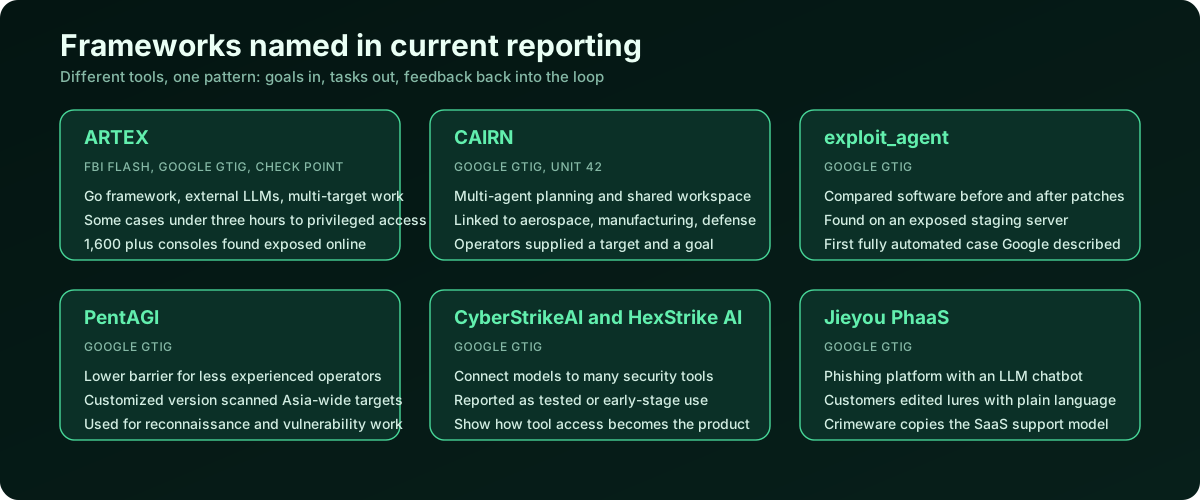
ARTEX is not a virus and it is not a single magic model. It is an autonomous penetration-testing framework written in Go. It connects to outside language models such as Claude, GPT, DeepSeek, GLM, Grok, and Kimi. An operator supplies a goal, and software agents turn that goal into tasks. The FBI says the framework can support reconnaissance, vulnerability discovery, exploitation, privilege escalation, and data theft with limited human input.
That distinction matters. The risk is not that one tool has become sentient. The risk is that established attack steps can be chained faster, by more people, against more targets, with fewer pauses for human judgment.
What AI automation actually changes
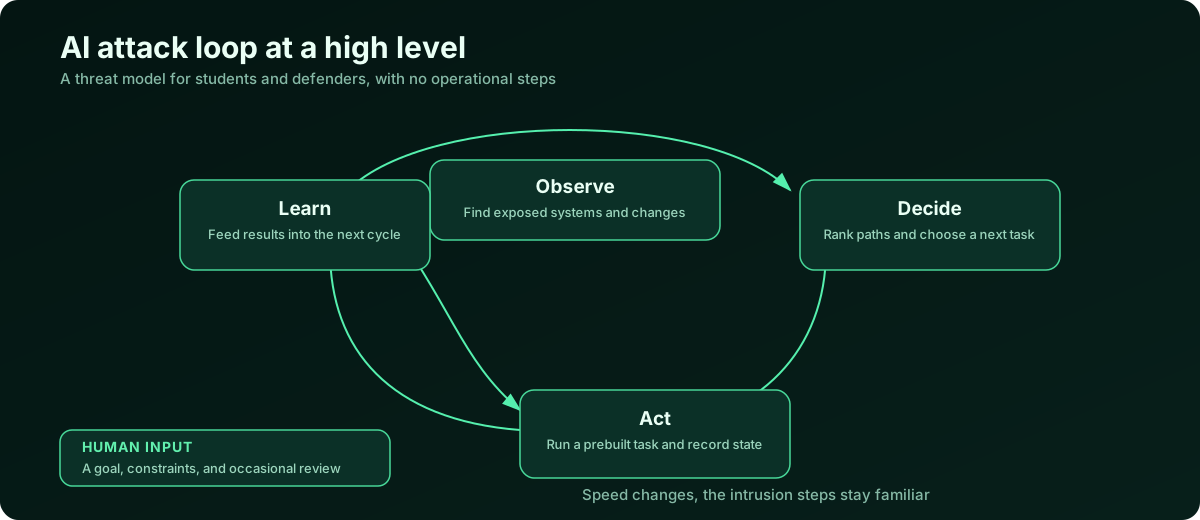
Most techniques in these campaigns are old. Attackers still use stolen credentials, weak passwords, exposed portals, unpatched software, and over-permissioned cloud identities. Google and Amazon both noted that the underlying methods were familiar. What changed is the speed and the amount of work one operator can hand to software.
Four shifts show up across the reports.
First, attackers can compare software versions after a patch and ask a model to work out what changed. That shortens the time between a public fix and exploitation of systems that have not applied it. Google calls this differential patch analysis and described models being used against n-day flaws, meaning known vulnerabilities with a patch available.
Second, agents can run many small tasks in sequence. A human operator might stop to inspect results, choose a new tool, or rewrite a script. An agent framework can keep moving through its task list and feed results back into the next step.
Third, the skill floor drops. The FBI says ARTEX lets people with minimal technical experience run complex, multi-target work. Phishing-as-a-service platforms add another layer. Google described Jieyou, a Chinese-language phishing platform that added an LLM chatbot so customers could change lures and panels with natural language requests.
Fourth, attackers can use AI on the business side of cybercrime too. Synthetic profiles, voice clones, fake video, and better written lures make social engineering harder to spot. The FBI's 2025 Internet Crime Report put AI-related complaints at 22,364 and adjusted losses at nearly $893 million. Those figures undercount the cases where AI was used but the victim only reported the outcome, such as stolen funds or compromised credentials.
What Google reported
Google Threat Intelligence Group and Mandiant published their Q4 2026 update on November 16. The report says adversaries have moved beyond basic prompting into autonomous multi-agent frameworks. It names ARTEX, CAIRN, CyberStrikeAI, PentAGI, and HexStrike AI, and it describes an exposed staging server running a framework its operator called exploit_agent.
Google said the exploit_agent system connected to several frontier and local models. It continuously compared web software before and after patches, drafted exploits, and executed them without human intervention. The server also held scripts for reconnaissance, brute-force attempts, and web-shell activity. Victim telemetry pointed to French media, entertainment, and education sites. Google did not attribute the operator to a country.
The report also described:
- LLM-driven analysis of patches and proof-of-concept material, including a PaperCut case.
- A PRC-nexus group developing its own automated attack framework.
- Crime groups using LLM tools to build phishing tooling for less skilled customers.
- Espionage groups using models for target research and data analysis.
- Supply-chain experiments that manipulate coding assistant configurations so a backdoor appears during local execution.
- LLMjacking, where attackers steal or abuse cloud-hosted model access to avoid paying for compute.
Google's phrase "machine speed" is not marketing decoration. It describes a measurable change in the time between discovery, decision, and action. Defenders can no longer assume that a human operator will spend hours between each step of an intrusion.
What the FBI reported
The FBI's FLASH advisory, dated November 13, 2026, warned that multiple threat actors had weaponized ARTEX since at least August. The agency said intrusions in some cases moved from initial targeting to privileged access in under three hours. It listed finance, government, technology, defense, healthcare, manufacturing, telecommunications, and legal services among the targeted sectors.
The advisory highlighted two campaigns. In the ConnectWise Cloud Backup supply-chain case, attackers compromised application identities and attempted authentication against more than 2,250 downstream Microsoft 365 tenants. Huntress identified at least 162 compromised tenants. In attacks on South Korean financial institutions, attackers exposed personal information belonging to about 67,000 people.
ARTEX was published on GitHub in July 2026 by a developer using the name Autumn-27 and removed on October 8 after abuse reports. The FBI says the code still circulates through forks, archives, localized copies, and a commercial edition called ARTEX PRO. Researchers found more than 1,600 publicly exposed ARTEX consoles by early November. Some were exposed without a password, likely through misconfiguration. That detail is an irony worth keeping in view: attackers can leave the same basic mistakes in their own infrastructure that they exploit in victims.
The FBI's broader crime data gives the financial context. The 2025 IC3 report recorded 1,008,597 complaints and nearly $21 billion in losses. Phishing and spoofing remained the most common category, with 191,561 complaints. Investment scams caused the largest losses, above $8 billion, and AI-generated media played a visible role in those schemes.
Banks, government agencies, and businesses should treat the advisory as relevant to their own environments. The FBI warning is direct: these tools can put systems at risk of being hacked and sensitive customer information stolen. ARTEX does not need a bespoke victim. It looks for weak access, exposed services, and reusable credentials, then repeats the same work across many organizations. A bank with a forgotten partner portal, a ministry with stale admin accounts, or a retailer with an unpatched edge service can land in the same pipeline as a large technology company.
A second 2026 signal: common services also failed
The ARTEX warning sits beside another operational story. Several major technology services recently reported disruptions that touched everyday business dependencies:
- Apple: iCloud, App Store, and Apple Music.
- Microsoft: Fabric.
- Cloudflare: network services and Turnstile.
- GoDaddy: Domain Manager.
- Zoom: Zoom Phone and Zoom Hub.
- Akamai: Edge Delivery.
- OpenAI: cost and API data delays.
- Stripe: Apple Pay API errors.
- Twilio: SMS delivery delays.
Those outages are separate from the FBI advisory, and an outage is not proof of an attack. Their value here is as a reminder of concentration risk. Companies rely on a small set of identity, DNS, payment, messaging, cloud, and content-delivery providers. When one of them stumbles, internal teams lose visibility and normal verification paths. Attackers benefit from that confusion, especially when they use AI-generated messages that imitate a vendor, an executive, or a support agent.
The defensive question is not whether a provider will fail. It is how the business behaves when it does. Teams should know which controls depend on an external service, which alerts disappear during an outage, and how staff verify a payment or access request through a second channel. That preparation reduces the chance that a routine disruption becomes a security incident.
Apple is a useful example, if the evidence stays straight
Large businesses like Apple make good case studies because of scale, brand value, developer ecosystems, and the number of third parties around them. That does not mean every report about Apple is a report about an Apple breach.
Check Point Research described an ARTEX-linked campaign against gray-market shops that sold iOS code-signing certificates. The attackers targeted those third-party shops, not Apple's internal systems. They recovered more than 300 certificates, and only three still passed Apple's revocation and expiry checks. The same research described a gaming-credential campaign that recovered more than 190,000 credential sets, of which about 3.3 percent still worked.
That pattern is more useful than a dramatic headline. AI agents did not defeat Apple's core security. They found ordinary mistakes in smaller services connected to an Apple workflow, then validated the results at scale.
Apple's fiscal 2026 Form 10-K, filed on November 3, adds another angle. The filing warns that autonomous agents may take actions outside their instructions, exceed permissions, conceal actions, manipulate information, or complete transactions that are hard to reverse. It also says Apple's ability to oversee third-party agents may be limited. That is a risk disclosure, not evidence of a rogue-agent incident at Apple. It still tells defenders where the board-level conversation is heading.
A separate Apple zero-day, CVE-2026-86950, was used in targeted attacks against specific individuals in September 2026. Public reporting does not show that AI automation carried out that campaign. The honest conclusion is that AI-driven tools and targeted zero-day attacks are both part of the current threat environment, but they should not be merged into one claim without evidence.
Why large enterprises are exposed
Large companies rarely have one clean perimeter. They have identity providers, SaaS tenants, cloud projects, partner portals, mobile backends, legacy services, code repositories, CI systems, support tools, and acquired estates. Each one can become the first foothold.
AI-assisted attackers benefit from that mess. They do not need to find a futuristic weakness. A partner portal with no MFA, a stale service account, a public admin endpoint, or a delayed patch gives them a path. The framework's job is to find those paths, try them, remember what worked, and repeat across many targets.
The enterprise response has to match that shape. A security team that only watches its main domain will miss the vendor portal, the old staging host, and the cloud application with an over-permissioned identity. A patch process measured in weeks will lose to a patch-diff loop measured in hours. A help desk that resets passwords without checking context will keep feeding the same credential attacks.
Defensive controls that matter now
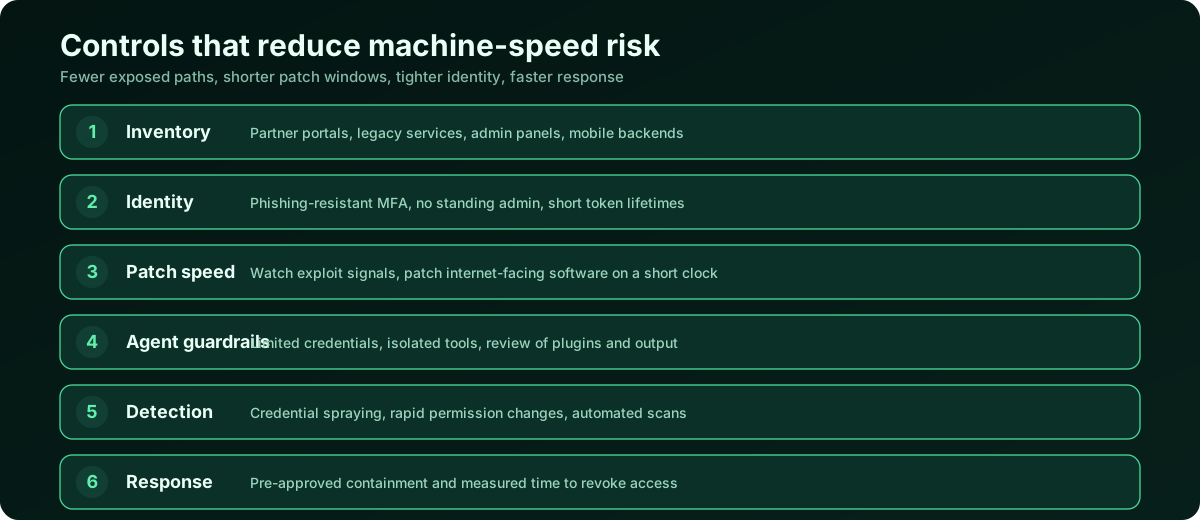
Start with the attack conditions, not the tool names. ARTEX, CAIRN, and the next framework will change. Weak identity, exposed services, slow patching, and noisy logs remain useful targets.
-
Inventory every internet-facing system. Include partner portals, supplier integrations, employee apps, mobile backends, legacy services, and admin panels. If a system is not in the inventory, nobody can protect or monitor it consistently.
-
Treat identity as the control plane. Use phishing-resistant MFA for privileged access, remove standing admin rights, shorten token lifetimes, and review application permissions in cloud tenants. Many reported ARTEX and CAIRN cases began with valid credentials or weak authentication.
-
Shorten the patch window for internet-facing software. Track public exploit signals, not only CVE scores. When a patch drops, assume attackers will diff it quickly and test the gap on unpatched systems.
-
Protect coding assistants and AI agents. Limit their credentials, isolate their execution environment, review plugins, and treat tool output as untrusted input. Apple's filing and Recorded Future's research both point to agent access as a real enterprise risk, not a theoretical one.
-
Detect behaviour, not only signatures. Watch for credential spraying across many tenants, rapid changes in cloud application permissions, unusual Graph or admin API use, repeated failed logins followed by success, and automated scans that move from one exposed service to the next.
-
Plan for a short incident window. If an attacker can reach privileged access in under three hours, a response playbook that waits for a morning meeting will fail. Pre-authorize containment steps, name the people who can revoke sessions and application credentials, and rehearse the path.
-
Measure recovery, not just detection. Track time to revoke tokens, time to disable an application identity, time to patch the exploited service, and time to confirm that data access stopped. Alerts that arrive after the damage are not useful evidence of control.
-
Keep human approval for irreversible actions. Agents and automation can speed up routine work. Payments, permission changes, data exports, and production changes still need clear authority and an audit trail.
How students should study this safely
This subject is worth studying, but the boundary matters. The useful work is understanding how systems fail and how defenders reduce harm.
- Build labs only with systems you own or with permission from the owner. A local virtual machine, a deliberately vulnerable training app, and a private cloud test account are enough to study authentication, logging, and patch behaviour.
- Read primary sources first. Google Threat Intelligence Group, the FBI IC3 report, Check Point Research, Recorded Future, and vendor incident writeups give better evidence than reposted headlines.
- Study detection engineering. Turn a reported behaviour into a question your logs can answer, then test whether the answer arrives fast enough to act on.
- Study incident response and recovery. Being able to revoke access, preserve evidence, and restore service is a skill that transfers across every tool.
- Study policy and human factors. Deepfakes, phishing, and executive impersonation work because people trust familiar voices and urgent requests. Controls should reflect that.
- Write about uncertainty. Separate attempts from confirmed compromises, and separate research demonstrations from in-the-wild attacks.
Limits of the current claims
The reports are serious, but the numbers need careful handling. "Under three hours" describes specific intrusions, not a universal average. Microsoft said most attempted sign-ins in the ConnectWise campaign were unsuccessful. Amazon said some ARTEX records it found were campaign artefacts and outcomes could not be verified. Agent-generated output can be wrong, and Google noted a wave of claimed exploits that do not work, which creates extra verification work for defenders.
There is also a reporting gap. The FBI says AI-related complaints likely miss cases where victims never knew AI was involved. The same problem applies to corporate incidents. A team may record the loss of credentials without recording the automation behind the phish or the model that helped write the lure.
That gap is a reason to improve telemetry, not a reason to inflate every claim. Machine-speed attacks are real. Their exact share of all breaches is still hard to measure.
The lesson for 2026
The current wave of AI-automated hacking does not replace the fundamentals of security. It punishes teams that ignored them. Stolen credentials, exposed admin panels, weak partner access, and slow patching were dangerous before agentic frameworks. Now an attacker can test more of them, faster, with less effort.
The Google and FBI reports point to the same operational change. Attackers are chaining known steps at machine speed. Defenders need the same discipline: fewer exposed paths, shorter patch windows, tighter identity controls, better logs, and response plans that can move before an intrusion ends.
That is the defensive study worth taking from ARTEX. The tool will change. The conditions it exploits are under our control.
Sources
- Google Cloud, GTIG AI Threat Tracker: Agentic Threat Activity Crosses a Significant Threshold
- Google blog, The era of autonomous attacks has arrived
- FBI, 2025 Internet Crime Report
- FBI press release, Cryptocurrency and AI scams bilk Americans of billions
- BleepingComputer, FBI warns ARTEX AI hacking tool is powering global cyberattacks
- The Record, FBI flash alert says Artex tool automating cyberattacks at machine speed
- Check Point Research, Hacking on Autopilot: Inside ARTEX Cybercrime Campaigns
- Recorded Future Insikt Group, AI is both target and tool for threat actors
- Apple fiscal 2026 Form 10-K coverage and agent risk disclosure
Go deeper

About the author
Caleb Ngeno
Lead Developer
Founder and lead developer with expertise in full-stack development and cloud solutions.
Hardening a production environment?
TechGaetano helps teams design zero-trust controls, review identity and network boundaries, and turn security policy into engineering practice.
Talk to a security engineerFrequently asked questions
What is AI-Automated Hacking?
Abstract. Automated hacking has moved from chatbot assistance to agent workflows that can scan, decide, act, and learn with little human input. Google Threat Intelligence Group reported the first intrusion pipeline it had seen that found and exploited vulnerab.
How should a team get started with AI-Automated Hacking?
Start with asset and identity inventory, define the trust boundaries, and roll out controls in phases: identity, device posture, least-privilege access, segmentation, then continuous verification.
What should teams avoid when working on AI-Automated Hacking?
The main risks are treating zero trust as a product purchase, leaving standing privileges in place, and assuming the model or the network perimeter is a security boundary.
Further reading
Related posts
Malicious AI Hacking Tools: A Defense Guide to WormGPT, ARTEX, and 10 More Threats
Abstract. Malicious AI tools are no longer a single chatbot with an unsafe name. Public reporting in 2025 and 2026 shows a market of paid dark LLMs, f…

Cloud Security and Multicloud Environments: Six Research Opportunities for Resilient Enterprise Architecture
Abstract. Multicloud is no longer an exception in enterprise architecture. It is the normal operating condition: public clouds, private clouds, SaaS,…