Article · Edge Computing
Edge Computing vs Centralized Cloud: Cost, Latency, and Architecture Trade-offs
By Caleb · October 27, 2026
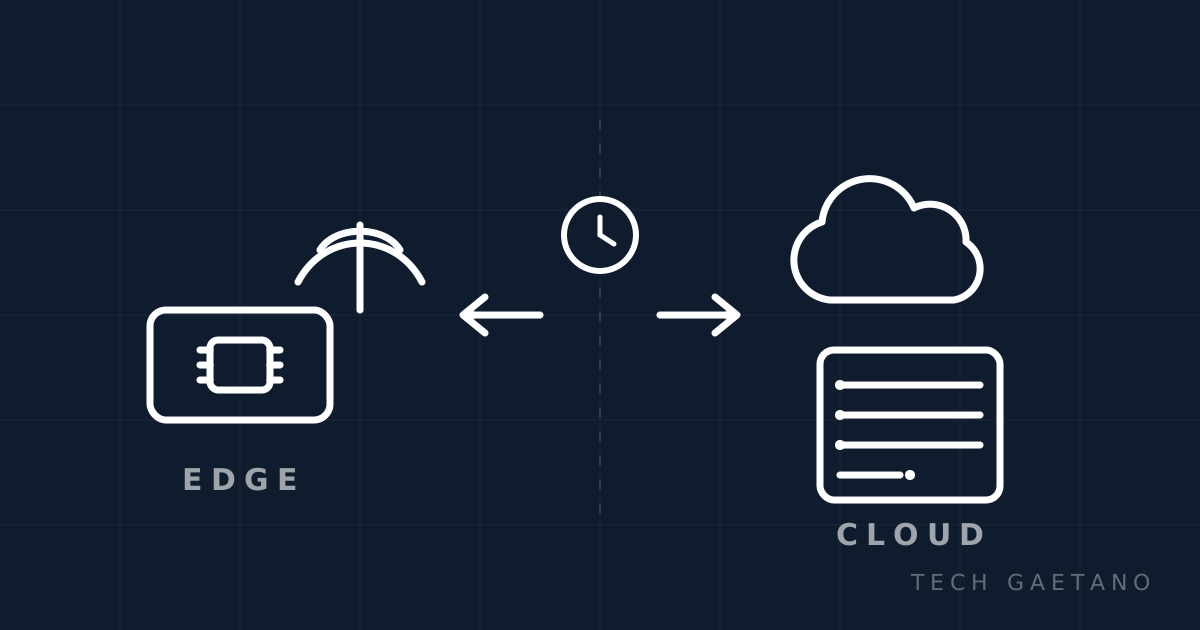
Edge computing is often sold as the inevitable future and dismissed as a marketing term in the same conversation. Neither position is useful. The real question is narrower and more practical: for a given workload, where should the compute live?
Centralized cloud is still the right default for most systems. Edge is the right answer for a specific set of constraints: hard latency budgets, enormous data volumes, unreliable connectivity, or data that legally cannot leave a location. Getting the decision right requires honest numbers rather than architecture fashion.
The question is workload placement
"Edge" covers a wide range of locations: a CDN point of presence, a regional cloud zone, a telco access network, a factory floor, a retail store, or the device in a user's hand. Each has different capabilities, costs, and failure modes. A CDN edge function is not the same as a ruggedised server in a mine.
Centralized cloud means a small number of large regions with managed services, elastic capacity, and deep tooling. It is cheaper to operate because it concentrates expertise and utilisation. The trade-off is distance.
The useful framing is a placement decision, not a migration. Some workloads belong at the edge, some in the centre, and many need a control plane in the cloud with a data plane at the edge.
Latency math without the marketing
Light in fibre travels at roughly 200,000 km/s, or about 5 microseconds per kilometre. A round trip of 1,000 km has a theoretical floor near 10 ms, before routing, queuing, TLS handshakes, and application processing. Real-world paths are longer than the straight line and often cross several networks.
The last mile usually dominates. A user on a mobile connection may see 20-50 ms of radio and backhaul latency before the request reaches the internet. Putting compute at a CDN PoP helps, but it cannot fix a congested radio link. Putting compute on the device can.
Rough guidance:
- Under 10 ms: edge or on-device processing is usually required. Industrial control, live video effects, gaming, and safety systems fall here.
- 10-50 ms: regional edge or a nearby cloud region can work. Interactive retail, AR overlays, and real-time collaboration are candidates.
- Over 50 ms: central cloud is usually fine. Most business applications, dashboards, and batch workflows live comfortably in this range.
Average latency is not the whole story. Jitter and tail latency matter more for real-time systems. A 30 ms average with occasional 300 ms spikes will ruin a voice or control application.
Also measure where time actually goes. If inference takes 800 ms and the network takes 15 ms, moving the compute to the edge saves almost nothing. Optimise the dominant cost before relocating the workload.
Bandwidth and data gravity
Bandwidth is the second constraint. A factory with thousands of sensors can generate terabytes per day. Sending all of it to the cloud costs money, consumes uplink capacity, and adds delay. Processing locally and sending aggregates or anomalies is often the only sensible design.
Data gravity works the same way in reverse. If a dataset already lives in a cloud region and analyses scan it repeatedly, moving compute to the data is cheaper than moving data to the compute. Egress fees are the tax on getting this wrong.
Regulatory residency adds a hard constraint. Some data must remain in a country or on a premises. Edge is sometimes the only compliant option, regardless of economics.
The full cost model
Edge is not cheap. The sticker price of a device is a fraction of the total cost. A realistic model includes:
- Hardware and ruggedisation.
- Installation and commissioning.
- Space, power, cooling, and physical security.
- Connectivity, including redundant links.
- Spare parts and replacement cycles.
- Fleet management, remote updates, and rollback.
- Monitoring, logging, and on-call coverage.
- Security patching and attestation.
- Underutilised capacity, because edge nodes are sized for peak.
Central cloud has its own hidden costs: egress, cross-zone traffic, NAT gateways, managed-service premiums, and idle capacity. The difference is that cloud costs scale with usage and are visible on a bill, while edge costs are capital and operational, spread across teams and easy to underestimate.
A simple break-even test helps. Estimate the three-to-five-year total cost of ownership for both options at realistic utilisation. If the edge node runs at 20 percent utilisation, the per-request cost is five times worse than the average suggests. Cloud elasticity wins for spiky or uncertain demand; edge wins for steady, predictable, latency-sensitive load.
Architecture trade-offs
Consistency and state
Edge introduces distributed state. Replicating a database to many locations creates consistency problems, conflict resolution, and failover complexity. Many successful edge designs keep state central and push only stateless compute outward, or partition data by geography and accept eventual consistency within a region.
If you need strong consistency across locations, edge is probably the wrong choice.
Failure modes
Edge systems fail partially and often. A store loses connectivity; a device reboots; a PoP degrades. Design for offline operation with local queues, idempotent writes, and clear reconciliation rules. Assume the network will disappear and plan what the system does while it is gone.
Fleet operations
Managing one deployment is easy. Managing ten thousand is a different discipline. You need zero-touch provisioning, signed updates, staged rollouts, remote diagnostics, and a reliable rollback path. Configuration drift is the default state unless you automate against it.
Security
Edge devices live in places you do not control. Physical access, tampering, and stolen hardware are real threats. Use secure boot, disk encryption, hardware-backed keys, and remote attestation. Patch quickly, and assume any single device can be compromised.
Observability
Centralised logging is a luxury at the edge. Buffer locally, sample intelligently, and ship summaries when connectivity allows. Clock skew and partial traces will complicate debugging; plan for it.
When edge wins
- Sub-20 ms interaction requirements that cannot be met from a region.
- High-volume sensor or video data where uploading everything is impractical.
- Intermittent connectivity where local operation is mandatory.
- Data residency or sovereignty rules that require local processing.
- Bandwidth costs that dominate the bill.
- Physical control systems where a round trip is unacceptable.
When centralized cloud wins
- Batch analytics, model training, and data warehousing.
- Bursty or unpredictable web traffic.
- Workloads that need strong consistency and a single source of truth.
- Small teams without the capacity to run a fleet.
- Rapid experimentation where managed services shorten the loop.
- Anything where 50 ms of latency is imperceptible to users.
Hybrid patterns that work
Most real systems are hybrid, and the good ones are explicit about the split.
- Central control plane, edge data plane. Manage configuration, identity, and deployments centrally; run latency-sensitive processing locally.
- CDN first. Before buying hardware, try edge functions and caching at a CDN. It is the cheapest form of edge and solves many static and personalisation problems.
- Regional cells. Deploy full stacks in multiple regions for latency and residency, with a central account and billing layer.
- Store-and-forward. Buffer locally, sync when connected, and reconcile with idempotent operations.
- Hierarchical aggregation. Process at the device, aggregate at the gateway, and analyse in the cloud.
A decision checklist
Before committing, answer these questions honestly:
- What is the actual latency budget, measured end to end?
- Where does the time go today: network, compute, storage, or the model?
- How much data is generated, and how much must leave the site?
- Are there residency or sovereignty requirements?
- Does the workload need strong consistency?
- Can your team operate a fleet, including patching and on-call?
- What is the realistic utilisation of edge capacity?
- What is the three-to-five-year total cost of ownership for both options?
- How will you observe and debug a partial failure?
- What is the exit cost if the approach fails?
Bottom line
Centralized cloud remains the correct default. It is simpler, more elastic, and cheaper for most workloads. Edge earns its place when latency, bandwidth, connectivity, or regulation make centralisation impossible or uneconomical.
Do not choose edge because it sounds advanced. Choose it because you have a measured constraint that the centre cannot satisfy, and because you have the operational maturity to run a distributed fleet. For everyone else, a regional deployment and a good CDN will deliver most of the benefit at a fraction of the complexity.
Visual field notes
The system at a glance
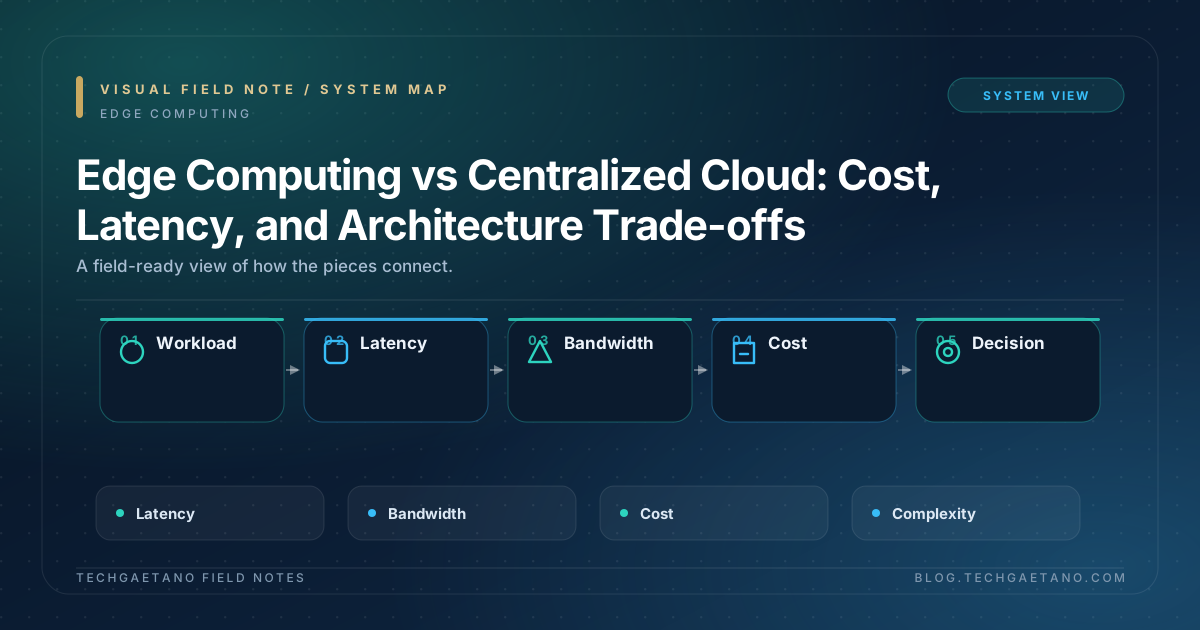
System map
How the moving parts connect, from first input to operating outcome.
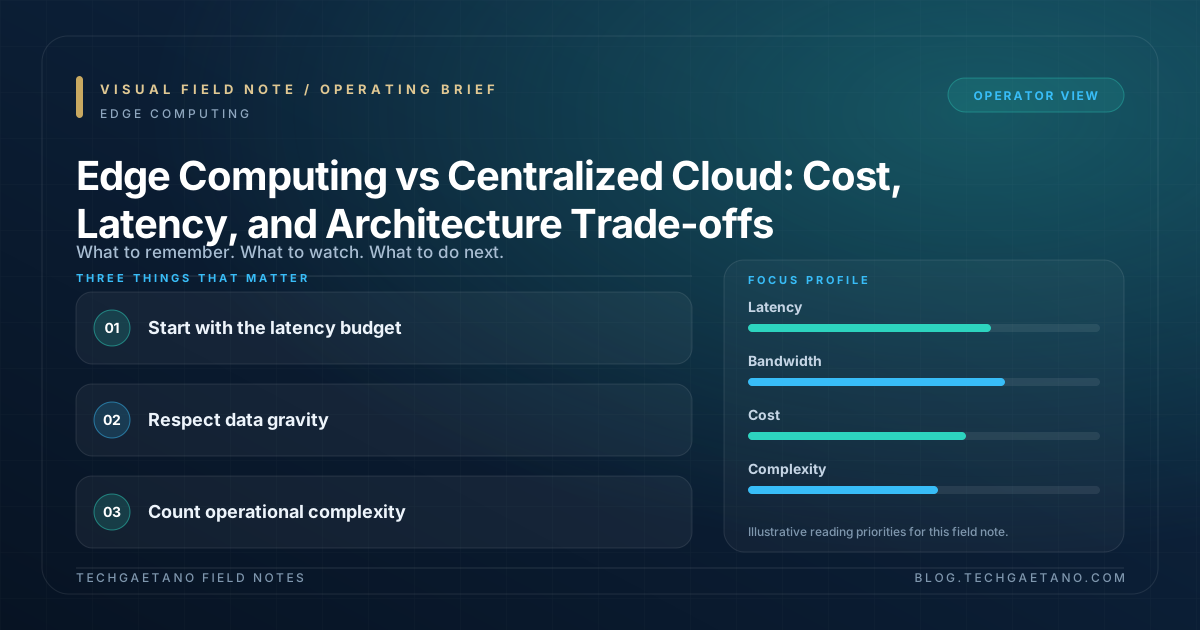
Operating brief
The three decisions that matter and the signals to watch.
Building a low-latency edge architecture?
TechGaetano helps teams compare edge, regional, and centralized designs, then audit the infrastructure and cost model behind them.
Partner with our engineering teamFrequently asked questions
What is Edge Computing vs Centralized Cloud?
Edge computing is often sold as the inevitable future and dismissed as a marketing term in the same conversation. Neither position is useful. The real question is narrower and more practical: for a given workload, where should the compute live? Centralized clo.
How should a team get started with Edge Computing vs Centralized Cloud?
Start with the workload and the latency budget, not the technology. Measure where data is created and consumed, then compare edge, regional, and centralized options on total cost and operational risk.
What should teams avoid when working on Edge Computing vs Centralized Cloud?
The main risks are underestimating operational complexity, ignoring data gravity and bandwidth costs, and deploying edge infrastructure without a clear latency or compliance requirement.
Further reading
Related posts
The Future AI Hub: Architecture for a Multi-Model Enterprise
Most companies now have an AI story. Fewer have an AI architecture. The difference shows up the second time a model changes, the first time an auditor…
Read more
Platform Engineering: The Business Case for an Internal Developer Platform
Every engineering organization pays a coordination tax. It shows up as onboarding that takes weeks, pipelines that differ from team to team, security…
Read more