Article · Cybersecurity
Continuous Threat Exposure Management: CTEM and Cloud Resilience
By Caleb · November 2, 2026
Annual vulnerability scans produce a number that is technically accurate and operationally useless. By the time the report is triaged, the environment has changed, the highest-scoring findings sit behind controls that make them unreachable, and the one finding that matters was on a page nobody read.
Continuous Threat Exposure Management replaces the periodic scan with a continuous loop: scope what matters, discover what is exposed, prioritise by actual attack path, validate whether it is exploitable, and mobilise the fix. The output is not a list of CVEs. It is a shrinking set of verified, reachable paths to the things you care about.
The reason this matters now is structural. Hybrid and multi-cloud estates spanning Kubernetes, AWS, Azure, and GCP have no single perimeter and no single inventory. Assets appear and disappear hourly. Static assessment cannot keep pace with a runtime that does not sit still.
The five phases
Scoping
Decide what is in play before looking for anything. Which business services matter, what data do they hold, what would a serious incident look like, and which environments are in scope this cycle.
Scoping is the phase teams skip, and it is why exposure programmes drown. Without a scope, every asset competes for attention and the loudest finding wins instead of the most consequential one.
A useful scope is small and explicit: a crown-jewel service, its data store, its identity paths, and the environments it touches. Expand deliberately, not by accident.
Discovery
Build a live inventory of everything relevant: workloads, identities, network paths, data stores, configurations, and the relationships between them. In cloud, this means accounts and subscriptions, Kubernetes clusters and namespaces, IAM roles and policies, storage buckets, and the service mesh or load balancers that connect them.
Discovery has to be continuous. A weekly export of cloud resources is a photograph of a system that has already changed.
Prioritisation
Rank exposures by whether they are actually reachable and what they lead to, not by base score alone. A critical vulnerability behind a network policy that denies all ingress is lower priority than a medium finding that sits on an internet-facing path to customer data.
Prioritisation needs three inputs: exploitability, reachability, and consequence. Threat intelligence supplies the first, attack path analysis the second, asset and data criticality the third.
The output is a short list of paths, ordered by how much damage a capable attacker could do with them.
Validation
Prove it. Safe exploitation, configuration replay, or controlled simulation that demonstrates the path works in the current environment. Validation converts a hypothesis into evidence and removes the arguments that stall remediation.
It also filters out findings that will never matter: unreachable services, dead code paths, controls that already block the technique. Those disappear from the queue permanently rather than being re-reported next cycle.
Mobilisation
Hand the validated finding to the team that can fix it, with the evidence, the owner, the blast radius of the change, and a deadline. Track it to closure, then re-run discovery to confirm the path is gone.
Mobilisation is where most programmes leak. Discovery produces a list, the list goes into a ticket queue, and closure is never verified. Exposure that is not re-measured has not been reduced; it has been filed.
Attack path mapping across clouds
The unit of analysis is the path, not the finding. A typical cloud attack path looks like this:
- A public-facing workload accepts untrusted input.
- It holds an IAM role with broader permissions than it needs.
- That role can assume a role in another account or subscription.
- The target role can read a data store containing regulated data.
- Egress is unrestricted, so exfiltration is trivial.
Each step alone might be a low or medium finding. Together they are one route to a breach. Prioritisation at the path level changes which fixes you do first: break the chain anywhere and the path is gone, so you fix the cheapest link that actually severs it.
Doing this across Kubernetes, AWS, Azure, and GCP requires normalising four different identity and network models into one graph. That is genuinely hard, and it is the core capability to evaluate when choosing tooling. If the graph cannot join a Kubernetes service account to an AWS IAM role to an Azure managed identity, it cannot see the path.
Cloud resilience as the outcome
Exposure management tells you which paths exist. Resilience is what happens when one is used anyway.
- Blast radius segmentation. Assume a workload is compromised. Limit what its identity can reach, in every connected environment.
- Identity separation. Distinct roles per workload and per environment. No shared credentials across clusters, accounts, or pipelines.
- Egress control. Default-deny outbound traffic with explicit allow rules. Exfiltration requires a path too.
- Recoverable data. Backups that are tested, isolated from the production identity plane, and restorable within a defined objective.
- Detection on the path itself. Alerts on permission assumption, unusual data access, and new external connections, not only on exploit signatures.
Resilience is what makes the exposure programme durable. A path you can contain and recover from is a different business risk than a path that ends in a permanent compromise.
A practical implementation
Days 1-30: Define scope around one crown-jewel service. Build discovery for its runtime, identities, and data stores across the clouds it touches. Stop scanning everything.
Days 31-60: Turn on attack path analysis. Produce the top ten paths by reachability and consequence. Validate the top three. Assign owners.
Days 61-90: Mobilise fixes for the validated paths. Break the cheapest link in each. Re-run discovery to confirm closure. Add egress default-deny and role separation for the scoped service.
From there, expand scope by service rather than by adding more assets to the same queue. Each cycle should produce fewer paths than the last.
Common pitfalls
- Scanning instead of scoping. More coverage without a scope produces more noise and the same three real problems.
- Prioritising by score alone. Severity without reachability is a sorting exercise, not a decision.
- Ignoring identity. Most cloud paths run through permissions, not software flaws. A pure vulnerability programme will miss them.
- Treating clouds separately. Path analysis that stops at the account boundary cannot see the path that crosses it.
- Never verifying closure. If you do not re-measure, you do not know whether exposure went down.
- Buying without operating. Platforms produce graphs. Someone still has to own scope, validation, and mobilisation.
Metrics worth reporting
- Number of validated, reachable paths to crown-jewel assets, trended weekly.
- Median time from validated finding to verified closure.
- Percentage of findings that are unreachable and therefore removed from the queue.
- Share of exposure attributable to identity and configuration rather than unpatched software.
- Count of cross-account and cross-cloud paths detected.
- Time to detect and contain a simulated path in a tabletop or purple-team exercise.
- Recovery objective actually achieved in the last restore test.
Report path count and closure time to leadership, not CVE counts. Path count is the number that changes when the programme works.
Bottom line
Exposure is not a list. It is a set of live routes from the outside to the things you cannot afford to lose, running across environments that change every hour.
Scope deliberately. Discover continuously. Prioritise by reachability. Validate with evidence. Mobilise to closure and re-measure. Then build the resilience that limits the damage when a path you have not found yet is finally used.
Shrink the path count. Everything else is reporting.
Visual field notes
The system at a glance
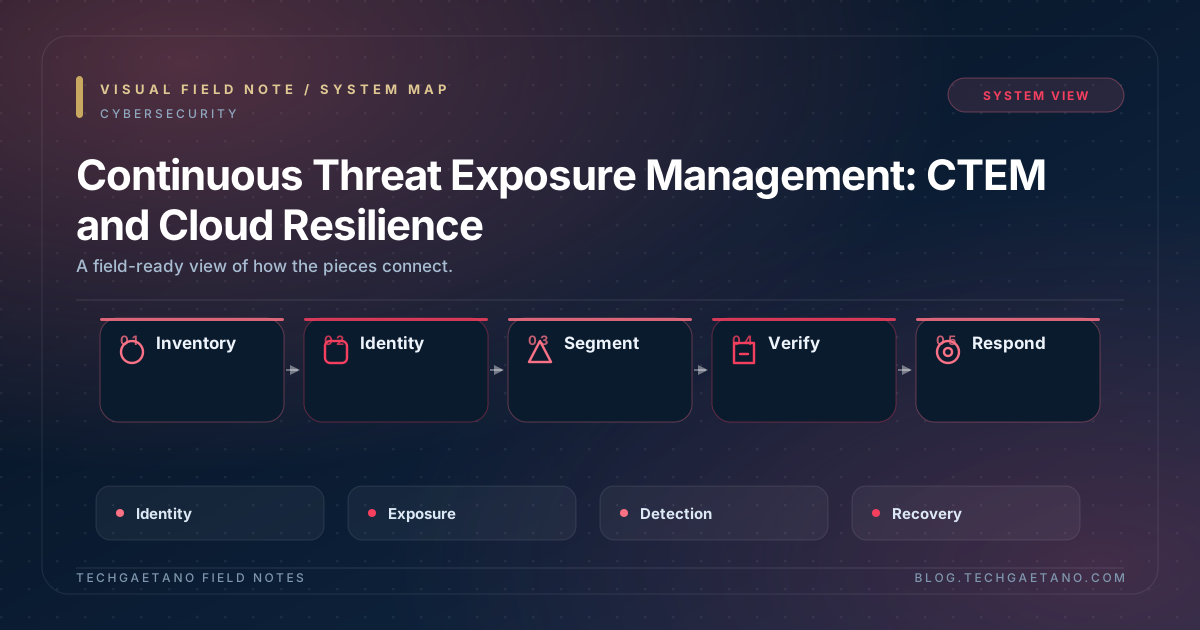
System map
How the moving parts connect, from first input to operating outcome.
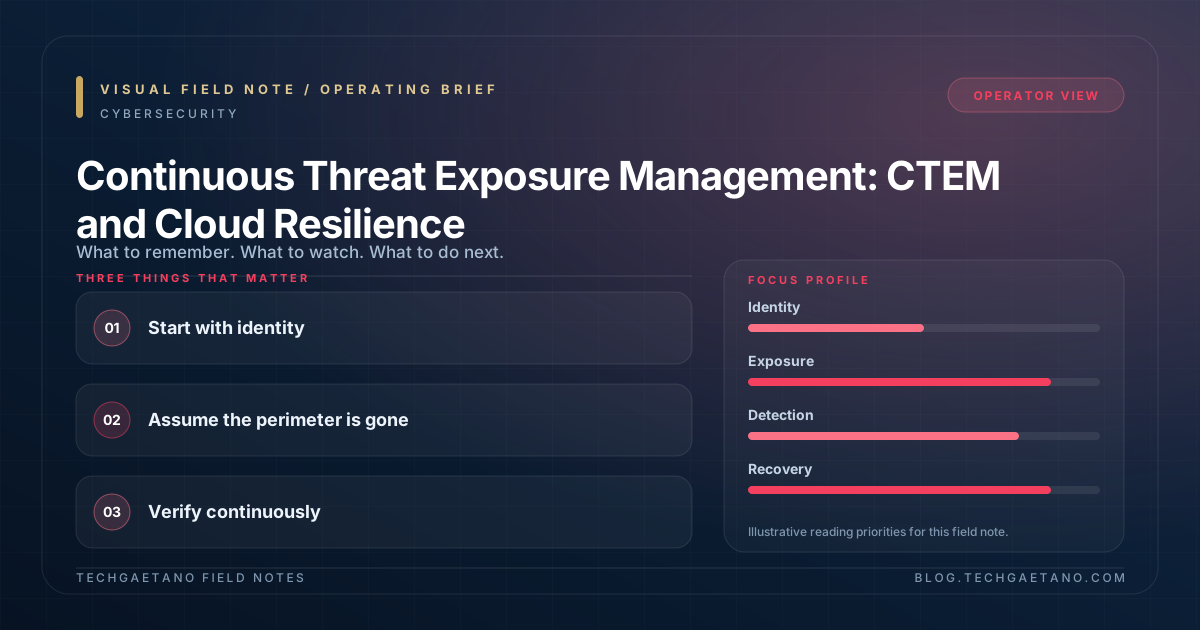
Operating brief
The three decisions that matter and the signals to watch.
Hardening a production environment?
TechGaetano helps teams design zero-trust controls, review identity and network boundaries, and turn security policy into engineering practice.
Talk to a security engineerFrequently asked questions
What is Continuous Threat Exposure Management?
Annual vulnerability scans produce a number that is technically accurate and operationally useless. By the time the report is triaged, the environment has changed, the highest scoring findings sit behind controls that make them unreachable, and the one finding.
How should a team get started with Continuous Threat Exposure Management?
Start with asset and identity inventory, define the trust boundaries, and roll out controls in phases: identity, device posture, least-privilege access, segmentation, then continuous verification.
What should teams avoid when working on Continuous Threat Exposure Management?
The main risks are treating zero trust as a product purchase, leaving standing privileges in place, and assuming the model or the network perimeter is a security boundary.
Further reading
Related posts
Zero Trust Architecture Implementation Guide for Engineering Teams
Zero trust has a branding problem. It is simultaneously the most important security architecture of the decade and a phrase that has been attached to…
Read more
The Agentic SOC: AI vs AI Defense and the Future of Cybersecurity
Security operations have an arithmetic problem. Attack volume grows with automation on both sides, analyst headcount does not, and the median alert qu…
Read more