Article · Cybersecurity
The Agentic SOC: AI vs AI Defense and the Future of Cybersecurity
By Caleb · November 2, 2026

Security operations have an arithmetic problem. Attack volume grows with automation on both sides, analyst headcount does not, and the median alert queue keeps getting longer. The industry has responded with better dashboards, more correlations, and another layer of detection rules. None of that changes the ratio.
The emerging answer is an agentic SOC: autonomous agents that triage alerts, correlate attack paths across environments, and propose or execute containment, while humans supervise outcomes instead of reading every event. It is not a replacement for analysts. It is a shift in what analysts are for.
The same economics apply to attackers. Synthetic identity fraud, automated phishing, and hyper-personalised deepfake social engineering all run at machine speed. Defending against machine-speed abuse with human-speed review is a losing trade.
Why triage has to be autonomous
A typical alert fires because one signal crossed a threshold. Deciding what it means requires enrichment: who the user is, what the asset does, whether the behaviour is normal, whether similar signals appeared elsewhere this week. That enrichment is mostly lookup work.
Analysts do it well for a while, then the queue wins. Alert fatigue is not a motivation problem; it is a throughput problem. The predictable outcomes are suppressed rules, shallow investigations, and burnout.
Automation already handles the first step: enrichment, deduplication, and scoring. The next step is agents that can chain those lookups, form a hypothesis about what happened, gather more evidence, and return a reasoned conclusion with the artifacts attached.
The difference between a playbook and an agent is flexibility. A playbook handles the case it was written for. An agent can notice the case is different, decide what else to check, and stop when it has enough.
Anatomy of an agentic SOC
Ingestion and deduplication
Signals arrive from endpoints, identity providers, cloud control planes, network sensors, and application logs. The first agent layer normalises them, drops noise, and groups related events into a single case rather than forty tickets.
Enrichment and context
Each case is enriched automatically: asset criticality, owner, data classification, recent changes, user behaviour baseline, threat intelligence matches, and the blast radius of the affected identity. This is where most of the time saving lives, because it is deterministic work.
Attack path correlation
The step that changes outcomes is connecting individual events into a path. An unusual login, a new IAM role, a permission escalation, and an object storage read are four alerts. Together they are one narrative: an attacker establishing persistence and staging data.
Agents are good at this because the question is open-ended. Given these four events, what else should have happened? Query the identity store. Check for newly created credentials. Look for egress to an unusual destination. Follow the hypothesis until it holds or collapses.
Triage and verdict
The agent returns a verdict with evidence: severity, affected assets, confidence, recommended action, and the queries it ran. An analyst reviews the reasoning rather than starting from zero.
Containment
With appropriate guardrails, the agent can act: revoke a session, isolate a host, disable a key, block an egress path, or open a change ticket. Every action is reversible by default and gated by policy.
Feedback
Every verdict that a human overrides becomes training signal. Suppressed alerts that turned out to matter become detection gaps. The loop is what makes the system improve instead of merely operating.
The offensive mirror
Defenders are not the only ones automating.
- Synthetic identity fraud. Generated identities assembled from real and fabricated attributes pass onboarding checks that assume a human is behind the application. Detection has to move from document validation to behavioural and relational signals.
- Automated phishing. Campaigns are personalised at scale using leaked data and public profiles. Generic awareness training does not keep up with per-target content.
- Deepfake social engineering. Voice and video impersonation defeat out-of-band verification that was designed for a world where seeing was believing.
Against these, an agentic defence is not optional. The volume and speed are simply beyond manual review, and the attacks are designed to look routine.
Building it safely
Autonomy in a security tool is a blast-radius decision. Get these right before you grant write access.
- Separate reasoning from authority. The agent proposes; policy decides what it may execute unilaterally. Start with read-only investigation and human-approved action.
- Scope every action. An agent that can revoke sessions should not also be able to delete logs. Narrow permissions per capability.
- Keep a kill switch. One action disables the agents and freezes their credentials. Test it.
- Make it explainable. Every verdict includes the queries run, the evidence found, and the confidence. An unexplainable verdict is a black box you cannot defend to an incident commander.
- Preserve the audit trail. Store prompts, tool calls, and decisions. When an incident is over, you will need to reconstruct what the defence did as well as what the attacker did.
- Respect change control. Automated containment in production is a change. Deploy it behind flags, in stages, with a rollback path.
Common pitfalls
- Automating the wrong layer. Speeding up alert delivery does not help if the decision quality is unchanged. Target enrichment and correlation first.
- Unreviewed autonomy. An agent with unilateral containment and a bad signal source can lock out your own responders.
- No feedback loop. Without measuring overrides and misses, the system optimises for looking busy.
- Treating it as a SIEM feature. Buying a chat interface over the same alert stream produces the same conclusions, faster and with more confidence than warranted.
- Ignoring the data foundation. Agents amplify whatever quality your logs have. Incomplete telemetry produces fluent, wrong answers.
- Skipping tabletop exercises. Run the agents against a simulated incident before they meet a real one.
Metrics that mean something
- Median time from alert to enriched case, before and after.
- Percentage of cases where the agent's verdict matched the analyst's final call.
- Analyst overrides per hundred agent verdicts, and their direction.
- Mean time to contain a confirmed incident.
- Number of attack paths reconstructed from otherwise separate alerts.
- Share of alerts that never reached a human because they were correctly closed.
- False containment actions and their blast radius.
- Analyst hours spent on repetitive enrichment versus investigation.
If confidence rises while overrides fall, the system is learning. If confidence rises and overrides stay flat or climb, it is becoming confidently wrong.
A practical sequence
First: automate enrichment and deduplication. Measure the time saved. This is low risk and immediately useful.
Next: add attack path correlation with human review. Let the agent propose a narrative and evidence, and have analysts grade it.
Then: enable reversible containment actions behind approval for the highest-confidence, lowest-blast-radius cases: session revocation, key disabling, host isolation.
Finally: widen autonomy as the override rate drops and the audit trail proves the reasoning. Move to full auto-investigation for well-understood alert classes, keeping humans on novel and high-impact events.
Bottom line
The agentic SOC is not a product category so much as a change in the unit of work. Analysts stop reading alerts and start reviewing conclusions. Agents stop being alert routers and start being investigators.
Both sides of the conflict already operate at machine speed. The defence has to as well, with policy, scope, and auditability as the constraints that keep autonomy from becoming its own incident.
Start with enrichment. Prove correlation. Grant reversible actions. Measure overrides. Then widen the aperture, one alert class at a time.
Visual field notes
The system at a glance
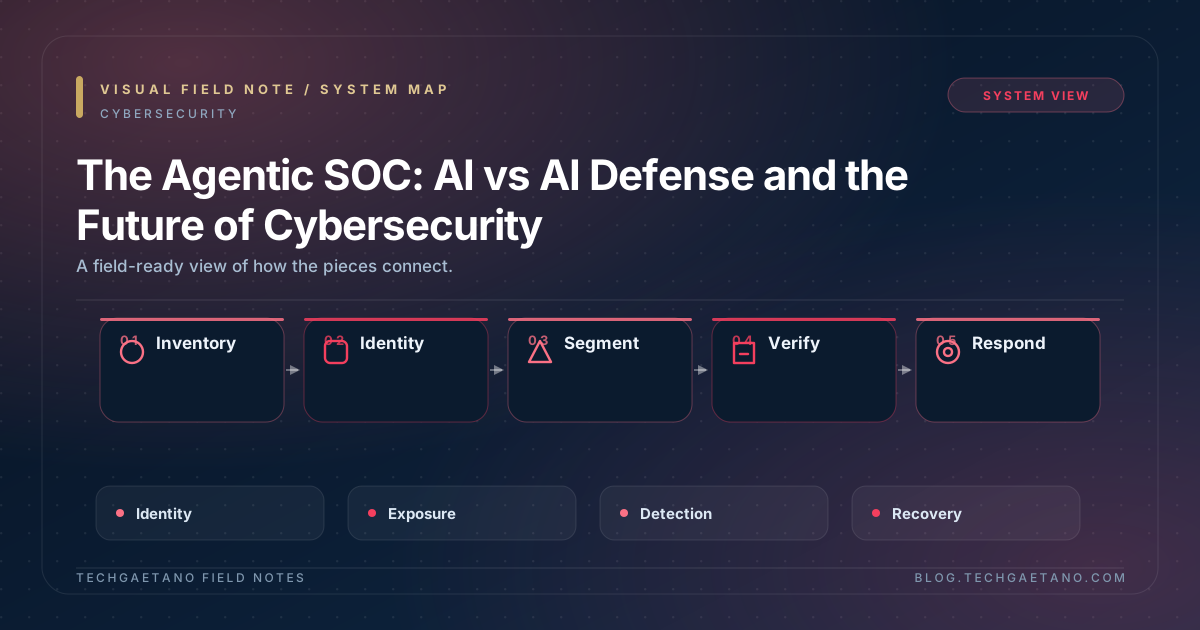
System map
How the moving parts connect, from first input to operating outcome.
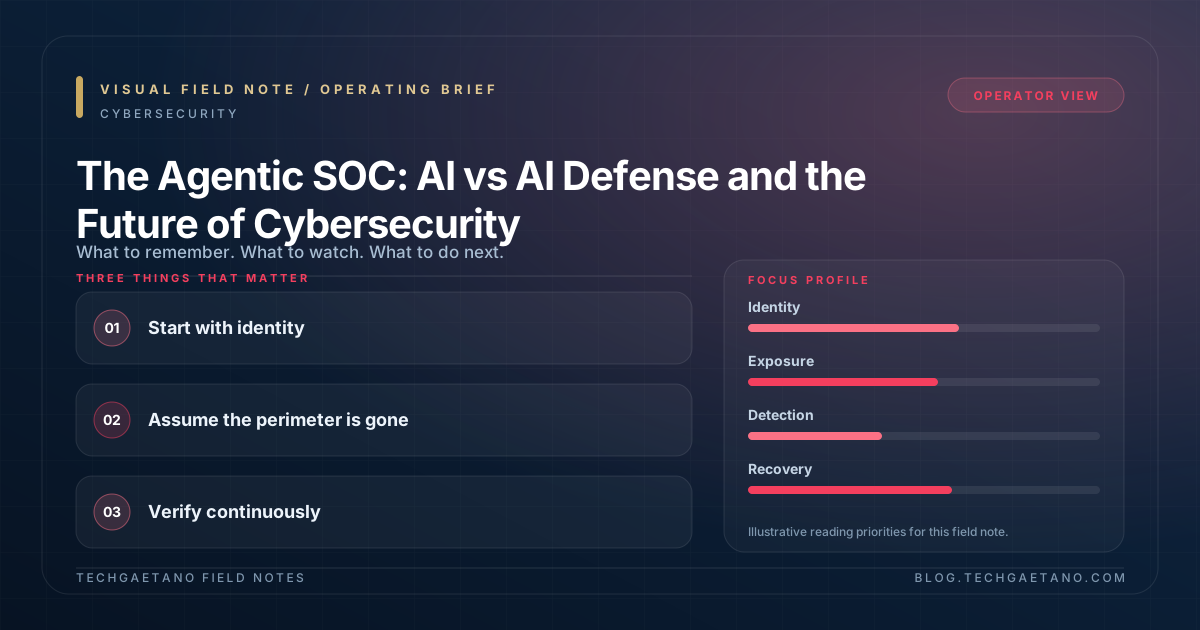
Operating brief
The three decisions that matter and the signals to watch.
Hardening a production environment?
TechGaetano helps teams design zero-trust controls, review identity and network boundaries, and turn security policy into engineering practice.
Talk to a security engineerFrequently asked questions
What is The Agentic SOC?
Security operations have an arithmetic problem. Attack volume grows with automation on both sides, analyst headcount does not, and the median alert queue keeps getting longer. The industry has responded with better dashboards, more correlations, and another la.
How should a team get started with The Agentic SOC?
Start with asset and identity inventory, define the trust boundaries, and roll out controls in phases: identity, device posture, least-privilege access, segmentation, then continuous verification.
What should teams avoid when working on The Agentic SOC?
The main risks are treating zero trust as a product purchase, leaving standing privileges in place, and assuming the model or the network perimeter is a security boundary.
Further reading
Related posts
Zero Trust Architecture Implementation Guide for Engineering Teams
Zero trust has a branding problem. It is simultaneously the most important security architecture of the decade and a phrase that has been attached to…
Read more
Agentic AI and Identity Management: Securing AI Agents as Digital Identities
Autonomous AI agents are no longer a demo. They query databases, execute scripts, call APIs, open pull requests, and move data between systems without…
Read more