Article · Cybersecurity
The $6.3 Billion Binance Hack: Frozen Funds, Recoveries, and the Myth of Crypto Security
By Caleb · October 30, 2026

The short version
On October 29, 2026, Binance disclosed what is now the largest crypto theft on record. The exchange estimated the impact at roughly $6.3 billion in digital assets. Within hours, stablecoin issuers and security partners had frozen around $3 billion, including about $2.3 billion in USDT and USDC. Binance said customer losses would be covered and that withdrawals were suspended while it investigated.
That sounds like a recovery story. It is not — at least not yet.
A freeze is not a refund. It stops the money from moving. Returning it requires law enforcement, court orders, issuer cooperation and a legal process that can take months or years. The distinction matters because the headline number — “$3 billion recovered” — is already being repeated as if the money is back in customers’ accounts. It is not.
The deeper story is simpler and less comforting: the blockchain was not hacked. The custody and operations layer around it was. Crypto was never “safe” in the way the marketing implied. It was transparent, programmable and irreversible — three properties that cut both ways.
What Binance says happened
Binance’s initial investigation points to a compromised laptop belonging to a DevOps engineer. According to the exchange, that access allowed an attacker to reach a service container and submit unauthorized withdrawal transactions. Binance said it found no evidence of a private key leak.
The attacker did not need to break Bitcoin’s cryptography. They needed a path to a system that could authorize withdrawals. That is a familiar enterprise security failure wearing crypto clothes:
- One compromised endpoint.
- One privileged engineering workflow.
- One service container with too much authority.
- One withdrawal path that executed before alarms could stop it.
Binance suspended deposits and withdrawals and said it would cover all hacking losses using its Secure Asset Fund for Users (SAFU) and company funds. Co-CEO Yi He said the platform would cover “all hacking losses.” Former CEO Changpeng Zhao, who no longer manages Binance, said user funds were safe and that he expected full coverage.
Blockchain intelligence firm TRM Labs attributed the attack with high confidence to TraderTraitor, a North Korean state-sponsored group. Chainalysis also pointed to North Korea. TRM said preparations began at least 36 hours before the theft, with attackers using Tornado Cash to fund wallets, and that assets were moved across 10 blockchains, most within about 20 minutes.
That speed is the point. Crypto gives defenders a public ledger, but it also gives attackers a global, near-instant settlement network.

Photo: U.S. Department of Justice, public domain. This 2023 image is historical and is not from the 2026 incident.
The money: what was frozen, what was recovered
The numbers moved quickly on the first day. Here is the clearest snapshot available as of October 30, 2026:
| Item | Reported figure | What it means |
|---|---|---|
| Total estimated impact | ~$6.3 billion | Binance’s estimate; other analysts put it near $5.9–$6.4 billion |
| Assets frozen | ~$3 billion | Blocked from moving, not yet returned |
| Stablecoins frozen | ~$2.3 billion | Mostly USDT and USDC |
| USDT frozen by Tether | ~$1.57 billion | Issuer-level block |
| USDC frozen by Circle | ~$800 million | Issuer-level block |
| Still unfrozen | ~$3.3 billion | Fundstrat estimate |
| SAFU fund | ~$1.2 billion | Binance emergency reserve |
| Binance assets before hack | ~$144 billion | Stolen funds equal roughly 4% |
At one point, the attacker’s wallets held more than $5.7 billion across assets, according to Arkham, including roughly $1.5 billion in bitcoin, $900 million in ether, $1.5 billion in USDT and more than $800 million in USDC. CoinDesk later reported that about $1.4 billion of bitcoin was split into 19 wallets that no one can freeze.
That last detail is the whole problem in one sentence. Stablecoins are recoverable because an issuer controls the token contract. Bitcoin and ether have no issuer to call. They can be traced, but they cannot be frozen at the protocol level.
“A freeze stops the money from moving, and recovery follows through legal process,” Ari Redbord, global head of policy at TRM Labs, told CNBC. “Stablecoins are the most recoverable asset class in crypto because the issuer controls the token contract.”
Eric Jardine, head of research at Chainalysis, added: “There is no standard recovery timeline. A technical freeze may happen quickly, while returning funds can take months or years.”
So the honest answer to “how much was recovered?” is: about $3 billion was frozen; very little, if any, had been returned to customers at the time of writing. Binance’s pledge to cover losses is a solvency and customer-protection promise, not proof that the stolen assets have been clawed back.
Why “recovered” is doing a lot of work
There are three different events people confuse:
- Seizure or freeze. An issuer, exchange or law enforcement blocks an address or account. The attacker cannot move the funds.
- Forfeiture. A court or authority establishes a legal right to the assets.
- Restitution. The assets are converted, reissued or returned to the victims.
Only the third step puts money back in a customer’s pocket. The first step is fast. The second is slow. The third can take years and may never happen in full.
For stablecoins, the path is comparatively clear: Tether and Circle can freeze, burn and reissue tokens, allowing frozen USDT or USDC to be returned to a victim after legal process. For bitcoin and ether, investigators must trace the funds until they reach a cooperating exchange, bridge or other centralized chokepoint. If the attacker keeps moving, splits and mixes the funds, recovery becomes a race with no guaranteed finish line.
Photo: embljusocmedia, public domain, via Wikimedia Commons.
This is also why the “code is law” slogan was always incomplete. The code may be neutral. The issuers, exchanges, validators and courts around it are not.
The uncomfortable truth: crypto was never “safe”
Crypto’s security model is often described as trustless. That is a useful shorthand, not a literal description. The cryptography can be strong while the surrounding system is fragile.
A public blockchain gives you:
- Integrity — transactions are hard to alter after finality.
- Transparency — anyone can inspect the ledger.
- Availability — no single company has to keep the ledger online.
It does not automatically give you:
- Confidentiality — addresses are pseudonymous, not private.
- Custody — whoever controls the keys or the withdrawal path controls the assets.
- Recoverability — finality means a valid transfer is final.
- Operational security — endpoints, laptops, CI/CD systems and humans remain targets.

Photo: Project Kei, CC BY-SA 4.0, via Wikimedia Commons.
The Binance incident is a case study in the gap. The attacker did not need to forge a block or break a signature scheme. They needed a compromised laptop and an authorization path. That is not a blockchain failure. It is an identity, endpoint and privilege failure — the same category of problem that has plagued banks, SaaS companies and governments for decades.
“Not your keys, not your coins” is good advice for avoiding exchange counterparty risk. It is not a complete security strategy. Self-custody removes the exchange from the trust equation, but it adds key management, transaction verification and phishing risk. A hardware wallet does not save you if you sign a malicious transaction. A seed phrase does not save you if you store it in a screenshot. Irreversibility protects you from chargebacks and censorship; it also protects the thief.
And the stablecoin safety net is itself a form of centralization. The reason $2.3 billion could be frozen is that two companies had the power to freeze it. That power is useful in a crisis, but it is not decentralization. It is a permissioned recovery layer sitting on top of a permissionless ledger.
That is the trade-off crypto users rarely want to discuss: the assets that are easiest to recover are the ones with a central issuer. The assets that are hardest to censor are also the ones that are hardest to recover.
A short history of “this time it’s different”
This is not Binance’s first major security incident.
In May 2019, hackers withdrew 7,000 BTC from Binance’s hot wallet — about $40 million at the time. Binance used its SAFU fund to cover the loss and said no user funds were affected. The breach involved phishing, viruses and compromised API keys and two-factor codes. The exchange survived, reimbursed users and kept growing.
In October 2022, attackers exploited the BSC Token Hub bridge and withdrew 2 million BNB, initially valued at around $570 million. The actual amount moved off-chain was closer to $100–110 million, and Binance said it froze about $7 million with security partners. The incident exposed the risk of cross-chain bridges, which concentrate liquidity and trust in a single contract.
The pattern repeats: the protocol usually holds; the bridge, exchange, hot wallet, endpoint or approval workflow fails. The amounts get larger because the market gets larger and the attackers get faster.
What actually worked — and what didn’t
Several things went right after the 2026 breach:
- Binance suspended withdrawals quickly.
- Tether and Circle froze large stablecoin balances.
- Investigators and analysts coordinated in public.
- Binance pledged to cover customer losses rather than socializing them silently.
- The incident was attributed quickly enough to trigger sanctions and law-enforcement attention.
Several things went wrong before it:
- A single engineer’s laptop appears to have been enough to reach a withdrawal-capable service.
- The attacker moved across 10 chains in roughly 20 minutes.
- Bitcoin and ether moved beyond the reach of issuer freezes.
- The market reaction was immediate: bitcoin fell below $77,000, ether dropped sharply and BNB sold off.
For Binance, the immediate solvency risk looks manageable. Fundstrat’s Sean Farrell estimated that about $3.3 billion remained unfrozen and said the episode did not currently appear to create meaningful solvency risk. With roughly $1.2 billion in SAFU, Binance could cover about a third of the unfrozen loss from that fund alone, with the rest coming from company resources.
But “manageable for Binance” is not the same as “safe for the industry.” The attack reinforces a lesson that regulators, insurers and institutional allocators have been slow to price in: crypto’s risk is concentrated at the edges, not in the middle.
What security teams should take from this
The Binance breach is a crypto story, but the control failures are general-purpose. Any organization that moves money — fintech, payments, banking, treasury, even large e-commerce — should recognize the pattern.
1. Treat withdrawal systems as tier-zero infrastructure
A withdrawal service is not just another internal API. It is a money-movement system. It needs the same controls as wire transfers: strong authentication, separation of duties, transaction limits, anomaly detection, and a break-glass process that is tested under pressure.
2. Break the laptop-to-withdrawal chain
The reported entry point — a compromised DevOps laptop reaching a service container — should be a board-level concern. Engineering workstations should not have standing production access. Use just-in-time credentials, privileged access workstations, hardware-backed authentication and short-lived tokens. Assume any laptop can be compromised and design so that one endpoint cannot authorize a large transfer.
3. Make freezing a rehearsed playbook
The stablecoin freezes worked because issuers had contacts, procedures and authority. Most companies do not have a pre-negotiated freeze playbook with their banks, custodians, stablecoin issuers and law enforcement. They should. The first hour matters more than the first press release.
4. Measure time-to-freeze, not just time-to-detect
Detection is necessary but insufficient. The useful metric is how long it takes to stop the money from moving after an unauthorized transaction is identified. Binance’s attacker moved most funds in about 20 minutes. A 24-hour incident-response process is not a control; it is a postmortem.
5. Do not confuse proof of reserves with proof of controls
Proof of reserves can show that an exchange held assets at a point in time. It does not prove that liabilities are matched, that withdrawal paths are secure, or that the organization can respond to a compromise. Reserves are a balance-sheet signal. Controls are an operating signal.
6. Accept that recovery is a legal process
Technical teams often assume recovery is an engineering problem. It is not. Freezing is technical. Returning assets is legal, diplomatic and institutional. Plan for both.
What this means for investors and users
If you hold crypto on an exchange, you are exposed to the exchange’s operational security, not just the asset’s price. That was true before this week. It is simply harder to ignore now.
A few practical takeaways:
- Spread custody risk. Do not keep all assets on one exchange or one chain.
- Understand stablecoin issuer risk. USDT and USDC can be frozen. That can protect you in a hack; it can also be used against you.
- Do not treat “self-custody” as a complete answer. It removes counterparty risk but adds key-management and signing risk.
- Assume irreversibility. Verify addresses, use hardware wallets for large amounts and treat every signature request as a financial decision.
- Watch the recovery, not the headline. “Frozen” is the beginning of a legal process, not the end of a loss.
The bottom line
The Binance hack is the largest crypto theft on record, and the recovery story is still being written. Roughly $3 billion was frozen. Billions more were not. Binance says customers will be covered. The market is watching to see whether that promise holds and how quickly withdrawals resume.
The larger lesson is not that crypto is uniquely unsafe. It is that crypto was never uniquely safe. It inherited every weakness of the systems that touch it — laptops, identities, containers, approvals, custodians, issuers and courts — and then made the consequences irreversible.
The blockchain did not fail. The perimeter around it did. And “crypto was never really safe” is not cynicism. It is a more accurate starting point for designing systems that actually are.
Image credits
- Cover: “Binance t-shirt and bag — 2022-07-09” by Bretwa, Wikimedia Commons, CC BY-SA 4.0.
- “Binance and Zhao Changpeng guilty pleas press conference” by the United States Department of Justice, Wikimedia Commons, public domain.
- “Cryptocurrency mining machine” by Project Kei, Wikimedia Commons, CC BY-SA 4.0.
- “Blockchain Peter Merc cryptocurrencies” by embljusocmedia, Wikimedia Commons, public domain.


Sources
Visual field notes
The system at a glance
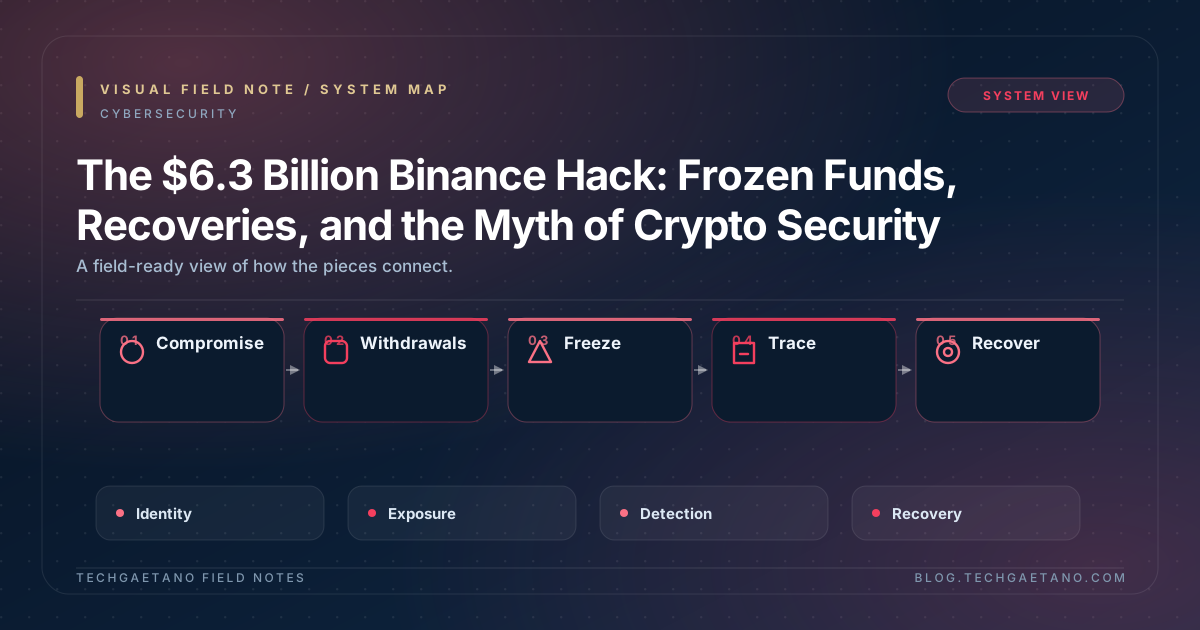
System map
How the moving parts connect, from first input to operating outcome.
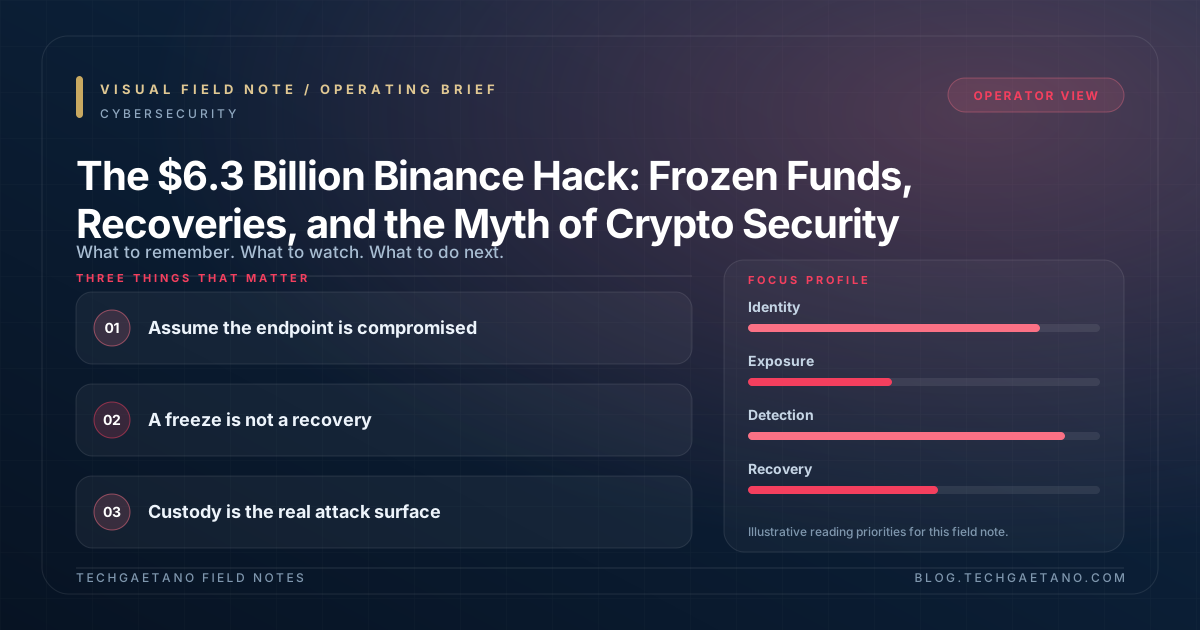
Operating brief
The three decisions that matter and the signals to watch.
Hardening a production environment?
TechGaetano helps teams design zero-trust controls, review identity and network boundaries, and turn security policy into engineering practice.
Talk to a security engineerFrequently asked questions
What is The $6.3 Billion Binance Hack?
The short version On October 29, 2026, Binance disclosed what is now the largest crypto theft on record. The exchange estimated the impact at roughly $6.3 billion in digital assets. Within hours, stablecoin issuers and security partners had frozen around $3 bi.
How should a team get started with The $6.3 Billion Binance Hack?
Start with asset and identity inventory, define the trust boundaries, and roll out controls in phases: identity, device posture, least-privilege access, segmentation, then continuous verification.
What should teams avoid when working on The $6.3 Billion Binance Hack?
The main risks are treating zero trust as a product purchase, leaving standing privileges in place, and assuming the model or the network perimeter is a security boundary.
Further reading
Related posts
Zero Trust Architecture Implementation Guide for Engineering Teams
Zero trust has a branding problem. It is simultaneously the most important security architecture of the decade and a phrase that has been attached to…
Read more
Kenya's Data Protection Act: A Practical Compliance Guide for Engineering Teams
Kenya's Data Protection Act, 2019 changed the conversation about personal data from a legal formality to an engineering requirement. The Office of the…
Read more