Article · Market Infrastructure
The New York Stock Exchange: The World's Most Famous Trading Floor
By Caleb · August 3, 2026
At the corner of Wall and Broad Streets in lower Manhattan stands a building that has become a global symbol of capitalism: the New York Stock Exchange. Founded in 1792, it is the largest stock exchange in the world by market capitalization and the anchor of American finance.
A buttonwood beginning
The NYSE traces its origins to 1792, when 24 stockbrokers and merchants signed the Buttonwood Agreement under a tree on Wall Street. They agreed to trade securities with one another and to charge fixed commissions. It was an informal pact that grew into the most powerful capital market on earth.
Key milestones in its history:
- 1817 — the exchange formalized its rules as the New York Stock & Exchange Board.
- 1865 — the telegraph linked the exchange to the rest of the country, speeding prices nationwide.
- 1929 — the crash and subsequent Great Depression reshaped financial regulation, producing the SEC.
- 1971 — the NYSE incorporated as a not-for-profit and later, in 2006, merged with Archipelago to become a public company.
- 2013 — ICE (Intercontinental Exchange) acquired the NYSE for over $8 billion.
How it works
Unlike purely electronic markets, the NYSE still operates a visible trading floor at 11 Wall Street. Designated market makers, formerly called specialists, stand at physical posts to match buyers and sellers and maintain orderly markets in their assigned stocks.
The opening and closing auctions are theatrical events watched worldwide. The opening bell and closing bell are rung by CEOs, celebrities, and occasionally heads of state, and have become cultural institutions in their own right.
Beneath the pageantry sits a deeply modern system. The NYSE matches the majority of its orders electronically, while the human market makers provide liquidity, quote markets, and dampen volatility in times of stress. It is a hybrid model that blends the old with the new.
The biggest listing venue on Earth
The NYSE is home to many of the world's largest companies — blue chips like ExxonMobil, Johnson & Johnson, Berkshire Hathaway, and thousands more. Its listings span every sector of the economy, and its data feeds inform a trillion-dollar ecosystem of investors, funds, and algorithms.
For companies, a NYSE listing carries prestige. The exchange's brand is a badge of legitimacy and visibility that many firms around the world pay a premium to acquire.
The modern market
Today the NYSE is part of a dense web of American equities markets. Trading is fragmented across a dozen exchanges and dozens of dark pools, all competing for order flow. The NYSE has responded by innovating — rolling out faster technology, new order types, and even an all-electronic exchange for corporate bonds.
Critics note that the human floor has shrunk and that much of the drama is now ceremony. Even so, the NYSE remains a powerful signal: when a company rings the bell at the New York Stock Exchange, the world notices.
Visual field notes
The system at a glance
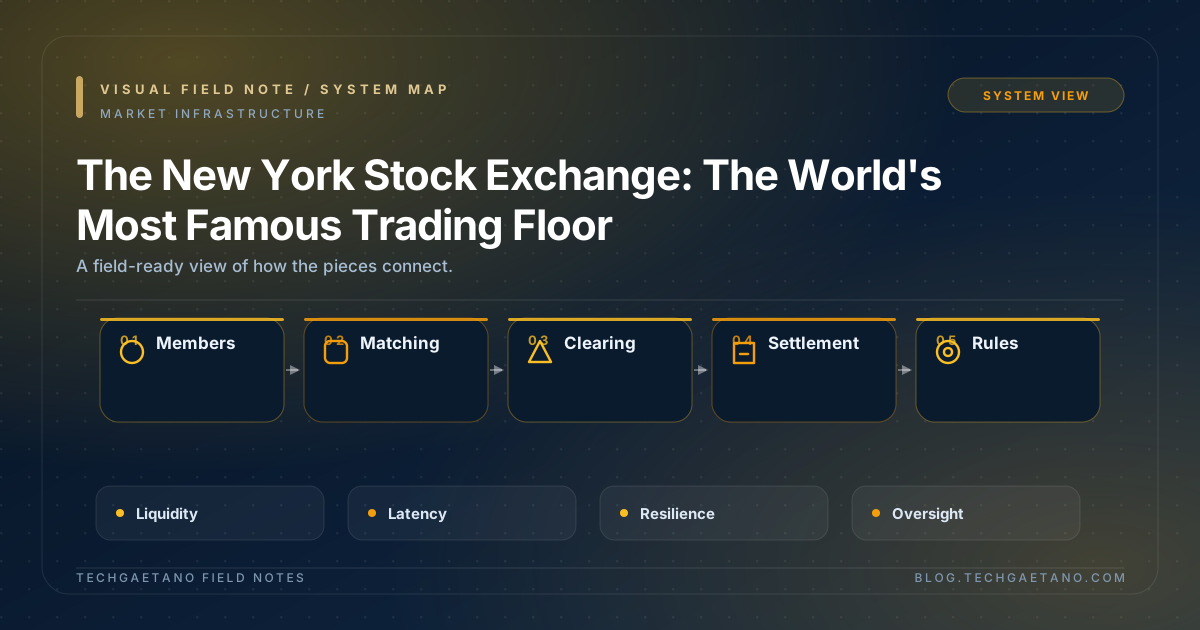
System map
How the moving parts connect, from first input to operating outcome.
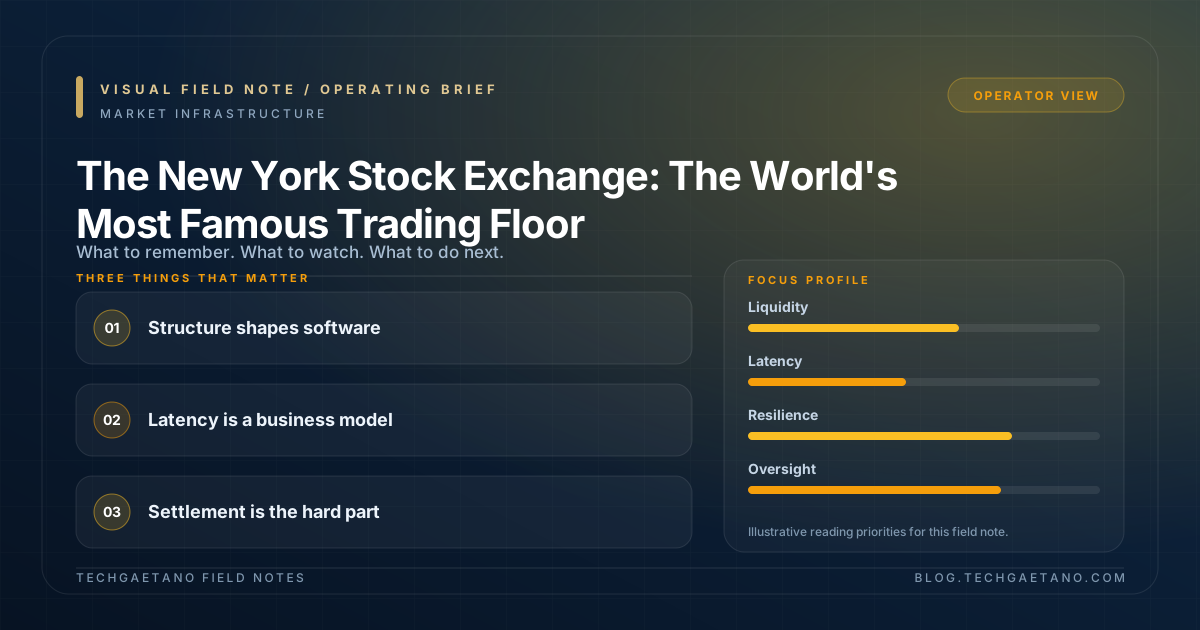
Operating brief
The three decisions that matter and the signals to watch.
Working on market infrastructure?
TechGaetano brings engineering and market-structure context to teams building trading, settlement, and financial data systems.
Start a conversationFrequently asked questions
What is The New York Stock Exchange?
At the corner of Wall and Broad Streets in lower Manhattan stands a building that has become a global symbol of capitalism: the New York Stock Exchange . Founded in 1792, it is the largest stock exchange in the world by market capitalization and the anchor of .
How should a team get started with The New York Stock Exchange?
Start with market structure, participants, and settlement mechanics. Trace how regulation and technology changed the venue over time before applying the lessons to modern systems.
What should teams avoid when working on The New York Stock Exchange?
The main risks are confusing market structure with software architecture, overlooking settlement and regulatory constraints, and assuming today's dominant venue will remain dominant.
Further reading
Related posts
NASDAQ: The Exchange That Changed How Markets Work
Most of the world's most valuable companies — Apple, Microsoft, Amazon, Alphabet, Meta — call one market home: the NASDAQ . Short for the National Ass…
Read more
The London Stock Exchange: A 300-Year-Old Market That Keeps Reinventing Itself
In the heart of the City of London, the London Stock Exchange (LSE) tells the story of global finance better than almost any institution. From coffee…
Read more