Article · Market Infrastructure
NASDAQ: The Exchange That Changed How Markets Work
By Caleb · August 3, 2026
Most of the world's most valuable companies — Apple, Microsoft, Amazon, Alphabet, Meta — call one market home: the NASDAQ. Short for the National Association of Securities Dealers Automated Quotations, it began in 1971 as the first electronic stock market, a radical departure from trading floors and paper tickets.
Born electronic
When NASDAQ launched, Wall Street ran on physical trading floors where humans shouted orders. NASDAQ was different: it was a computerized quotation system that displayed prices for thousands of securities on terminals. It had no floor at all.
This founding idea proved prophetic. By demonstrating that markets could work electronically, NASDAQ paved the way for the automated, high-speed markets of today. In 2006, it completed the journey by converting from a quotation system into a fully registered national securities exchange.
The home of innovation
NASDAQ built its identity around the companies that defined the digital age. Early listings included Intel in 1971 and Microsoft in 1986. As personal computing, the internet, and later mobile and cloud computing exploded, NASDAQ became the default destination for technology and growth companies.
The Nasdaq Composite index tracks all ~3,000 companies listed on the exchange. Because technology carries so much weight in it, the index has become a barometer not just for one exchange but for the entire global tech economy. When commentators say "tech rallied", they are usually watching the Nasdaq.
The 2000 dot-com bubble
NASDAQ's history is also a lesson in euphoria. In the late 1990s, internet companies with little revenue — sometimes no business model at all — listed on the exchange. The Nasdaq Composite rose from 1,000 in 1995 to a peak of 5,048 in March 2000, then collapsed, losing nearly 80% of its value over the next two and a half years.
The bust wiped out trillions in paper wealth and countless companies. But it also cleared the field for stronger firms, and the survivors of that era grew into the mega-cap giants that now dominate the index.
All-electronic trading today
NASDAQ's markets are now among the fastest in the world, executing orders in microseconds. The exchange offers sophisticated matching engines, market data products, and a family of indexes and ETFs. It also expanded beyond equities into options, and acquired the OMX Group in 2008 to build a global footprint across Nordic and Baltic markets.
Today NASDAQ and the NYSE together dominate US equity trading, yet they represent opposing philosophies. The NYSE is the grand old house of the floor; NASDAQ is the native-born digital native. That a 1970s upstart now hosts most of the world's most valuable companies is a fitting marker of just how completely the digital era has reshaped finance.
Visual field notes
The system at a glance
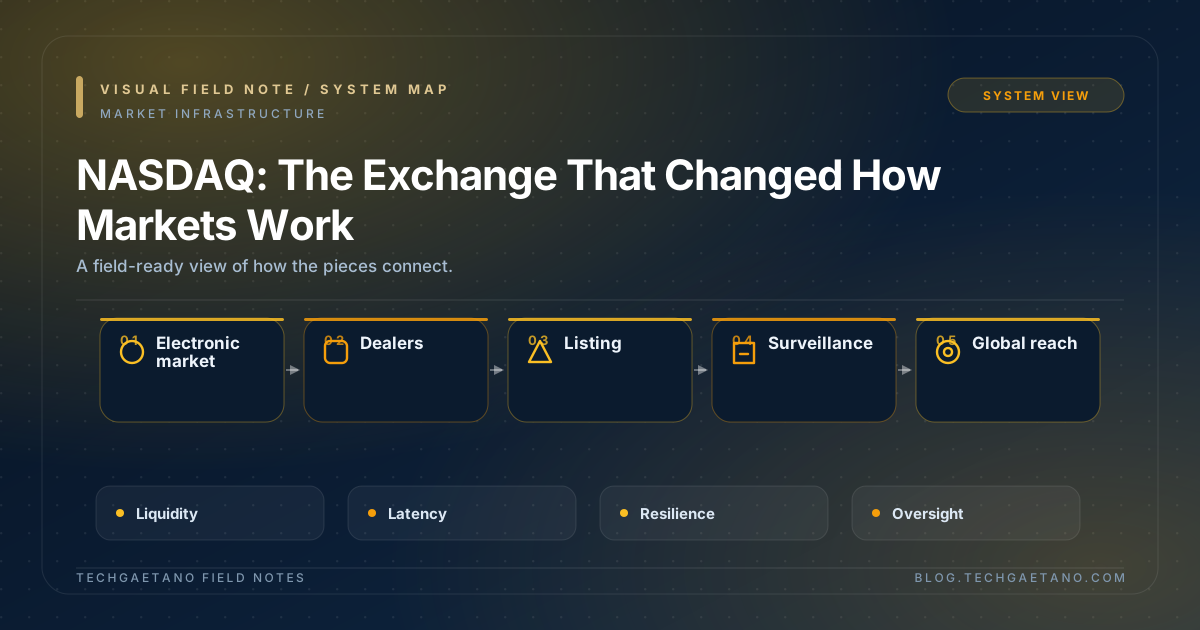
System map
How the moving parts connect, from first input to operating outcome.
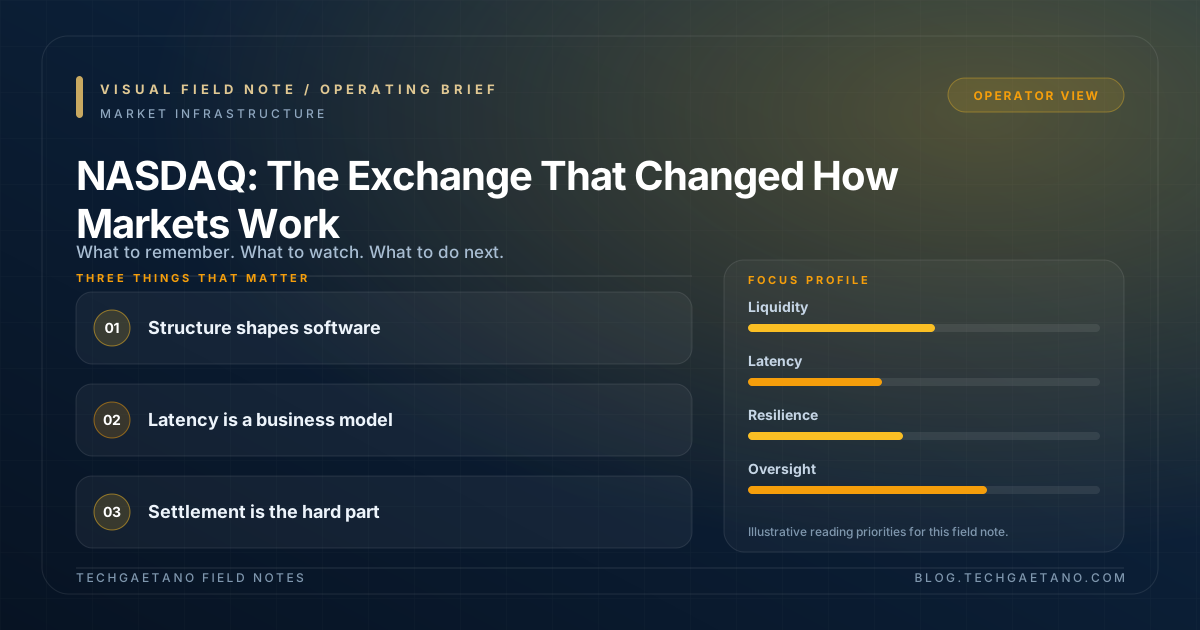
Operating brief
The three decisions that matter and the signals to watch.
Working on market infrastructure?
TechGaetano brings engineering and market-structure context to teams building trading, settlement, and financial data systems.
Start a conversationFrequently asked questions
What is NASDAQ?
Most of the world's most valuable companies — Apple, Microsoft, Amazon, Alphabet, Meta — call one market home: the NASDAQ . Short for the National Association of Securities Dealers Automated Quotations , it began in 1971 as the first electronic stock market, a.
How should a team get started with NASDAQ?
Start with market structure, participants, and settlement mechanics. Trace how regulation and technology changed the venue over time before applying the lessons to modern systems.
What should teams avoid when working on NASDAQ?
The main risks are confusing market structure with software architecture, overlooking settlement and regulatory constraints, and assuming today's dominant venue will remain dominant.
Further reading
Related posts
The New York Stock Exchange: The World's Most Famous Trading Floor
At the corner of Wall and Broad Streets in lower Manhattan stands a building that has become a global symbol of capitalism: the New York Stock Exchang…
Read more
The London Stock Exchange: A 300-Year-Old Market That Keeps Reinventing Itself
In the heart of the City of London, the London Stock Exchange (LSE) tells the story of global finance better than almost any institution. From coffee…
Read more