Post
5G and Enterprise Connectivity
By Caleb · August 3, 2026
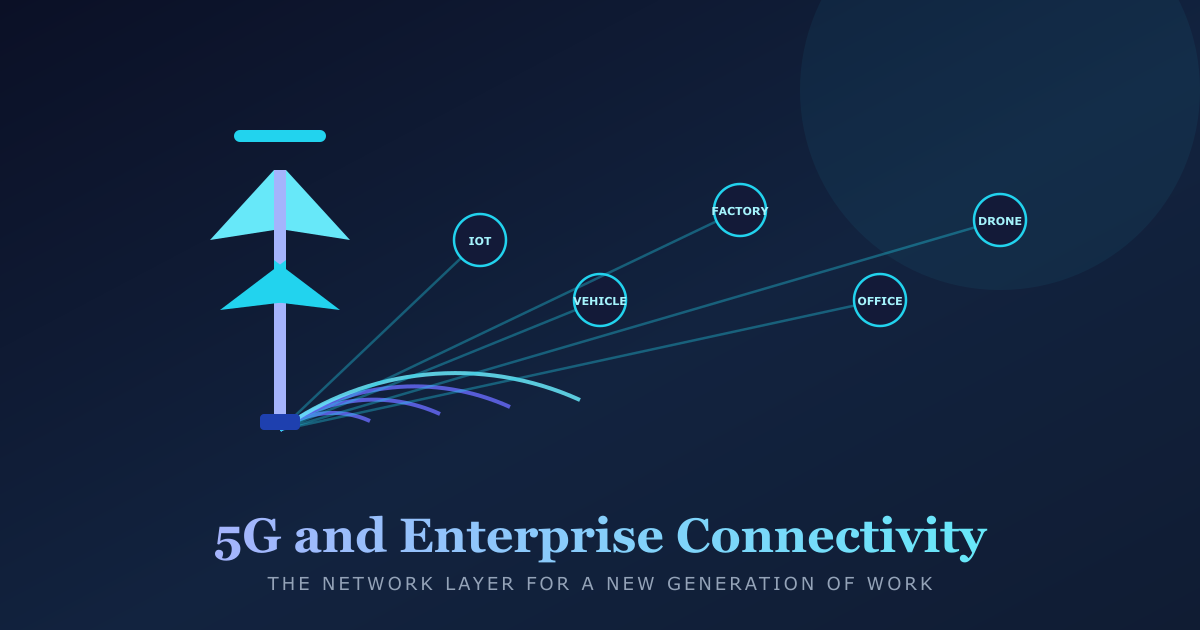
For consumers, 5G mostly means faster downloads on a smartphone. For enterprises, it means something far more consequential: a network layer capable of connecting tens of thousands of devices, supporting real-time control, and running the modern connected business. In 2027, 5G is no longer a promise — it is the infrastructure underneath a new generation of operations.
What 5G actually changes
The jump from 4G to 5G is not just speed. It is three different capabilities that enterprises can finally rely on:
- Massive bandwidth, measured in gigabits, enough for high-definition video feeds from hundreds of cameras and sensors simultaneously.
- Ultra-low latency — data round trips in a few milliseconds, opening the door to remote control of machines and vehicles.
- Massive device density, supporting a million connected devices per square kilometer, versus tens of thousands on older networks.
The combination is what makes it different. Older networks could give you one of those things; 5G is the first generation designed to deliver all three.
The factory floor reimagined
The clearest enterprise wins are in manufacturing. Wired networks are rigid; Wi-Fi is unreliable at scale; 4G cannot handle the density. 5G brings wireless reliability to the factory:
- Autonomous guided vehicles and robots navigate production lines without cables or Wi-Fi dead zones.
- Real-time machine monitoring streams telemetry from thousands of sensors, feeding predictive maintenance models.
- Augmented reality guides technicians with overlays that require the low latency only 5G can deliver.
- Flexible layouts let plants reconfigure production lines in hours instead of weeks, because nothing needs to be rewired.
For manufacturers, 5G is the wireless network that finally behaves like a wire.
Private networks change the game
The most interesting enterprise development is the private 5G network — a dedicated cellular network a company operates on its own premises. Private 5G gives organizations:
- Reliability and coverage engineered for their own facility, not shared with millions of consumers.
- Security and sovereignty — traffic stays on the premises, isolated from the public network.
- Predictable performance, with quality-of-service guarantees for critical applications.
Private networks have moved from pilot to deployment in ports, mines, warehouses, campuses, and factories — anywhere the cost of downtime exceeds the cost of the network.
Beyond the factory
The same infrastructure is reshaping other industries. Logistics and warehousing track and coordinate fleets of robots with sub-second accuracy. Energy and utilities monitor grid assets across vast geographic areas with dense sensor networks. Healthcare uses 5G-connected ambulances and remote surgery where latency and reliability are life-or-death. Retail runs edge-based customer experiences that depend on the instant response 5G enables.
Where it still falls short
5G is not magic. Coverage outside well-provisioned sites still varies; the hardware ecosystem is maturing but not uniform; and the costs of spectrum, equipment, and integration are real. Enterprises should not replace every connection with 5G — the skill is choosing where the wireless-first approach genuinely pays for itself, starting with the locations and workloads where downtime or latency hurt the most.
The bottom line
Connectivity has always been the invisible layer that decides what an organization can do. 5G raises that ceiling: reliable wireless at scale, real-time control, and the density to connect an entire operation. In 2027, the companies pulling ahead are the ones treating 5G not as a network upgrade but as an operating capability — one that lets them build the connected factory, campus, or city that their competitors are still wiring up one cable at a time.
Related Posts
The Rise of Edge Computing
For the last twenty years, the architecture of the internet was simple: send the data to a central cloud, get the answer back. That model worked beaut…
Read More
Top 10 Cybersecurity Tools for 2027
The cybersecurity tool market is crowded, noisy, and expensive. Every vendor claims to be the one product that will finally keep you safe. The truth i…
Read More