Post
The Rise of Edge Computing
By Caleb · August 3, 2026
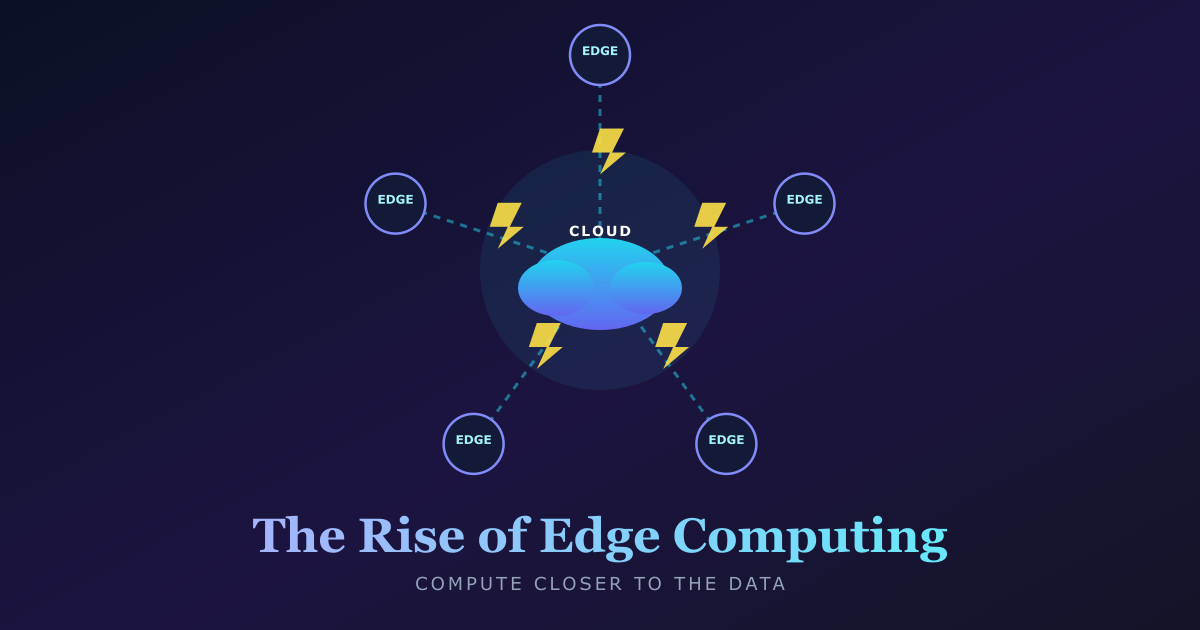
For the last twenty years, the architecture of the internet was simple: send the data to a central cloud, get the answer back. That model worked beautifully until the answer had to arrive in milliseconds, and the data was being produced faster than it could travel. That is where edge computing comes in — and in 2027 it is no longer a buzzword, it is the backbone of a growing share of the digital world.
What edge computing actually is
Edge computing means processing data close to where it is generated, instead of shipping it to a distant data center. The "edge" can be a factory floor, a retail store, a cell tower, a vehicle, or a small server room in a city — anywhere compute sits near the source of the data.
Think of it as the opposite of the old model. Instead of one centralized brain, you have thousands of small brains, each handling the decisions that need to be instant, and handing the cloud only what needs the big picture.
Why now
Edge computing has been discussed for years, but three forces have finally made it practical:
- Latency is non-negotiable. Autonomous vehicles, surgical robotics, and industrial safety systems cannot wait for a round trip to a distant server. Some decisions need to happen in single-digit milliseconds.
- Data volume exploded. Cameras, sensors, and connected machines generate far more data than can be economically shipped to a cloud. In 2027, most of that data is processed locally and only the meaningful fraction ever travels.
- Bandwidth costs too much. Moving terabytes over the network costs money and time. Processing at the edge and sending summaries is dramatically cheaper than streaming raw data.
Where edge computing is changing everything
Manufacturing. In smart factories, edge servers monitor machines continuously, predict failures before they happen, and shut down unsafe conditions in an instant — even when the plant loses its connection to the cloud.
Retail. Stores use edge vision to track inventory, prevent shrinkage, and manage self-checkout — processing video locally to keep customer data private and decisions instant.
Healthcare. Medical devices at the edge run diagnostic models on-site, alerting clinicians immediately without waiting for a remote server, and preserving patient privacy by keeping sensitive data local.
Autonomous transport. Vehicles run their decision-making entirely on onboard edge computers, because a one-second gap in the cloud connection could be the difference between stopping and not.
Telecommunications. Telecom operators are building edge compute into their networks, turning cell towers into mini data centers that power everything from gaming to industrial IoT.
The real challenges
Edge computing is not free. Running hundreds of locations means managing distributed infrastructure — updates, security, and monitoring — at a scale most IT teams have never faced. Security is harder at the edge, because devices live in physical locations you do not control. And orchestration is more complex: the software that decides which decisions happen where, and keeps all those brains in sync.
The mature response is centralized control with decentralized execution: manage everything from one pane of glass, but let each edge node operate independently when it must.
The bottom line
Edge computing does not replace the cloud; it extends it. The two form a continuum — edge for the instant, cloud for the deep. As sensors multiply and the demand for real-time decisions grows, the question is not whether your industry will use the edge, but which of your workloads will get there first. The companies that design for the edge now will have a real head start on the ones that keep routing everything through the same old bottleneck.
Related Posts
5G and Enterprise Connectivity
For consumers, 5G mostly means faster downloads on a smartphone. For enterprises, it means something far more consequential: a network layer capable o…
Read More
Top 10 Cybersecurity Tools for 2027
The cybersecurity tool market is crowded, noisy, and expensive. Every vendor claims to be the one product that will finally keep you safe. The truth i…
Read More