Post
Which Programming Language Should You Learn in 2027?
By Caleb · August 3, 2026
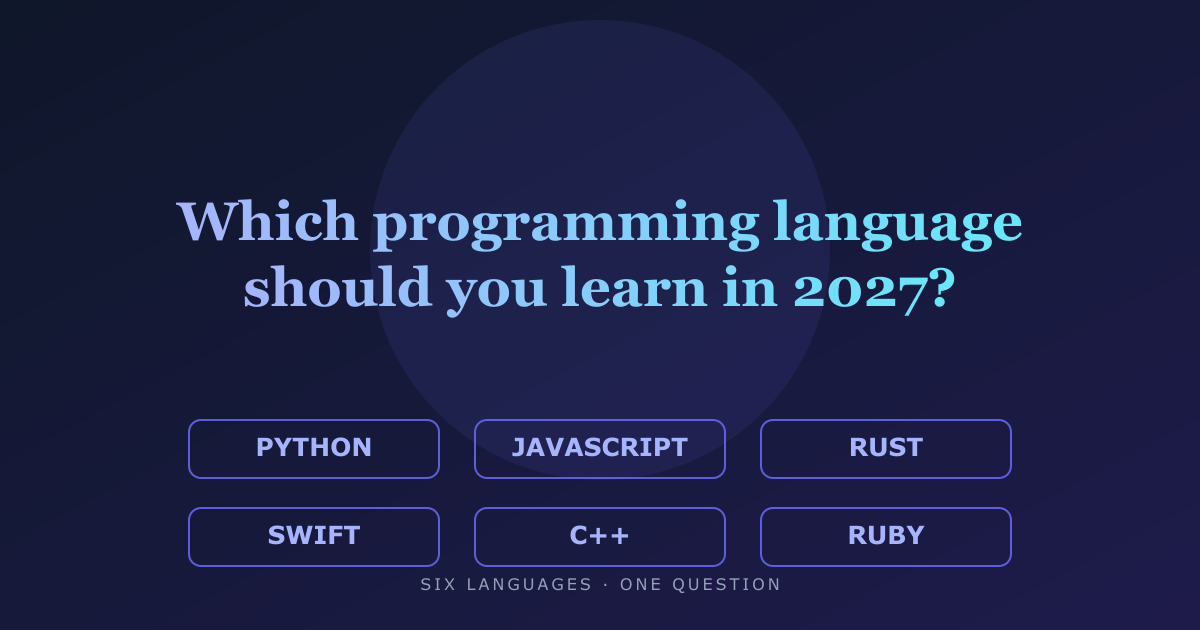
Ask five developers which programming language you should learn in 2027 and you will get five confident, contradictory answers. The truth is more useful: there is no single right language, but there is definitely a right language for you. Here is an honest look at six of the most important candidates — JavaScript, Python, Rust, C++, Swift, and Ruby — and how to choose between them.
The landscape in 2027
The language market is mature but far from static. Artificial intelligence has supercharged demand for Python, WebAssembly is opening new ground for Rust, and the Apple ecosystem keeps Swift essential. The languages below are not ranked by "best" — they are ranked by where they dominate.
Python: the language of AI
Python has become the default language of data science and machine learning. Every major AI framework — PyTorch, TensorFlow, scikit-learn, the whole ecosystem — is Python-first. If your goal is AI, data analysis, or automation, Python is the obvious starting point.
It is also the easiest major language to learn: clean syntax, a huge standard library, and an enormous community mean you will rarely be stuck. Salaries and demand remain strong, and the rise of AI only deepens its moat. The trade-off is performance — Python is slow — but for most data work that is irrelevant.
JavaScript and TypeScript: the language of the web
JavaScript runs in every browser on earth, and with Node.js it runs on servers too. It remains the most widely used language in the industry, and TypeScript — a typed superset — has become the professional standard for serious projects.
Learn JavaScript if you want to build websites, web apps, or full-stack products, or if you want maximum flexibility about where you work. The ecosystem (React, Next.js, Vite) is enormous, and the job market is the largest of any language. It is not the most elegant language, but it is the most portable: one language, browser to backend.
Rust: memory safety without the pain
Rust gives you C-level performance with compiler-enforced memory safety — meaning entire classes of bugs that plague C and C++ are caught before your code ever runs. It is consistently voted the most-loved language in developer surveys.
Rust's center of gravity has grown steadily: it underpins parts of Linux, Windows, and Android, powers WebAssembly, and is increasingly used for backend infrastructure, blockchain, and game engines. The learning curve is steep — the borrow checker takes time to master — but the payoff is a language that is fast, safe, and in rising demand.
C++: raw power where it counts
C++ remains the undisputed king of performance-critical software. It powers game engines like Unreal, browsers, trading systems, embedded devices, robotics, and much of the operating system stack.
It is a big, demanding language with decades of accumulated complexity, and it is not beginner-friendly. But if you want to work on systems where every millisecond matters — and where software meets hardware — C++ skills are career-defining. It also makes you a better programmer: learning C++ forces you to understand memory, data structures, and the machine itself.
Swift: the Apple platform
Swift is Apple's language for iOS, iPadOS, macOS, watchOS, and visionOS. It is modern, safe, and pleasant to write, with a clean syntax and great tooling in Xcode.
Choose Swift if you are excited about building mobile apps for the Apple ecosystem — an enormous and profitable market — or if you want to work in AR/VR and spatial computing. Its reach beyond Apple is limited, but within that ecosystem it has no serious rival.
Ruby: developer happiness as a feature
Ruby, with the Rails framework, prioritizes developer productivity and joy. You can ship a full web application in a fraction of the time it would take in most other stacks.
Ruby's market is niche compared with JavaScript or Python, but it is a profitable niche: Rails developers are consistently in demand for startups and established companies running Ruby monoliths. If you value expressive code and rapid iteration over raw performance or job-volume, Ruby is an excellent and underrated choice.
How to choose
Stop looking for the "best" language and answer one question instead: what do you want to build?
- Want to do AI or data science? Learn Python.
- Want to build websites or apps? Learn JavaScript/TypeScript.
- Want to write fast, safe systems software? Learn Rust (or C++).
- Want to build for Apple devices? Learn Swift.
- Want to ship web apps quickly and enjoy the process? Learn Ruby.
Two strategic notes. First, JavaScript and Python are the safest bets in 2027: enormous ecosystems, abundant jobs, and versatility. Second, concepts outrank syntax — the language you start with matters far less than the fundamentals you learn in it. Most senior developers speak several languages; the second one is always easier than the first.
The best language to learn in 2027 is the one that gets you building something today. Pick one from this list, write your first program, and let your goals pull you forward.
Related Posts
Top 10 Cybersecurity Tools for 2027
The cybersecurity tool market is crowded, noisy, and expensive. Every vendor claims to be the one product that will finally keep you safe. The truth i…
Read More
MCP, Explained: What Is the Model Context Protocol?
If you have used an AI assistant in the last year, you have probably asked it to do something: check your calendar, query a database, send a message,…
Read More