Post
The Future of AI in Business
By Caleb · August 3, 2026
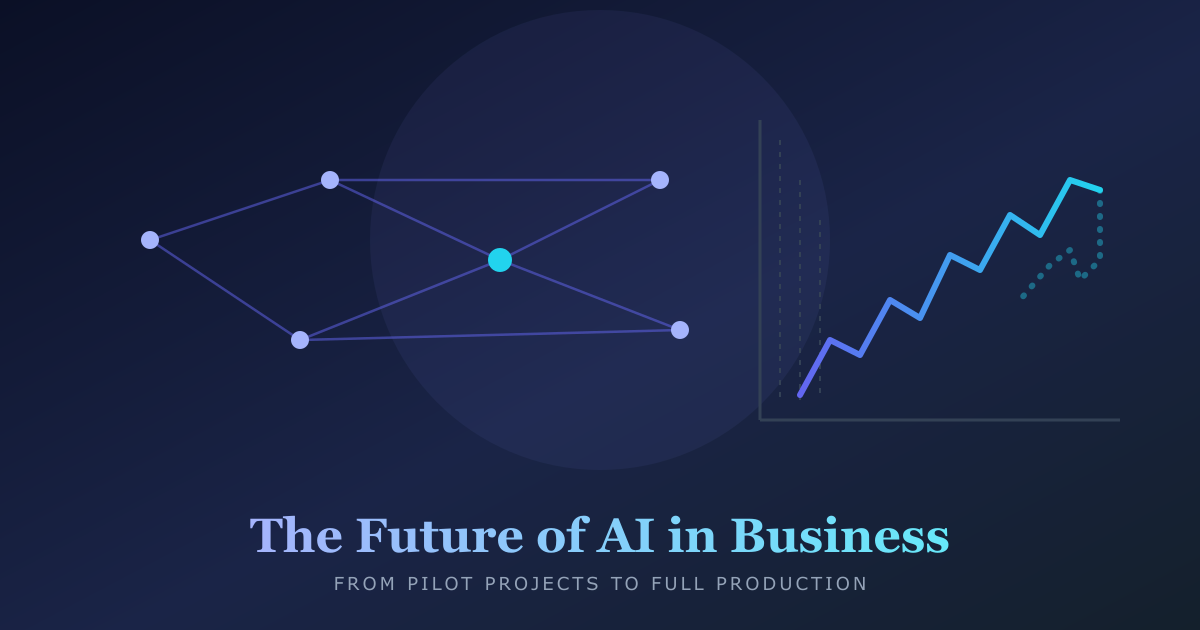
A few years ago, "AI strategy" meant a slide in a board deck and a pilot nobody could kill. In 2027, that era is over. Artificial intelligence has moved from the innovation lab to the core of how companies operate — and the businesses that treat it as a one-time experiment are already falling behind the ones that treat it as infrastructure.
From pilots to production
The graveyard of AI projects is full of demos that never shipped. The difference between a pilot and a real deployment is not the model — it is everything around it: data pipelines, integration with existing systems, security, cost controls, and change management.
Successful companies in 2027 share a pattern. They start with a narrow, high-value use case, prove it end to end, measure the impact, and then expand. They resist the temptation to "do AI everywhere" at once. A single workflow that actually works beats a hundred experiments that never reach production.
The rise of agents
The biggest shift this year is the move from models that answer questions to agents that take action. Instead of generating a draft or a summary, an AI agent can schedule a meeting, update a CRM, triage a support ticket, or reconcile an invoice — subject to rules and approvals you define.
This changes the economics of work. Companies are reorganizing around humans-plus-agents, where the agent handles the volume and the human handles judgment, exceptions, and relationships. The teams that win will be the ones that design these workflows deliberately, with clear handoffs and clear accountability, rather than letting automation happen by accident.
Data is the moat
Models are now widely available and increasingly commodity-priced. What no competitor can copy is your data: your customer histories, your operational records, your institutional knowledge. The companies building durable advantage are the ones investing in:
- Clean, governed data — because a model is only as good as what it is trained on and what it can access.
- Owned models and retrieval systems built on private data, rather than trusting everything to a third-party prompt box.
- Data pipelines that stay current, so decisions are made on today's reality, not last year's snapshot.
Treat your data like a product. It is the only asset that appreciates as you use it.
Measure everything
The fastest way to kill an AI program is an unverifiable ROI story. Decide the metrics before you build: cost per resolved ticket, days saved per employee, revenue from faster decisions, error rates compared with the old process. Then run the pilot long enough to get real numbers, and publish them.
Transparency about what worked — and what did not — is what separates credible AI programs from hype. Leadership teams reward honest measurement; they punish vague promises.
Governance is not a constraint, it is a feature
As AI gets more powerful, the cost of getting it wrong rises. Companies that succeed in 2027 treat governance as part of the product:
- Human review for high-stakes decisions, with clear escalation paths when the model is uncertain.
- Audit trails so you can always explain why a decision was made.
- Clear boundaries on what the AI is allowed to do autonomously — and what always requires a person.
Governance done well does not slow you down. It is what lets you move fast without breaking the trust of customers and regulators.
The bottom line
The future of AI in business is not a single miracle product. It is a thousand boring, well-executed improvements: a faster response here, a cheaper process there, a better decision everywhere. The companies that win will be the ones that ship AI like they ship software — in small pieces, measured carefully, integrated deeply, and owned by the people who understand the business. The technology is ready. The question is whether your organization is.
Related Posts
Cybersecurity Best Practices for 2027
Every year, the security headlines get louder and the attacks get smarter. In 2027, the question is no longer whether you will be targeted, but when —…
Read More
Top 10 Cybersecurity Tools for 2027
The cybersecurity tool market is crowded, noisy, and expensive. Every vendor claims to be the one product that will finally keep you safe. The truth i…
Read More